This approach follows established access-control practice while adapting it to agents that choose tools dynamically. The NIST AI Agent Standards Initiative treats secure agent operation as a standards problem, and NIST work on software and agent identity emphasizes granular authorization rather than reused human credentials.
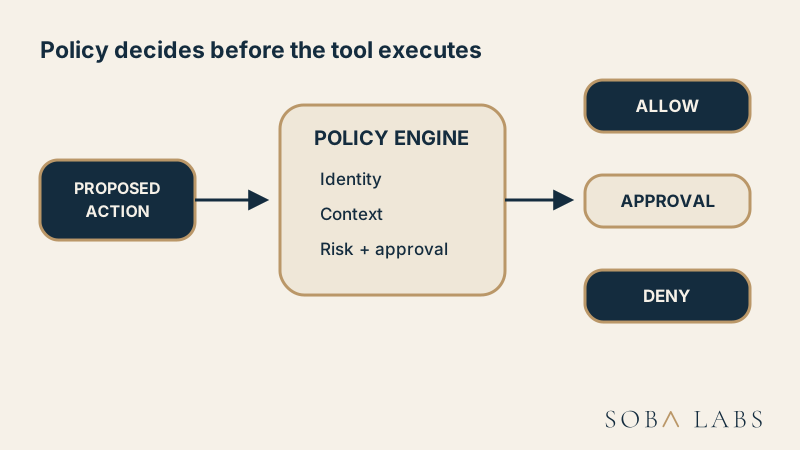
What inputs should an agent policy engine evaluate?
The request should identify the acting agent identity, the represented user or organization, the requested tool method, target resource, purpose, and relevant risk signals. Context may include environment, data sensitivity, time, location, transaction value, and whether the action was explicitly approved. A policy decision is only as reliable as the structured facts supplied to it.
Do not ask the model to infer missing permission facts from conversation tone. Unknown identity, ownership, or purpose should produce denial or a request for clarification rather than a permissive guess.
Where should the policy decision be enforced?
Evaluate policy immediately before the trusted tool adapter performs the effect. The model can propose an action, but the adapter must block execution until agent authorization returns an allow decision. The model must not grade its own permission request.
Enforcement at the tool boundary also covers retried or replayed calls. If a workflow bypasses the boundary through another integration, the same policy must protect that path or the control is incomplete.
How should allow, approval, and deny decisions differ?
Allow applies when every required rule passes. Deny applies when the action is prohibited or the requester lacks permission. Require approval routes a bounded exception to tool approval with the exact proposed effect, not a vague summary. Human approval should authorize one understandable action, not an open-ended future session.
Record the policy version, inputs, result, and reason code in the audit trail. Operators need to distinguish a model failure from a valid policy refusal, and reviewers need evidence that the enforced rule matched the approved policy.
How does a policy engine relate to guardrails?
Guardrails can validate text, detect unsafe content, limit schemas, or monitor behavior. A policy engine has a narrower job: make deterministic authorization decisions over structured requests. The two controls complement each other, but they should not be merged into one opaque score. Critical permissions belong in reviewed rules whose refusal can actually stop the tool.
Test policies with representative allow, deny, and approval cases before deployment. Version them like code, review changes, and use default-deny behavior for unknown actions so a newly added tool cannot inherit accidental permission.