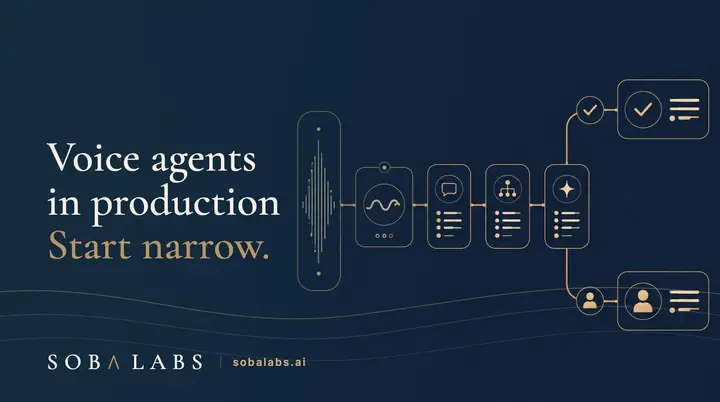
Voice agents in production: what to automate first
Automate predictable, recoverable calls first. Keep complaints, emergencies, and irreversible decisions with people.
ReadEssays on agentic workflows, operating state, and the craft of getting AI into real business processes.
Automate predictable, recoverable calls first. Keep complaints, emergencies, and irreversible decisions with people.
Readnpm downloads put the Vercel AI SDK ahead of every other TypeScript agent framework. The August 2026 ranking, with the caveats it deserves.
ReadPyPI downloads put LangChain far ahead of every other Python AI agent framework. The August 2026 ranking, with the caveats it deserves.
ReadWe nearly hired a marketer and a salesperson. The system they would have joined did not exist yet, and a hire cannot fix that.
ReadSummaries are lossy in one direction: they drop reversals, negative findings and non-events, the class of fact that changes a decision.
ReadA deep agent's ceiling is its context window. The harness ships four separate levers, and knowing which one is working decides whether a long run finishes.
ReadLangChain's deepagents ships subagents, a filesystem, and summarization by default. You still own the human gate, the evals, and the cost.
ReadWe routed our coding agents' shell commands through RTK AI, an open source CLI proxy. Verified: 49.6% of tokens saved across 1,456 commands.
ReadSelf-reported LLM confidence clusters near certainty. Compute a signal you can measure, then escalate the exceptions to a person.
ReadAI made writing code cheap. Architecture, verification and security did not get cheaper, and that is where the real work moved.
ReadThree May releases pointed somewhere; 35 more confirmed it. The signal is not the changelog, it is the maturity label on each command.
ReadLangChain ships tool-call approval as middleware now. When you still need interrupt() by hand, and the replay rule that bites either way.
ReadOne of them drops your unpushed commits from new worktrees. What changed under you, and the settings that hold it.
ReadIt refuses any write over its context budget and runs a curator that ages self-written skills out. What an agent keeps, and who prunes it.
ReadAfter testing 80+ official Claude Code plugins, these are the 7 that changed how we ship software every day.
ReadWiring an LLM judge takes an afternoon. Calibrating it against human labels is what decides whether its scores mean anything at all.
ReadTwo callbacks in langchain-core attribute LLM usage per user, workflow or agent node. The streaming opt-in is now a default, and a token count is not a bill.
ReadProviders now version prompts as immutable commits. One is retiring its hosted registry, so depend on the commit model, not on the registry.
ReadCache reads cost a tenth of fresh input tokens. The providers have converged on the same economics, and the old implicit-versus-explicit split no longer holds.
ReadA hardcoded token threshold is a model-specific assumption in disguise. LangChain's model.profile lets context logic read the real limits at runtime.
ReadWe rebuilt our six-day research agent against current LangGraph. Every architecture decision the skills made held up; four of their code samples no longer run.
ReadYour assistant knows general programming, not your framework's production patterns. Agent skills close the gap, loading a pattern only when it is needed.
ReadWe optimised a LangGraph agent's prompt with Agent Lightning. The algorithm has since left the framework; the lesson it taught has not.
ReadThe choice is not framework or custom. It is which layer you keep the right to replace, and that is what decides if a migration hurts.
ReadNo matches