
On September 14, at Barclays’ Global Financial Services Conference, a big-bank CEO did something the rest of his industry has refused to do for three years: he priced the AI program, on the record in the bank’s own webcast transcript. Bank of America has 130 to 140 AI projects implemented “at a cost of $400 million, generating a benefit of $800 million,” in CEO Brian Moynihan’s words, and each project was costed before it shipped. A month later, JPMorgan’s CFO argued the opposite position: quantifying AI returns wastes people’s time. Both can teach a mid-sized company something. This post covers what sits behind the number, why almost nobody else will publish one, and what you would have to instrument to claim your own.
The number came with a method, not a press release
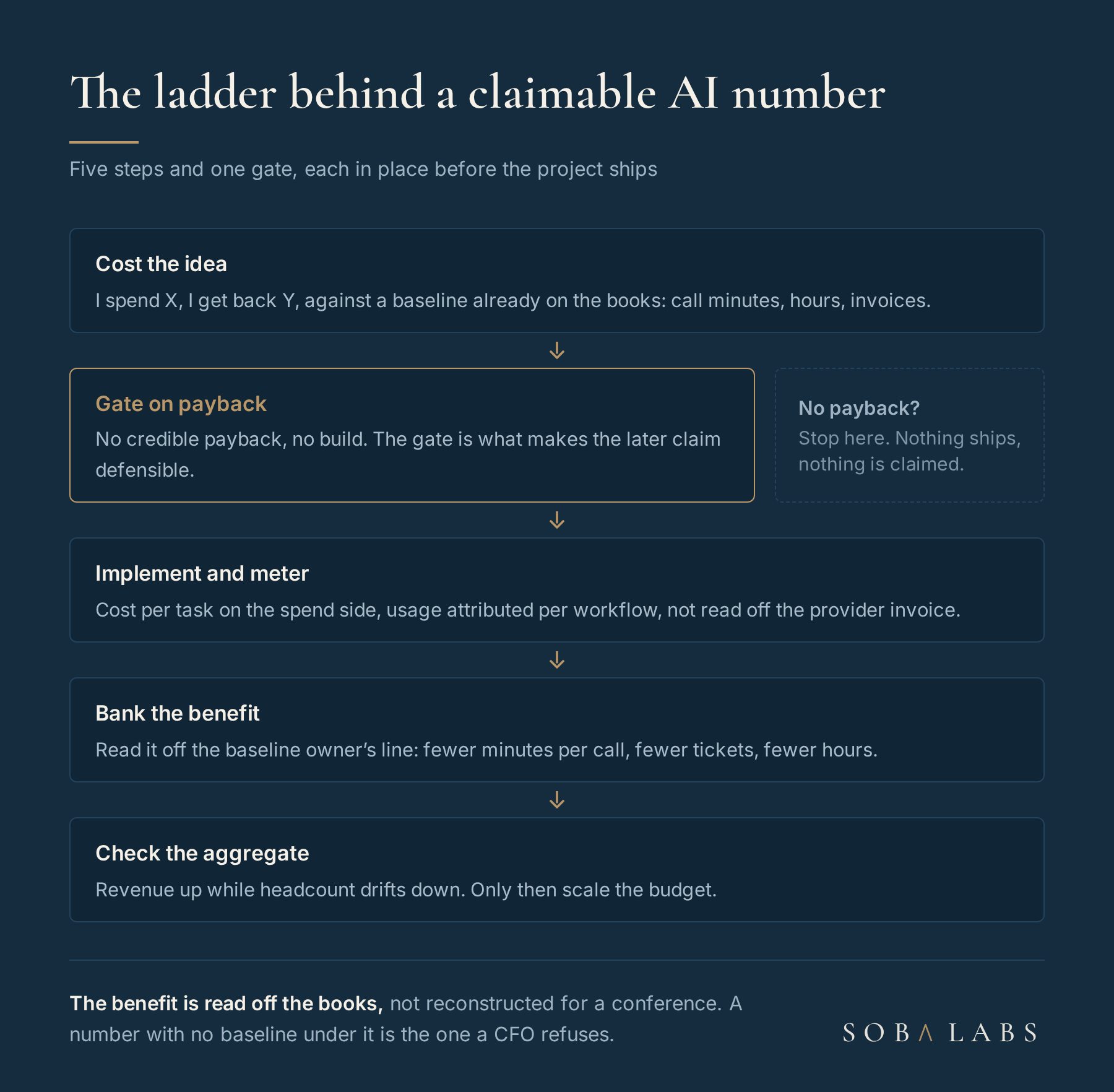
The method is in the same answer, and it is plain bookkeeping. Asked at the conference how the figure is built, Moynihan described per-project ROI measurement: each idea is costed out as “I spend X, I get back Y,” with a payback attached, before it goes into the system. The macro check sits on top: whether revenue grows while headcount drifts down. Headcount is down about two thousand this year per the webcast transcript, managed through attrition running at 8 to 8.5 percent with no layoffs, and about 50 new use cases land each quarter.
What makes this a case study: the discipline is ordinary. Cost each idea, demand a payback, implement, then check the aggregate line. What is unusual is that a CEO stood behind the output of that bookkeeping in public, with a dollar figure.
One caveat belongs next to the number wherever it travels. PYMNTS noted that Moynihan never said what period the figures cover. A benefit without a period is a weaker claim than it sounds, and a buyer quoting it onward should carry that gap.
The rest of the industry still refuses to say a number
The silence around that statement is the measured part. Milos Maricic, founder of SPEC Research, wrote in Fortune that his team read 919 earnings calls of 60 major US-listed financial firms since January 2023. Exactly one firm put a specific dollar figure on what AI saved or earned it: S&P Global, about $9 million a year from its Kensho Scribe tool. Analysts asked for such a number 29 times and never got one. Among 100 major US companies outside tech, communications and finance, only FedEx has done it, crediting an AI image capture process with over $180 million annualized. Two companies in 160. Others publish an operating number instead of dollars: a freight broker in October credited its AI agents with more than 65% more shipments per person since 2022.
| Company | What was said | Where and when |
|---|---|---|
| Bank of America | 130 to 140 projects, $400M cost, $800M benefit | Barclays conference, Sep 2026 |
| JPMorgan Chase | $2B benefit against $2B spend; CFO later cut the spend figure to about $700M and stopped quantifying | Conferences and earnings calls, 2025 to 2026 |
| Goldman Sachs | No figure: not confident enough to publish one | To analyst Mike Mayo, Jan 2026 |
| S&P Global | About $9M a year from Kensho Scribe | Earnings call |
| FedEx | Over $180M annualized from AI image capture | Earnings call |
| Société Générale | Target: up to €600M of €1.9B gross savings, 2026 to 2029 | Strategic plan, Sep 2026 |
JPMorgan is the instructive reversal. In June 2025, CEO Jamie Dimon said “we do know we get benefits around $2 billion to pay for the $2 billion,” per the same Fortune analysis, and told Bloomberg in October 2025 the investment had paid for itself. Then on the bank’s October 2026 earnings call, CFO Jeremy Barnum said he is reluctant to quantify it because it winds up “wasting a lot of people’s time inside the institution,” and corrected Dimon’s spend figure: actual AI spend runs around $700 million annually, not $2 billion. Goldman’s David Solomon was blunter in January: “We don’t have the full confidence to put information out publicly.” Europe’s banks publish targets instead of results: Société Générale’s plan books AI as up to 600 million euros of savings by 2029, and Commerzbank expects about 350 million euros a year by 2030 from a 600 million euro investment, both per the PYMNTS review above.
What the $800 million is made of
The biggest single block is a chatbot whose development started a decade ago. Erica, deployed seven years ago, handled inquiries from 20 million people 200 million times last quarter, and it covers only 700 intents, up from 200 at launch. Moynihan’s staffing math in the transcript: answering those inquiries by chat, email, phone or branch visit would take ten to twelve thousand people. A March 2026 newsroom release puts Erica at 20.6 million users and nearly 700 million interactions last year, past 3.2 billion since its 2018 launch. The pattern worth copying is the intent cap. Erica stays at 700 intents because every answer has to be right, and the benefit is only claimable because the scope was held narrow enough to measure. As Moynihan put it: “But it has to be exactly right or you’re going to need 12,000 people tomorrow.”
The second block is internal. EricaAssist, the employee-facing version, is used by more than 18,000 service employees and cuts average call times by nearly one minute per interaction. A minute per call across a contact center is a benefit a finance team can price without heroics, which is precisely why it shows up in a public figure while fuzzier gains do not. The third block is coding: 18,000 coders using AI assistants have saved 10 to 15 percent of their time, per the transcript. Banking Dive’s report of a later conference has an executive putting developer gains at 15 to 20 percent and calling them clearly identifiable.
Against the tech budget, $800 million is a rounding line
Keep the denominator in view. The bank spends $14 billion annually on technology, of which more than $4 billion goes to new initiatives, including AI, per its July release. An $800 million benefit on a $400 million spend is a strong ratio and still under 6 percent of the technology budget. That proportion is the honest story across the industry: Accenture, cited in the Banking Dive report, found only 20 percent of bank leaders are seeing widespread, sustained value from AI. PYMNTS Intelligence’s survey of 60 senior technology executives at billion-dollar US companies, carried in the same review, found 90 to 100 percent report some return on AI spending while only 5 to 10 percent report a full payback, and at least half of firms in every industry group expect full payback to take five to six years. A doubled return on the measured slice, inside a program still far from paying back the whole stack, is what good looks like in 2026.
What you would have to instrument to claim your own number
The CFO measurement habit is converging on three lines. Among CFOs at billion-dollar US companies, 75 percent measure generative AI’s returns by improved margins, 60 percent by lower operating costs, and the share tracking higher revenue per customer jumped to 56.7 percent from 18.3 percent in July 2025, per the PYMNTS review. To produce any of those numbers you need attribution below them, and this is where most programs fail before they start. A per-project AI business case names the baseline it will beat. Cost per task prices the unit of work, so “saved a minute per call” becomes dollars. An AI FinOps practice keeps the spend side honest once usage scales.
We run the same bookkeeping at our own size, and both halves have bitten us. On the spend side, a month-end invoice on a mixed-provider pipeline once came in well over forecast, and it took days to trace because a provider invoice aggregates by model, not by workflow; the fix was per-workflow token attribution, which is the small-company version of costing each idea. On the benefit side, a claim needs its artifact: when we halved our coding agents’ token usage, the published figure was 49.6 percent across 1,456 commands, measured and screenshotted, not estimated. A number you cannot trace to an artifact is a number a CFO, or a reader, should refuse. The same rule produced our ranking of the AI vendors businesses actually pay for: published figures over briefings.
Governance decides whether the number survives scrutiny
The regulators stepped back exactly where you might expect them to step in. Revised model risk guidance issued April 17 by the Federal Reserve, the OCC and the FDIC left generative and agentic AI outside its scope, judging the technologies too new and fast-moving to standardize, per PYMNTS. Model risk management for these systems is now each institution’s own problem, and so is agent governance, and the hiring data shows institutions pricing that in: bank AI job postings rose 49 percent this year to 139,819 per Draup, mentions of agent orchestration grew from 108 to 1,967, responsible AI mentions rose 657 percent and AI governance mentions climbed 394 percent. The spend on checking the systems belongs on the $400 million side of anyone’s ledger. Skip it and the benefit may survive, but the claim will not. That is what Solomon’s hesitation means in practice: the benefit may exist, but the measurement would not survive an analyst pulling one thread.
The takeaway
One bank published an AI number because it had the bookkeeping to defend one; most of its peers stay silent because they do not, and one loud early claimer has now walked its own figure back. For a mid-sized company the transferable part is the ladder underneath the $800 million: a costed business case per use case, a unit price per task, a named baseline for every benefit, and one aggregate line a skeptical reader can check. Build those four and your number, whatever its size, will be one you can repeat with your CFO in the room. Start where the measurement is easiest, the work is repetitive and the baseline is already on the books, which is the same place our vendor fact sheet points readers.
Sources
- Bank of America, Barclays 24th Annual Global Financial Services Conference webcast transcript, September 14, 2026 (PDF)
- Milos Maricic in Fortune: banks will not say what AI saves them in earnings calls
- PYMNTS: Banks stop counting AI hours and start counting returns
- PYMNTS: Bank AI job postings jump 49% as agents go to work
- Banking Dive: Bank of America plans to double AI budget next year
- The Stack: JPMorgan says quantifying AI benefits is “wasting time”
- Semafor: Jamie Dimon says the bank’s AI investment has already paid off
- Bank of America newsroom: AI and digital innovations fuel 30 billion client interactions
- Bank of America newsroom: EricaAssist enhanced with generative AI