
AI market stories lead with benchmarks and token counts, and almost none of them shows who gets paid. Payment is countable. Ramp, a corporate card and bill-pay platform, publishes the share of its US business customers with a paid transaction for each AI vendor every month, from a sample it puts at more than 70,000 businesses. Measured by the share of US businesses paying each vendor in September 2026, Anthropic leads at 43.8 percent, OpenAI holds 40.6 percent, and no one else in the index reaches 5 percent. Below is the full ranking as it stood on 15 October 2026, the five months in which the lead changed hands, and the caveats to carry before you quote any of it.
How the ranking was built
The numbers below are the Ramp AI Index, fetched on 15 October 2026 with September 2026 the latest complete month. Ramp defines adoption as the “share of businesses with an observed payment for an AI product or service in a given month”, identified from merchant names and line items on corporate card, invoice and ACH transactions its platform processes. That makes it a different instrument from the surveys most AI adoption figures come from: Ramp’s methodology page argues that surveys underreport fast-moving adoption, and a payment either happened or it did not. The series is monthly back to January 2023 and is mirrored on FRED, the St. Louis Fed’s public data service, which is where we pulled the Anthropic, OpenAI, xAI and cohort histories; the DeepSeek and Mistral AI figures sit on the index page itself. The index is built by Ramp under its lead economist Ara Kharazian, so the market gets the rare thing in AI coverage: a vendor ranking derived from bills, not briefings.
Anthropic leads a race with only two runners
The vendor table for September 2026 is short and lopsided. Anthropic is paid by 43.77 percent of businesses in the sample, OpenAI by 40.63 percent, and then the floor drops: xAI at 4.14 percent, DeepSeek at 0.26 and Mistral AI at 0.19. Those five are the model labs the index tracks vendor by vendor.
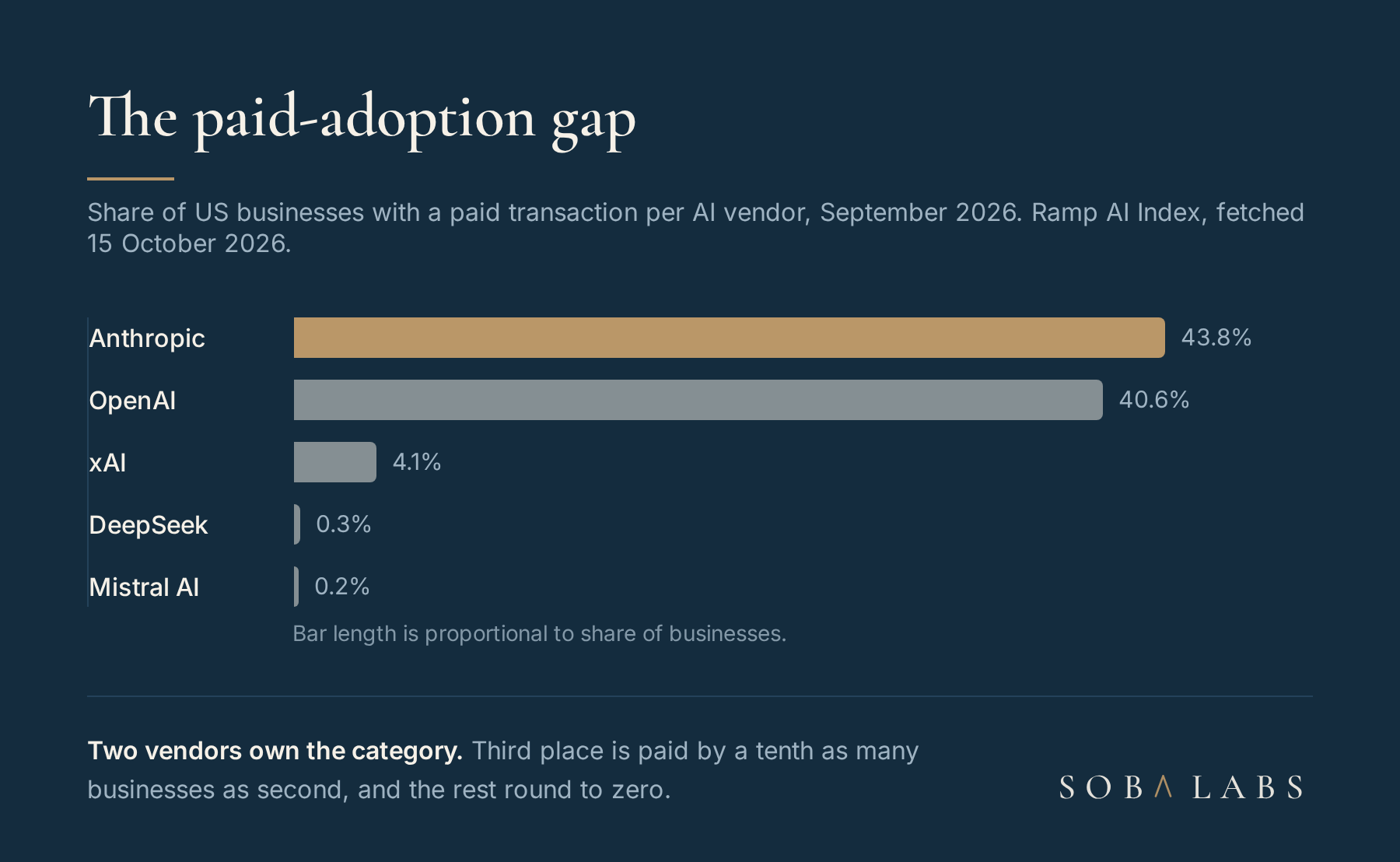
Third place deserves a second look because of how far away it is. xAI nearly doubled its share this year, from 2.20 percent in January to 4.14 in September, and is still paid by about a tenth as many businesses as either leader. And DeepSeek’s row looks like a misprint until you remember what the index counts: its flash models carry more tokens than anything else on OpenRouter’s usage rankings, which we walked through in the 10 most used AI models in 2026, yet about one US business in four hundred pays it directly. Usage boards and payment data disagree this sharply because they count different doors into the same technology. A developer routing tokens through a marketplace never shows up as a vendor’s paying business customer.
OpenAI did not fall; everyone else arrived
Read the two leaders’ 2026 series side by side and the story is not a collapse. OpenAI started the year at 40.85 percent and ended September at 40.63, spending the whole year inside a two-point band around 40 percent; its 1.12-point gain in September itself was its best month of the series this year. Anthropic started January at 21.16 percent and ended September at 43.77: more than doubled, up 22.6 percentage points, while the incumbent held still.
The climb is older than 2026. Ramp’s November 2025 analysis reported Anthropic jumping to 14.3 percent of businesses that October, its second-largest monthly gain on record as reported at the time, while OpenAI growth had already flattened. The same analysis is blunt about what the money buys: most business spend on model companies is API spend by engineering and product teams building AI into their own systems and coding workflows, not chatbot seats. That is worth keeping in mind when the two leaders are discussed as consumer brands. The race Ramp measures is for the LLM provider line on an engineering budget, and budget lines are won and lost on developer workflows, not on app downloads.
The crossover has a date, and revisions moved it
Ramp called the flip on 13 May 2026, in a post titled Anthropic beats OpenAI on business adoption: “Adoption of Anthropic rose 3.8% in April to 34.4% of businesses. OpenAI adoption fell 2.9% to 32.3%.” The Decoder’s coverage ran the same day and called it the first time Anthropic had passed OpenAI in paid business adoption.
Here is the detail a careful reader should know: the numbers have since been revised. In the vintage of the series we fetched this week, April 2026 still has OpenAI ahead, 39.39 percent to Anthropic’s 38.19, and the first month Anthropic leads is May, 40.70 to 39.32. Both figures sit well above the 34.4 and 32.3 announced in May, because transaction datasets get restated as more bills settle and models improve. The flip itself survived the revision; its date slid by a month. Treat any single month of a living dataset as provisional, the same discipline we apply to AI ROI measurement inside a company; what that discipline looks like when a CEO states the result in public is the subject of Bank of America’s AI math. Ramp itself flagged the fragility in the announcement: “So these results should not be construed to suggest Anthropic is the definitive leader in business adoption.”
Mid-sized businesses added the most adoption this year
Underneath the vendor race, the index answers the question a buyer actually brings to it: is everyone else paying for this yet? Overall, 55.86 percent of businesses in the sample paid for at least one AI product in September, up from 45.52 in January and up 12.1 percentage points year over year. Split by size, medium-sized businesses climbed most in 2026, from 49.5 to 62.5 percent, a 13-point gain against 11.2 for large businesses and 9.9 for small ones. The mid-market is not trailing the enterprise by much anymore, and it is closing the gap.
The industry spread says where the remaining room is. Information-sector businesses lead at 79.9 percent and finance follows at 73.7, with manufacturing at 60.9. At the other end, retail sits at 49.9, construction at 43.2, healthcare at 42.5 and hospitality at 33.0. If you sit outside tech and finance, roughly half of your industry peers now pay for AI and the other half do not, which is the window in which moving early still differentiates. What that first project should be is a selection problem, and the hours-times-repetition rule we use for it is in AI in manufacturing: automate the work nobody wants.
What a paid transaction does and does not measure
The index measures exactly one thing, and The Decoder’s caveat states it cleanly: “It tracks what share of those companies pay which AI providers, not how much they actually use or spend.” The same report notes the sample skews heavily toward US companies. A business paying Anthropic 50 dollars a month and one paying 50,000 count the same, so none of the figures above is revenue share, seat count or usage.
The trap: reading 43.8 percent as market share. It is a count of paying customers on one platform’s bills. Revenue share, usage share and contract size all live in other datasets, and each of them can rank the same vendors differently.
The vendor list is also short on purpose. Five model labs have series; Google is not among them, and a business running Gemini through its Google contract, or any model through a cloud marketplace, pays the platform rather than the lab, so that spend lands with the hyperscalers instead, or with the GPU-first specialists we rank in the top 5 neoclouds in 2026. Google’s newest flagship ships almost entirely through those first-party doors, as we found in Gemini 4 Argon: what you can actually call today. Free tiers and personal accounts are invisible here for the same reason: no business payment, no row. Vertical specialists have no series either, so a firm paying Harvey or Legora never shows up here; we compare those on their own published figures in the legal AI vendors law firms pay for in 2026. The index is the paid, direct, US slice of the market, which happens to be the slice a buyer deciding on a vendor contract belongs to.
How a buyer should use this ranking
Three uses survive the caveats. First, calibrate the shortlist. More than two in five US businesses pay each of the two leaders, so an AI vendor assessment that starts anywhere else needs a reason. The long tail is not where mid-sized companies are spending, whatever the demo said. If the cheap token prices from the Chinese labs tempt you anyway, price is the smallest of the questions to clear first; the other two are in Can you use a Chinese AI model?
Second, plan for the leaderboard to move. The paid-adoption lead changed hands within five months, in the most closely watched software category in the world. Kharazian’s own verdict in the crossover post is the sentence to pin up: “we have never seen a software industry as dynamic, where newcomers can disrupt market leaders in a matter of months, and where the pace of development overrides the typical forces of vendor stickiness.” A multi-provider setup keeps model choice a configuration change, and it is the practical answer to vendor lock-in in a market that reorders this fast.
Third, treat adoption as the start of the cost conversation, not the end. A paid transaction says a company bought something, not that the spend is controlled; the index’s own definition counts a single observed payment. Once the subscription exists, the discipline that matters is AI FinOps: spend per task, per team, per model, reviewed like any other cloud line. We sit in this data ourselves, on the Anthropic row: the posts on this blog, this one included, are drafted and shipped by scheduled agent sessions on a paid Claude subscription, running inside a harness of audits and gates we built, which is the practice described in Harness engineering: the model is not the product.
The takeaway
Ranked by the share of US businesses paying for them in September 2026, the AI vendors are Anthropic at 43.8 percent, OpenAI at 40.6, xAI at 4.1, and everyone else below half a percent. Anthropic more than doubled its share in nine months while OpenAI held flat, the lead changed hands in spring, and a later revision moved the crossover month, which is the right reminder of how live this data is. The metric counts paying customers on one platform, not revenue or usage, so use it the way a buyer should: start the shortlist at the top, keep the exit open because the top moved once already this year, and put the FinOps discipline in place before the invoices compound.
Sources
- Ramp AI Index: the adoption definition, methodology and the September 2026 vendor, size and industry figures, fetched 15 October 2026.
- Anthropic beats OpenAI on business adoption, Ara Kharazian, Ramp, 13 May 2026: the crossover announcement and its caveats.
- Anthropic adoption series on FRED, Federal Reserve Bank of St. Louis: the monthly histories behind every 2026 figure, fetched 15 October 2026.
- Anthropic overtakes OpenAI in B2B adoption for the first time according to Ramp spending data, Matthias Bastian, The Decoder, 13 May 2026: the independent coverage and the what-it-measures caveat.
- Ramp AI Index: AI business adoption re-accelerates, led by Anthropic, Ramp, 19 November 2025: the October 2025 figures as reported at the time and the API-spend observation.
- Anthropic beats OpenAI, Econ Lab, Ara Kharazian, 13 May 2026: the crossover post on the author’s own newsletter.