

Renting GPUs is now its own industry, with its own vendor class and its own league table. The top 5 neoclouds in 2026 are CoreWeave, Nebius, Crusoe, Lambda and Together AI, ranked on what each one’s own latest disclosures put on the table this year. The metric is disclosed money: reported revenue where a vendor files it, contracts, debt and equity where it does not, every figure fetched from the page that publishes it on 22 October 2026, with SemiAnalysis’s ClusterMAX quality rating beside each seat. This post walks the market the ranking sits in, the five vendors’ own numbers, and what a disclosed-money ranking cannot tell a buyer.
How the ranking was built
The market first. Synergy Research Group’s April 2026 forecast put neocloud revenue at $9 billion in Q4 2025, up 223 percent year over year, more than $25 billion for full-year 2025, and on course to approach $400 billion by 2031 at a 58 percent compound annual growth rate. The field chasing that money is wide and shallow: American Compute’s State of the Neoclouds, published 15 October 2026, counts 536 companies selling GPU capacity outside the hyperscalers, in 45 home countries, 399 of them GPU-native, built to rent GPUs rather than adding them to another business. The ranking below orders the five by the money their own publications place: quarterly filings for the two that report revenue, and closed financing rounds, rated debt and contracted capacity for the three that do not. Each figure carries its date, because in a market growing like this, a number without a date is a rumor.
What are the top 5 neoclouds?
American Compute’s report defines the category in one sentence worth quoting whole: “A neocloud is a cloud provider built to rent GPUs for AI training and inference, unlike a hyperscaler such as AWS, Azure or Google Cloud that sells a broad catalog of services.” The hyperscalers sell hundreds of services and treat GPUs as one line in the catalog; a neocloud is the catalog. How the big five hyperscalers themselves rank is a separate table we published in October; this one is about the specialists eating into their AI infrastructure business. The quality column is SemiAnalysis’s ClusterMAX 3.0 rating of 23 September 2026, which reviewed 77 GPU cloud providers and awarded its Medallion tiers to only 19 neoclouds worldwide.
| # | Neocloud | Latest disclosed figures | As of | ClusterMAX 3.0 |
|---|---|---|---|---|
| 1 | CoreWeave | $2.58B Q2 revenue, ~$104B revenue backlog | Aug 11, 2026 | Platinum |
| 2 | Nebius | $582.3M Q2 revenue, $3.0B ARR, $40B customer commitments | Aug 12, 2026 | Platinum |
| 3 | Crusoe | $3.9B Series F at a $30.9B valuation, $140B+ contracted value | Sep 17, 2026 | Bronze |
| 4 | Lambda | Two ~$1B debt facilities, the latest rated Baa1 | Oct 1, 2026 | Silver |
| 5 | Together AI | $800M Series C plus 500 MW of investor-funded capacity | Jul 1, 2026 | Bronze |
CoreWeave is the yardstick the rest get measured against
CoreWeave’s second quarter 2026 results, filed 11 August, report revenue of $2,575 million against $1,212 million a year earlier, so the quarter more than doubled year over year, and a revenue backlog of approximately $104 billion as of 30 June, a footnote adding that more than $25 billion of net new customer commitments landed in early Q3 on top of it. The physical plant behind those contracts grew by nearly 500 MW of active power in the quarter to 1.5 GW, with roughly 3.7 GW contracted, and the release notes the industry’s first bring-up of NVIDIA Vera Rubin NVL72 systems. Scale is not profit: the same table shows a net loss of $626 million for the quarter, against adjusted EBITDA of $1.51 billion. The external reads agree on the position. Synergy’s forecast says “CoreWeave stands out as the most direct challenger to traditional hyperscale cloud providers”, and SemiAnalysis, re-awarding its top tier, writes that CoreWeave “still sets the technical bar for others to follow”.
Nebius turned one Microsoft contract into the second seat
Nebius reported its second quarter on 12 August 2026, the figures carried by its shareholder letter: group revenue of $582.3 million, up 454 percent year over year, AI cloud revenue up 514 percent to $574.9 million, and annualized run-rate revenue of $3.0 billion, up 56 percent in a single quarter from the $1.9 billion reported at the end of March. The same letter counts $40 billion in customer commitments and expects over $9 billion in customer prepayments during 2026. The anchor tenant is Microsoft: Nebius’s SEC filing of 8 September 2025 describes a five-year agreement for dedicated GPU capacity from its Vineland, New Jersey data center where “the total contract value is about $17.4 billion through 2031”, expandable to about $19.4 billion. Quality follows the money here too: in ClusterMAX 3.0, “Nebius joins CoreWeave in the Platinum tier”, described as a provider that consistently commands premium pricing. A hyperscaler renting from a neocloud, rather than the other way around, is the single clearest signal of how real this vendor class has become.
Crusoe raised the biggest private round and still rates Bronze
Crusoe announced on 17 September 2026 the initial closing of a $3.9 billion Series F at a $30.9 billion post-money valuation, co-led by Atreides Management, Mubadala Capital and Valor Equity Partners, with NVIDIA, GIC, Founders Fund and Qatar Investment Authority among the backers. The same release claims over $140 billion in total contracted value across what it calls itself: the industry’s first vertically integrated AI infrastructure provider. Crusoe builds the energy supply, the data centers and the cloud on top, rather than renting space and power. That is the largest disclosed figure in this table, and it is also the one to handle most carefully, because it spans power and construction commitments as well as compute. SemiAnalysis’s September rating moved Crusoe down to its Bronze tier, a reminder that capital raised measures conviction about a vendor, while a cluster rating measures what its customers actually get, and the two can point in opposite directions in the same month.
The trap: the three biggest numbers in this ranking measure three different promises. CoreWeave’s $104 billion is backlog under committed cloud contracts, Crusoe’s $140 billion is contracted value across an energy-to-cloud platform, and Nebius’s $40 billion is customer commitments. None of them is revenue, and a ranking quietly reorders itself depending on which promise you treat as money.
Lambda borrows like a utility, and that is the point
Lambda publishes no revenue, but its financing says enough to seat it fourth. On 1 October 2026 it closed a $1.008 billion investment-grade delayed draw term loan at a 6.78 percent fixed rate, rated A (low) by Morningstar DBRS and Baa1 by Moody’s, funding GPU infrastructure for three committed customer deployments with two investment-grade offtakers, fully amortizing to a May 2033 maturity. It was Lambda’s second institutional credit facility in five weeks, after a broadly syndicated loan closed 27 August 2026, with roughly a billion dollars raised in each of its major 2026 financings. Debt at utility ratings is a different claim on the future than venture equity: an insurer buying a 6.78 percent fixed-rate note is underwriting contracted compute cash flows, not a growth story. American Compute’s report makes the same cut across the whole field: investment-grade GPU debt has reached only the largest operators.
The fifth seat is decided by disclosure, and Together AI discloses the most
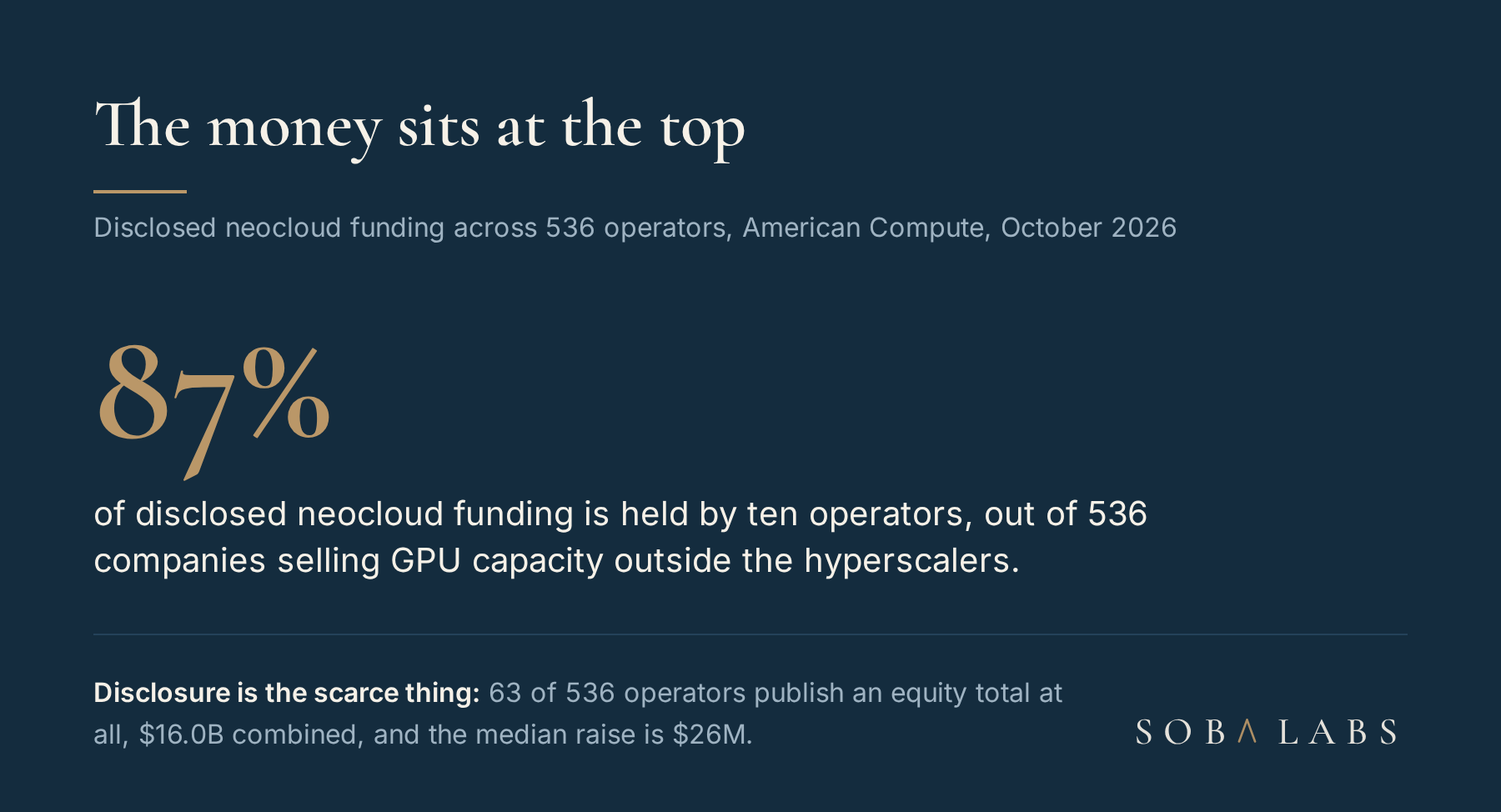
Below the top four, the public record thins out fast. American Compute’s funding data says it plainly: “The money sits at the top.” Ten operators hold 87 percent of disclosed funding, only 63 of the 536 disclose an equity total at all ($16.0 billion combined), and the median disclosed raise is $26 million. Synergy’s April list of market leaders names CoreWeave, Crusoe, Core Scientific, Lambda, Nebius and Nscale, but among the remaining contenders the largest recent disclosure we could fetch is Together AI’s: an $800 million Series C announced 1 July 2026, with investors including NVIDIA and Aramco Ventures, plus commitments for over 500 MW of compute capacity to be capitalized independently by its investors. Together is an inference provider as much as a GPU landlord, serving the open-weight models our most-used-models ranking tracks, and ClusterMAX 3.0 rates it Bronze this round on reliability grounds. The seat is genuinely contested: a private operator with quiet contracts could outweigh everyone below second place, and nobody outside its data room would know.
What a disclosed-money ranking does not measure
Four gaps matter before you quote this table. It does not measure quality: the ClusterMAX column exists precisely because capital and competence diverge, and only 19 neoclouds worldwide earned any Medallion tier at all. It does not measure comparable scale: two vendors report revenue, three report promises, and the trap above shows how differently those promises are shaped. It does not measure jurisdiction: the ranking is worldwide, while a European buyer’s hard constraints are data residency and, increasingly, sovereign AI requirements that a New Jersey or Texas data center does not satisfy. And it does not measure the circularity of the money: NVIDIA appears above as an investor in both Crusoe and Together AI while being every operator’s dominant supplier, the pattern that keeps the AI bubble question open even for businesses that never touch a GPU.
For a mid-sized company the practical reading is simpler. You will probably never rent a rack from any of these five: you will meet them as the capacity behind your model API, your hosted inference endpoint, or your hyperscaler’s own supply chain, the way Microsoft now buys Nebius capacity. We run that playbook ourselves: Soba Labs operates no GPUs, every model call in our agent systems is a metered API, and the one infrastructure discipline we install early with clients is AI FinOps, because a 223 percent growth market reprices faster than a budget cycle. Which AI vendors businesses actually hand money to, model labs included, is a ranking of its own.
The takeaway
The top 5 neoclouds in 2026, ranked on their own disclosures, are CoreWeave with a $2.58 billion quarter and a $104 billion backlog, Nebius with $3.0 billion ARR and a $17.4 billion Microsoft contract, Crusoe at a $30.9 billion valuation, Lambda with twin billion-dollar debt facilities, and Together AI on an $800 million round. The market behind them passed $25 billion in 2025 and is forecast to approach $400 billion by 2031, yet 536 operators share it and ten hold 87 percent of the disclosed money. Treat the table as a reading of published facts, dated 22 October 2026, in a market that re-ranks itself quarterly, and treat quality ratings and money as two different instruments that happen to agree only at the top.
Sources
- State of the Neoclouds 2026, American Compute: the 536-operator census, funding concentration, the neocloud definition and the investment-grade debt observation, published 15 October 2026.
- Neocloud market forecast to approach $400B by 2031, Synergy Research Group: 2025 market revenue, the 2031 forecast and the named market leaders, published 2 April 2026.
- CoreWeave second quarter 2026 results, SEC filing: revenue, net loss, backlog and power capacity.
- Nebius second quarter 2026 results: the results announcement of 12 August 2026.
- Nebius Q2 2026 shareholder letter: revenue, ARR, customer commitments and prepayment expectations.
- Nebius Form 6-K of 8 September 2025, SEC: the Microsoft agreement’s term and contract value.
- Crusoe announces Series F funding: the $3.9 billion round, valuation, investors and total contracted value.
- Lambda closes $1 billion senior secured fixed-rate financing: the facility’s size, rate, ratings and maturity.
- ClusterMAX 3.0, SemiAnalysis: the GPU cloud quality tiers of 23 September 2026.
- Announcing our Series C, Together AI: the $800 million round and the 500 MW of investor-capitalized capacity.