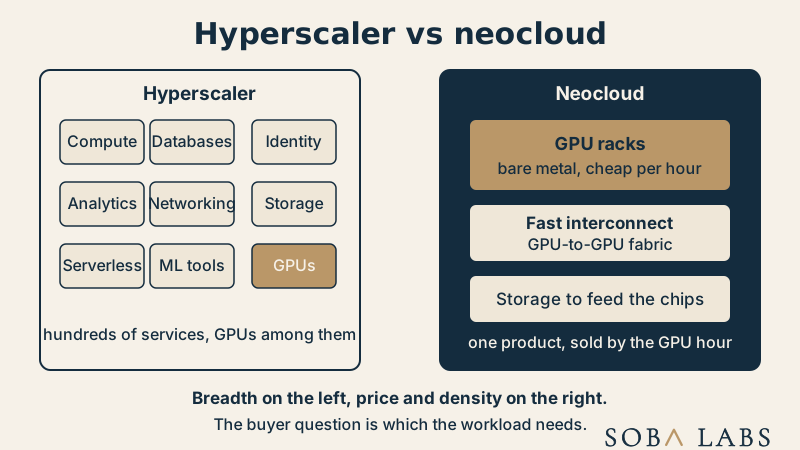
A neocloud sells you the chips. Everything else that makes AI run in production stays your problem.
Neocloud vs hyperscaler: what is the difference?
Breadth. A hyperscaler like AWS, Azure or Google Cloud carries databases, networking, identity, analytics and GPUs somewhere in the catalog. A neocloud carries GPUs, the high-speed fabric that connects them, and storage enough to feed them. The narrow catalog is the business model, not a gap: less virtualization overhead, no hundreds of services to maintain, and data center designs built only for dense accelerator racks, which is how the per-hour price undercuts the big clouds. The name is a contraction of “new cloud” and spread through 2025 and 2026 as AI demand outgrew what general-purpose clouds could allocate; our breakdown of the big five hyperscalers covers the incumbents’ side.
When does a neocloud make sense for a company?
When the work is GPU-shaped and bursty. Training or fine-tuning a model for weeks, rendering, large batch jobs: these want raw accelerator hours at the best price, and a neocloud quote is often a fraction of the hyperscaler list price for the same chips. Steady, latency-sensitive inference usually belongs elsewhere, with an inference provider that sells outputs per token, or inside the cloud where your data already lives. Most companies that use a neocloud use it alongside their main cloud, not instead of it, as one more layer of AI infrastructure.
What are the risks of building on a neocloud?
Concentration and survival. Gartner estimates that over 3.5 trillion US dollars of AI infrastructure spending could be exposed to impairment by the end of 2030 and expects about 80 percent of AI-focused cloud providers to cease operating independently by then (Gartner press release, 14 October 2026, read 19 October 2026). The sector is also heavily debt-financed: Fortune’s coverage of CoreWeave’s investor case walks through the borrowing behind the buildout and what defends it (Fortune, 16 October 2026, read 19 October 2026). Price the vendor’s survival into the contract: data egress terms, portability of your training setup, and what happens to committed spend in an acquisition. The exposure is a specific case of AI vendor lock-in, sharpened by balance sheets.
What should a buyer check before signing?
Four things beyond the hourly rate. Whether the quoted chips are actually available when you need them, since capacity is sold forward. Where the data centers are, which decides data residency and matters for any sovereign AI requirement. What the egress and exit terms cost, because the cheap hours are the entry price and moving petabytes out is the exit price. And how the provider is financed, which the risk section above makes a due diligence question rather than a curiosity. Treat a neocloud as a supplier to qualify, not a utility to assume.