LangGraph agents that survive their first week in production.
A LangGraph prototype runs on one laptop and forgets everything on restart. Production needs durable state, retries, streaming, human approval and a release gate. We build that layer and pick the LangSmith deployment option that fits your data and your team.
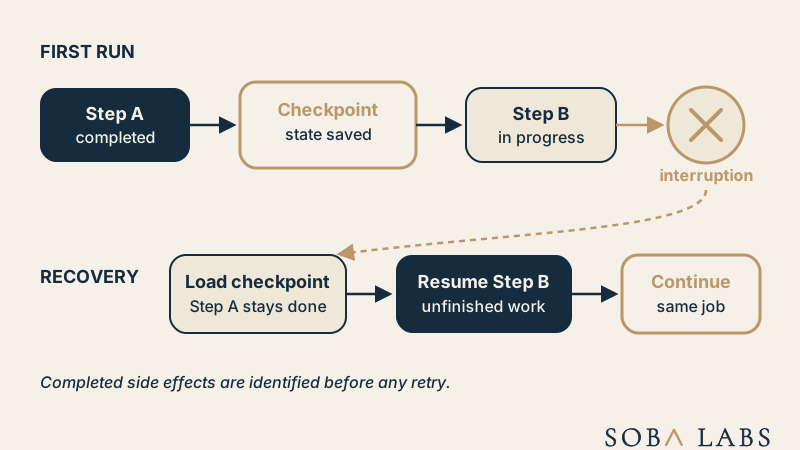
A persistent checkpointer (Postgres, not memory) behind every graph, so a run resumes from its last step after a restart, a tool failure retries without repeating a side effect, and a second message during a run queues instead of colliding.
LangSmith Deployment on LangChain's cloud, a hybrid setup with the agents in your VPC, a self-hosted platform on your Kubernetes, or a standalone Agent Server with no control plane. We decide from your data, your ops team and your budget, not from a default.
Release gate
Tracing and evals before go-live
Tracing is on from the first deploy and the evaluation set runs in CI, so no prompt, model or retrieval change reaches production unscored.
Interrupts where a person must approve, model calls behind a gateway with spend caps and fallbacks, and agent-generated code running in an isolated sandbox instead of on your servers.
What breaks when a LangGraph prototype goes to production?
State, mostly. A demo keeps its graph state in memory, so a restart loses every in-flight run and a retried tool call can repeat a side effect. Production needs a persistent checkpointer, a durability mode chosen on purpose, streaming to the client, a queue for messages that arrive mid-run, an interrupt where a person must approve, and a budget on model calls. Soba Labs builds that layer before the agent takes real traffic.
What are the LangSmith deployment options for a LangGraph agent?
As of October 2026, LangSmith Deployment runs an Agent Server in four ways: Cloud, where LangChain hosts everything (Plus plan or above); Hybrid, where LangChain runs the control plane and your Agent Servers run in your own cloud; Self-hosted, where the control plane, Agent Servers and databases all run on your Kubernetes alongside a self-hosted LangSmith (Enterprise plan); and a standalone Agent Server in Docker or Kubernetes with no control plane at all, sending traces to whichever LangSmith you use.
How do you choose between cloud, hybrid and self-hosted?
By who runs it and where the data may live. A small team with no platform engineers and no residency constraint is usually best on Cloud, where builds and scaling are handled for them. A team that must keep conversations and tool outputs inside its own cloud takes Hybrid or a standalone Agent Server on its own Postgres and Redis. Full self-hosting of the LangSmith platform is for the cases where traces themselves cannot leave your network and you have people to run a Kubernetes cluster, ClickHouse and Postgres. We write the decision down with its reasons before anything is provisioned.
Can we keep our data in the EU?
Yes. LangSmith Cloud has an EU region, hosted in GCP europe-west4 in the Netherlands, with its own sign-up URL and API endpoint, and deployments created in an EU organization run in that region (as of October 2026). If even that is too far, the Agent Server and its databases run in your own EU cloud account, with traces staying in the EU region or in a self-hosted LangSmith. Soba Labs is based in Poland, inside the EU.
Do we need LangSmith Deployment to run LangGraph in production?
No. LangGraph is open source and runs anywhere a Python or Node service runs, with a Postgres checkpointer you operate yourself. What LangSmith Deployment adds is the Agent Server runtime: a task queue for background runs, cron jobs, a long-term memory store, resumable streaming and a strategy for messages that arrive mid-run, plus the control plane that builds and scales it. We recommend it when those features would otherwise be built by hand, and skip it when a plain service with a checkpointer is enough. See LangGraph consulting for how we design the graph itself.
How do you keep model cost and agent-generated code under control?
Two LangSmith pieces, both verified against the docs in October 2026. The LLM Gateway (in beta) sits between the agent and the model providers, applies spend caps and rate limits per workspace or per API key, and can fall back to another model when a provider fails. LangSmith Sandboxes run code the agent writes in an isolated environment with its own filesystem, so a bad script never touches your infrastructure. Where the gateway is not an option, we attribute token cost per run from the traces and cache prompts so the bill stays predictable.
What has to be true before you call an agent production-ready?
Tracing on every run, an evaluation set from real conversations that runs in CI and blocks a regressing change, prompt versions pinned so a trace names the prompt that produced it, an interrupt on every side effect a person should approve, idempotency keys on writes, and a clear owner for the failures the agent escalates. Then we deploy, and the first week of production traces becomes the next evaluation set.
How is a deployment engagement priced?
Like every Soba Labs engagement: a fixed price on a defined outcome, agreed before we start. You own the graph, the deployment configuration and the evaluation sets, and the LangSmith plan is your contract with LangChain, not with us.
We sell a fixed price on a defined outcome, delivered in days. Every system is custom to your process and your data, and you own it and its source. No product to license, no platform to rent, no lock-in.
No advertising or tracking cookies, and our visitor counts are anonymous. The Cal.com booking widget loads only if you allow it. Privacy Policy.
The page itself, anything our host sets to serve and secure it, and the anonymous visitor count. Always on, and none of it stores anything on your device.
The Cal.com booking widget. Left off, a booking link opens the booking page instead of a popup, so you can still book a call.
 LangChain experts