
Ask where AI pays off in a factory and the published answers in 2026 are unglamorous: sanding, quoting, parsing drawings, chasing order status. The manufacturing AI that pays back first does the work nobody volunteers for, the tasks that eat hours, repeat every week, and need no judgment, while the decisions stay with people. An ambulance maker in Iowa cut sanding time by more than 30 percent with a robot that programs itself, and a machine shop that automated quoting cut its response time from 5 to 10 days to 1 to 3. This post walks through the results manufacturers have actually published this year, what they cost to reach, and the rule we use with clients to pick the first project.
How is AI used in the manufacturing industry?
Strip away the keynote language and AI in manufacturing today is a short list of working patterns: quoting systems that read a drawing and price the part, scheduling engines, machine vision for inspection, predictive maintenance on the machines that already have sensors, robots that plan their own paths for dull finishing work, and office tools that draft the documents around all of it.
What it is not, for most plants, is deployed at scale. Deloitte’s 2025 Smart Manufacturing and Operations Survey of 600 executives at large manufacturers with US operations found 29 percent using AI or machine learning at the facility or network level and 24 percent running generative AI at that scale, with another 23 percent piloting AI and machine learning and 38 percent piloting generative AI. And those are the large companies. At IMTS 2026, the Chicago manufacturing technology show that drew over 80,000 registrations in September, Control Design reported that fewer than 40 percent of small-to-medium job shops use robotics at all, and that the show’s overarching themes were low-barrier automation and background AI: tools that work without a programmer on staff.
So the honest picture of AI adoption in manufacturing is a wide gap between a handful of published, repeatable wins and a majority still deciding. The wins are worth reading closely, because they share a shape.
Nobody volunteered to sand ambulance panels
The result that best captures the shape comes from Modern Machine Shop’s editor-in-chief Brent Donaldson, in a June 2026 editorial titled The AI Inflection Point. Every Friday afternoon, the paint supervisor at Life Line Emergency Vehicles, an ambulance manufacturer in Sumner, Iowa, walked the production line looking for volunteers to sand ambulance panels. Nobody wanted the work. The plant installed GrayMatter Robotics’ Scan&Sand system, which scans each vehicle’s unique geometry and starts work without custom programming, and sanding time fell by more than 30 percent.
The supervisor’s own verdict is the part worth quoting: “It doesn’t take away jobs,” he says. “It handles monotonous, taxing tasks.”
Notice what made this automatable in 2026 when it was not in 2016. Ambulances are low-volume and every body is different, so classic robotics, which needs a programmed path per part, never fit. An AI system that scans the part and plans its own path removed the programming cost, which was the real barrier. The same editorial puts a number on a neighboring pattern: Open Mind Technologies reports its AI-assisted CAM programming typically saves 70 to 80 percent of programming time on automated portions. The scarce skill stops being the bottleneck.
The work that qualifies first is the work your people already avoid. That is not a coincidence: work nobody wants is almost always repetitive, physically or mentally taxing, and low on judgment, which is exactly the profile AI handles well, with human-in-the-loop review left for the calls that need a person.
The quoting inbox is a production line too
The same shape repeats in the front office, where the work nobody wants is quoting. Donaldson’s editorial again: domestic shops spending 15 to 20 minutes quoting each part manually are losing work on response time rather than price, and Uptool’s AI, which parses drawings and bills of material from the quoting inbox, gets that down to roughly 90 seconds per part. Uptool co-founder Benny Buller states the thesis plainly: “The biggest opportunity in the manufacturing of parts is not in developing the next modality of manufacturing technology. It is in software that allows better flow of information and faster decisions.”
The published customer numbers back him up. Focused on Machining, a Colorado CNC machine shop, cut quote response time from 5 to 10 days down to 1 to 3 days and credits the quoting platform with a 15 to 20 percent increase in throughput and revenue. Zero Hour Parts now advertises a 4-hour quote turnaround guarantee after raising quote throughput by 200 percent; before the change, the shop says it was not close to meeting that window consistently. Reading a drawing, finding the similar part you made last year, pricing it: this is document AI plus retrieval, applied to the one queue where a day of delay loses the order.
The trap: picking the first AI project by what demos well. A chatbot on your website demos well. The quoting inbox and the sanding bay do not demo at all, and they are where the published payback is.
Hours times repetition times low judgment picks the first project
The selection rule behind every result above fits in one line. Justin McKelvey’s September 2026 guide AI for manufacturing, written for shops under 50 million dollars in revenue, scores candidate tasks by “hours times repetition times low judgment”: how much time the task eats, how often it recurs, and how little discretion it needs. Sanding scores high on all three. So does quoting, order-status email, and re-keying data between systems, the classic targets of workflow automation. Approving a nonstandard discount or diagnosing a one-off quality escape scores near zero on repetition and high on judgment, so it stays human.
The rule works because it is really an AI use case prioritization filter in disguise: it selects for measurable baselines (hours are countable), fast feedback (repetition means you see results weekly), and low blast radius (low judgment means a wrong output is caught cheaply). We apply the same logic to phone traffic in Voice agents in production: what to automate first, and it survives contact with every industry we have tried it in: automate the predictable and recoverable first, keep the irreversible with people.
A subscription in the office, a capital project on the floor
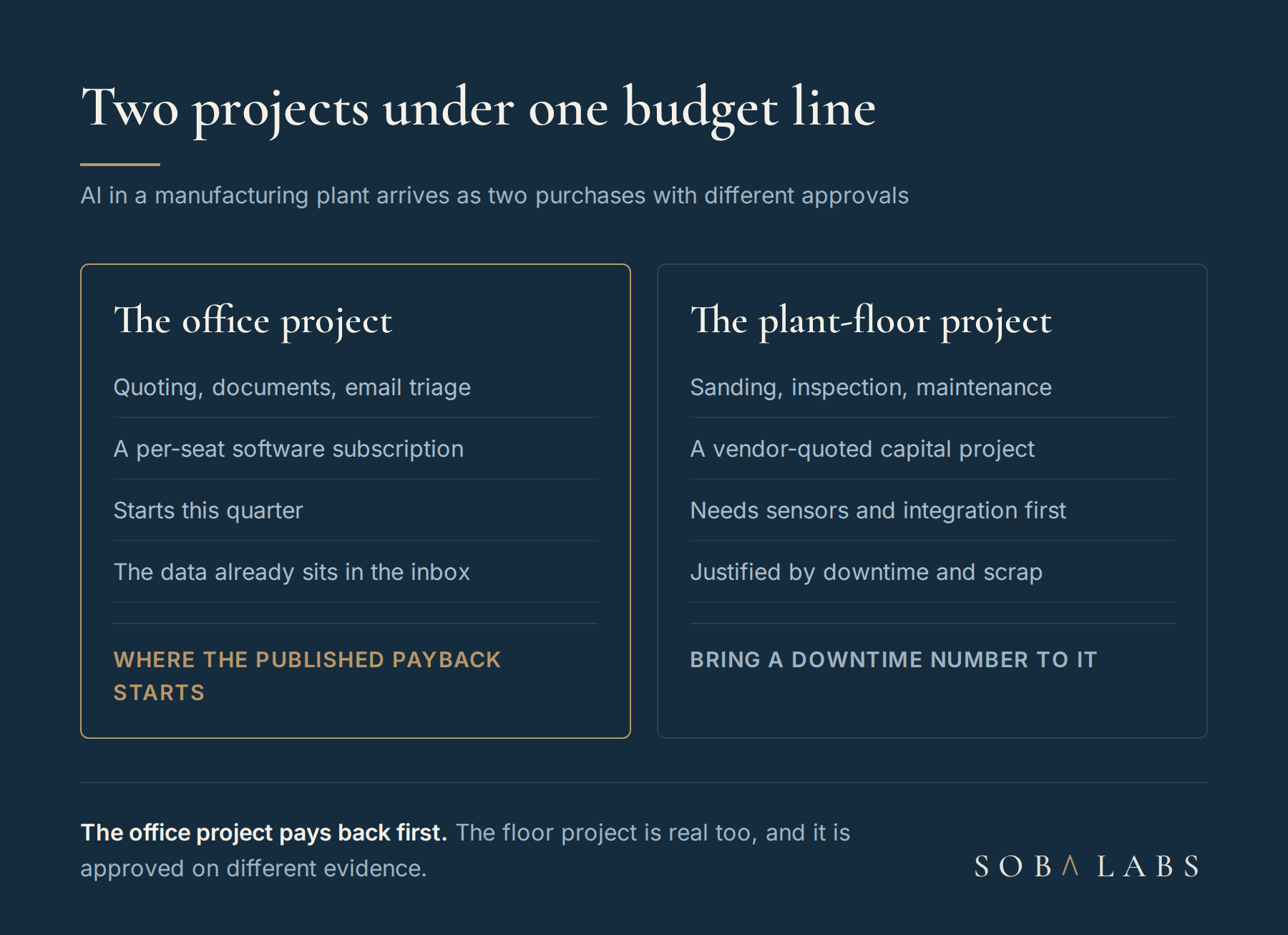
The two halves of the pattern carry very different price tags, and McKelvey’s guide is the rare source that states them side by side. The office half is a business seat at 20 to 25 dollars per person per month doing the paperwork around the shop: quoting support, document drafting, email triage. It can start this quarter, and for a shop under about 50 million dollars in revenue he argues it is the first and cheapest return available. The plant-floor half, predictive maintenance, machine vision and scheduling engines, he describes as a capital project, vendor-quoted, with sensors, the kind of project you bring a downtime number to.
That difference explains why the floor results that do get published cluster around vendors who removed the integration cost, like the self-programming sanding robot above, and why the famous plant-floor numbers come from companies with in-house platforms: Google Cloud’s catalog of production AI use cases records Toyota saving over 10,000 man-hours per year with a platform that lets factory workers build their own machine learning models. A mid-sized plant does not have Toyota’s platform team, which makes the build versus buy call the real decision on the floor. We mapped where that line falls for agents in Copilot Studio or a custom agent, and the manufacturing version is the same question with heavier hardware.
Most manufacturers are still stuck between pilot and payoff
The adoption statistics and the case studies describe the same wall from two sides. The World Economic Forum’s January 2025 white paper AI in Action: Beyond Experimentation to Transform Industry, written with Accenture, reports that “74% of companies report challenges in adopting AI at scale, with only 16% of enterprises prepared for AI-enabled reinvention”, and describes most organizations as still experimenting with individual use cases rather than transforming end to end. Deloitte’s piloting shares above say the same thing for manufacturing specifically: more companies are piloting generative AI than running it at scale.
The pattern we see behind that wall is rarely the model and usually the inputs. A quoting system needs your part history digitized and priced; a predictive maintenance pilot needs months of sensor data from the machines that actually fail. That is data readiness work, and it is why the hours-times-repetition rule quietly favors office tasks first: the data a quoting tool needs (your inbox, your drawings, your old quotes) already exists, while the data a floor project needs often has to be instrumented into existence. A pilot that cannot name its baseline also cannot prove payback, which is how AI ROI measurement becomes the difference between a second project and a quiet cancellation.
What we check before naming a first project
When we run this exercise inside a plant, the questions are the ones this post has already asked. Which tasks would nobody defend if a machine took them tomorrow? Which of those recur weekly and carry a countable baseline in hours or days? Is the data the tool needs already lying in an inbox or an ERP, or does it have to be created first? And who owns the process, because an operations design where nobody owns the queue defeats automation and hiring alike, which is the argument of Don’t hire until your operations are designed. We have run this exact audit inside a Polish wood products manufacturer; the findings are published in our Ryba Wooden Products case study.
None of this requires believing a transformation story. It requires a list of tasks, three multiplications, and the discipline to start where the product of the three is highest rather than where the demo is best.
The takeaway
The manufacturing AI results actually published in 2025 and 2026 share one profile: hours-heavy, repeated, low-judgment work that people already avoided, from sanding ambulance panels (over 30 percent time saved) to quoting machined parts (response down from 5 to 10 days to 1 to 3, quote throughput up 200 percent at one shop). The office version is a per-seat subscription you can start this quarter; the floor version is a capital project that needs a downtime number and a data trail. Score your own candidate tasks by hours times repetition times low judgment, check the data already exists, and give the first project a baseline it can beat. The rest is discipline, not transformation.
Sources
- The AI Inflection Point, Brent Donaldson, Modern Machine Shop, June 2026
- Practical AI and accessible automation at IMTS 2026, Control Design, September 2026
- AI for manufacturing, Justin McKelvey, September 2026
- 2025 Smart Manufacturing and Operations Survey, Deloitte, May 2025
- AI in Action: Beyond Experimentation to Transform Industry, World Economic Forum with Accenture, January 2025
- Focused on Machining case study, Paperless Parts
- Zero Hour Parts customer story, Paperless Parts
- Real-world gen AI use cases from leading organizations, Google Cloud, April 2026