
Most AI pitches for order entry lead with one accuracy number, and the unit behind it decides what it means. In the first phase of its rollout, a European cable maker’s AI captured 94.9% of the data fields on customer orders correctly, with people handling the exceptions on purpose. That result comes from LAPP’s order automation story, published by its software vendor in May 2025 and updated in February 2026. A field rate tells you how often single values are right. It does not tell you how many orders reach the ERP untouched, the number your team feels. Below is what the system does, how two other cases report results, and what to test on your own orders.
Before the project, 350,000 orders a year were typed by hand
The vendor’s case study starts from over 350,000 manual orders a year in the EMEA region. Each was entered by hand against a catalog of over 40,000 items. On our arithmetic that is roughly 1,400 orders for every working day. The group’s own company page puts fiscal 2025 sales at EUR 1.93 billion, so this is a large industrial supplier with a mid-sized company’s problem.
The work ran through a central hub launched in Poland to standardize order management across business units. Polish and Central European operations directors will recognize the sequence of shared services first and automation on top. The earlier tool was template-based OCR in a few sales entities. The new one is an AI agent setup in the document AI category that reads orders without templates. The company’s head of global and EMEA sales excellence says it works “even when received in completely unknown formats.” The first phase covered Spain, Denmark and Sweden, and the case study describes the rollout to additional countries as a plan.
Manual order entry costs more than the typing itself
Errors and delay cost more than the keystrokes, though the figures on them are older or vendor-run. A 2017 APQC survey on automating sales order entry, sponsored by an order automation vendor, put the cost of a sales order at $2.00 for top performers on digital channels and $7.00 for top performers on paper-laden methods, and $21.00 for the bottom performers on paper. A 2024 order fulfillment benchmark of 898 manufacturers and wholesale distributors, also published by a vendor, found that almost a third of respondents saw errors in 10% or more of their manual orders. In the same report, digital orders are on time 28% more often than manual ones.
That puts order entry near the top of the list in AI in manufacturing, next to quoting, which we covered in AI in manufacturing: automate the work nobody wants. A mistyped order turns into a wrong shipment and a credit note.
A 94.9% field rate leaves many orders with one wrong field
The published figure counts data fields, each scored on its own. That is field-level accuracy, a real result and a different quantity from the share of orders that need no correction.
One document AI vendor’s accuracy benchmark guide explains why with invoices. One wrong field triggers exception handling, so “a 95 percent field accuracy does not translate directly to a 95 percent straight-through rate.” A LlamaIndex post on review queues adds the arithmetic. Vendors quote accuracy per field while operations counts documents, and “Those two numbers have different denominators.” Its worked example puts 97% per field across 20 fields at about 54% of documents fully correct.
Run the same idealized model on 94.9%. A 10-field order comes out at about 59% of orders with every field right (0.949 to the power of 10), and a 20-field order at about 35%. The LlamaIndex post adds that field errors cluster in practice, because a bad scan breaks many fields at once, which makes real numbers somewhat better than this arithmetic. Read it as a range check.
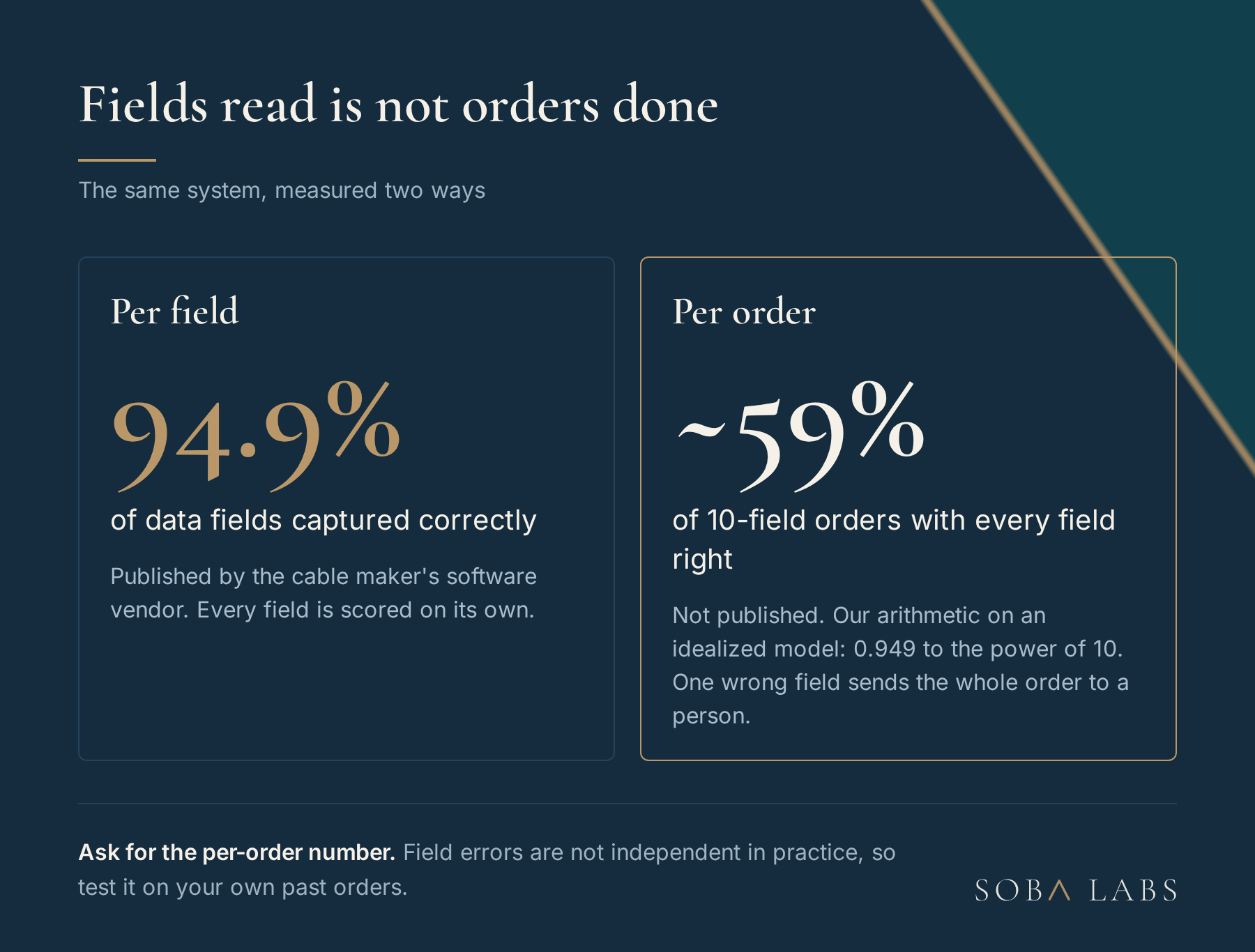
The question to ask: when a vendor quotes accuracy, ask what the denominator is. Fields, lines and orders give three different numbers for the same system, and only the order count tells you how many orders a person still opens.
Matching each order to the right catalog item is the hard part
Reading text off a PDF is the easier half of AI order entry. The harder half turns a customer’s wording into the right article, quantity and packaging in a catalog of tens of thousands of cable products.
The case study gives concrete examples. The system can split a 600 meter cable order into two 300 meter cuttings and pick the right packaging, drums or rings. It standardizes delivery addresses to match customer records, detects urgent orders and moves them up the queue, and raises an alert when an order conflicts with master data.
Most of the engineering in order entry sits here. A model turns unstructured data into structured output, a typed order the ERP accepts. Deterministic checks then test it. Does the article exist? Is the quantity a multiple the product is sold in? Does the address match a known ship-to? That second step is LLM output validation, and it stops a confident extraction from becoming a wrong delivery.
People still handle the exceptions, by design
LAPP did not aim for full automation. The case study states plainly that “Full automation wasn’t the main goal,” and some exceptions, such as unmatched shipping locations, are handled by hand on purpose. Most orders are now handled directly in the ERP, and one dedicated person manages the extraction interface.
We think that human-in-the-loop design is the right one for this job. An order the system cannot match with confidence goes to a person with the reason attached. The mechanism is confidence gating, where a rule decides which orders pass straight through and which wait for review, and the threshold comes from measured errors instead of the model’s own sense of certainty. We wrote about building those rules in deterministic confidence gates.
The German branch of Mitsubishi Electric’s European business took the strict version. Its order intake case study, published by its integration vendor in August 2026, states that “AI-generated data could not be posted in SAP without review.” The original order and the extracted data appear side by side, and a person corrects and approves before the order is posted. The page reports a 40% maximum time saving without saying what it was measured on.
Three order entry cases in Europe report three different measures
Each published case measures something else, which makes a direct comparison impossible.
| Case | What was published | What it measures | The human step |
|---|---|---|---|
| Cable maker, first phase | 94.9% of data fields correct | Extraction accuracy per field | Exceptions handled by hand on purpose |
| Serax, Belgium (May 2025) | Manual B2B orders cut by 33% | Share of orders still entered by hand | Staff confirm the values, then create the order |
| Mitsubishi Electric, German branch (August 2026) | 40% maximum time saving | Time, basis not stated | Review and approval before every posting |
SAP’s customer story on Serax, a Belgian homeware brand, was published in May 2025. Manual B2B orders arriving as PDFs made up 30% of all orders. Staff drag the PDF into an app that extracts and maps the data, confirm the values and convert the request into a sales order. At publication, picking attachments straight from the mailbox was still a proof of concept.
None of the three publishes the share of orders that reach the ERP untouched. Ask for that number, and measure it yourself.
What we would measure on your past orders before go-live
We designed a related system for a Polish pipe and hose manufacturer. It is a proposed assistant that reads a customer email and prepares an offer for a salesperson to check and approve. It is not deployed, and the figures in that case study are pilot targets. Order entry has the same shape, and the test plan is the part we would never skip.
Start with an eval dataset of a few hundred past orders, with the order your team actually entered as ground truth. Run the system on those and report four numbers:
- Field accuracy per field, because 99% on order number with 85% on article is a different system from 94% on both.
- Orders with every field right, the straight-through share your team feels.
- Catalog match accuracy on lines that do not quote your article number.
- Minutes per order for the orders that go to review, against today’s baseline.
An AI order entry project is judged on orders nobody had to open. Set the review threshold from those numbers, keep the rule visible to the team, and widen it only when the measured error rate allows.
The takeaway
The first-phase result is worth copying. AI captured 94.9% of order fields correctly, a central hub in Poland standardized the process first, and people kept the exceptions. Field accuracy is still the vendor’s number, so test on your own past orders, ask for the share of orders that need no human touch, and decide where the review gate sits. The same gap between one clean vendor figure and few operating ones ran through our read of seven freight firms’ AI results.
Sources
- LAPP order automation customer story (vendor page, 2025, updated 2026)
- LAPP Group company page (LAPP Finland)
- APQC: Automating the sales order entry process (2017 survey)
- B2B order fulfillment benchmark report (2024)
- Invoice processing accuracy benchmarks
- LlamaIndex: OCR document processing and review queues
- How Mitsubishi Electric orchestrates order intake with AI (2026)
- SAP News: Serax reduces manual work with SAP Business AI (2025)