
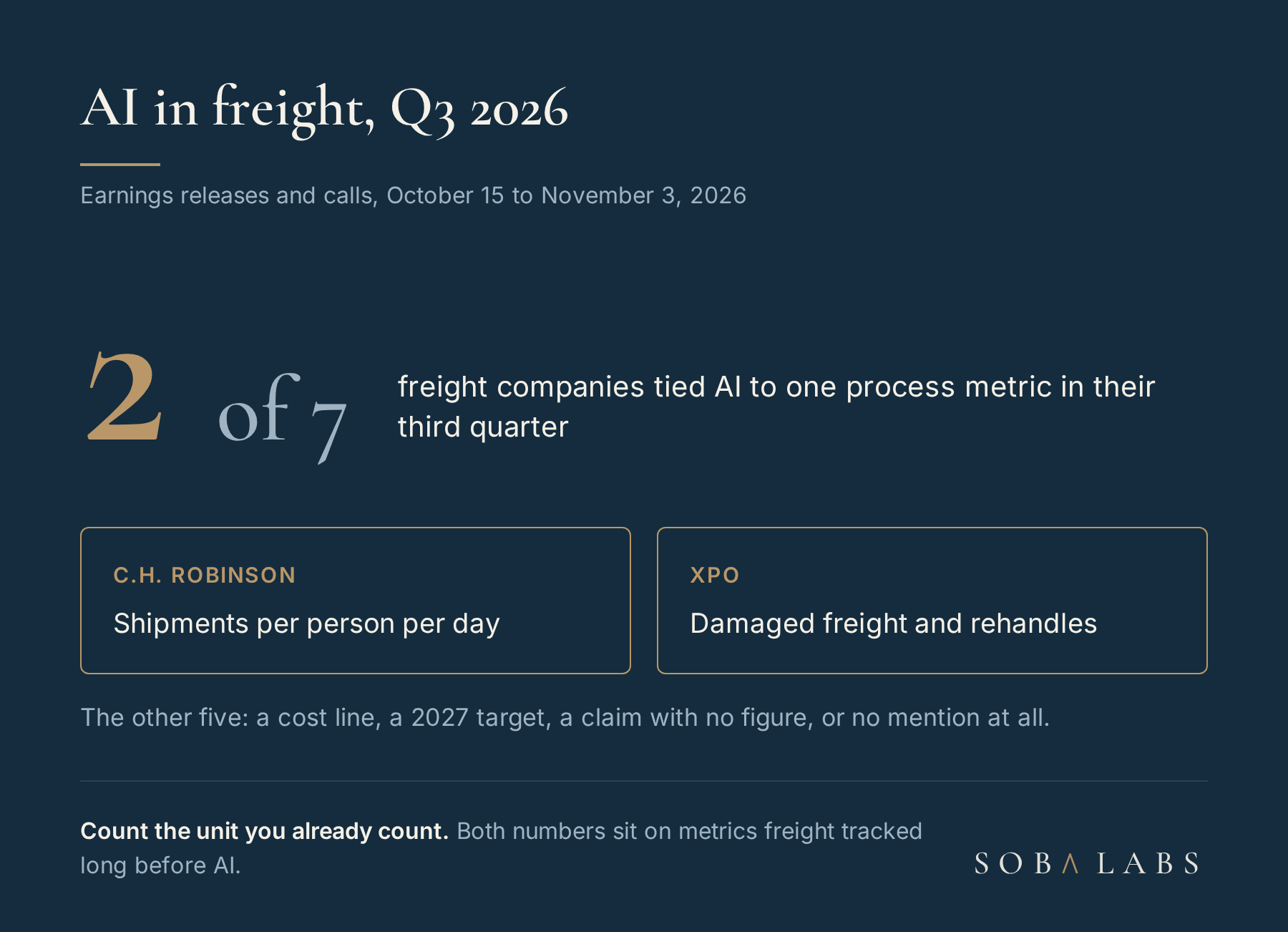
Seven listed freight and logistics companies reported their third quarter between October 15 and November 3, 2026, and six of them mentioned AI somewhere in the release or on the call. Only C.H. Robinson and XPO tied AI to a number for one process; the other five gave AI no figure, folded it into a cost line, or dated it to 2027. In insurance a week earlier not one of six insurers got that close, and the difference is that freight already counts its work in units. Below is what each company said, the number it printed beside the claim, why freight measures more easily than insurance, and the four numbers to copy.
What seven freight companies said about AI in the third quarter
We read each company’s earnings release or call transcript for the quarter and kept two things: what management claimed for AI, and the hardest number placed next to that claim.
| Company | Q3 2026 source | What it claimed for AI | The number beside it | AI’s share stated? |
|---|---|---|---|---|
| C.H. Robinson | Call, Oct 28 | Agentic AI automating manual freight workflows | Shipments per person per day up more than 15% | Partly (credited to automation) |
| XPO | Call, Oct 29 | AI planning, routing and dock feedback | Damages down 20%, rehandles down mid-single digits | Partly (“contributed to”) |
| Knight-Swift | Call, Oct 21 | AI automation among cost levers | Fixed costs flat on the year | No |
| Landstar | Call, late October | Agentic AI in agent offices since the summer | None (“quite good results”) | No |
| GXO | Earnings release, Nov 3 | AI named only as a risk; GXO IQ rollout as productivity work | None; adjusted EBITDA flat at $251 million | No |
| Kuehne+Nagel | Call, Oct 22 | AI pricing tested in air freight | CHF 100 million to 150 million a year, a 2027 target | Target only |
A seventh company, J.B. Hunt, did not mention AI at all on its October 15 call; the closest line was a plan to hold down costs with technology. That silence at least claims nothing, and nobody can accuse it of AI washing.
C.H. Robinson ties AI to shipments per person per day
The broker has the cleanest number of the quarter and we covered its mechanism in detail in our C.H. Robinson case study. Its third quarter summary has the North American surface business moving 3.5% more volume while the Cass Freight Shipment Index fell 0.3%, and on the call the CFO put average headcount down 10.4% on the year. The division’s president tied the productivity line to AI directly: “The increased automation of our workflows enabled us to continue delivering double digit increases in NAST shipments per person per day,” more than 15% in the quarter. The AI agents take the email queue, and the measure is per person, so pricing cannot inflate it.
What keeps this from being a pure AI number is the margin. The summary credits the company’s consistent performance to repricing, higher-margin spot volumes, the agentic workflows and its Lean AI strategy together, so the division’s 40.3% operating margin cannot be read as AI’s. The productivity metric is the one to read; the margin is everything at once.
XPO measures AI by damaged freight and rehandles
XPO, the less-than-truckload carrier, gave the most process-specific answers of any company here. Management named four uses on the call, each with its own measure. CEO Mario Harik gave the first three:
- Network planning. “Since we rolled out a planning model that leverages AI, we have reduced rehandles by mid-single digits to the lowest level in over a decade.” A rehandle is freight moved an extra time at a terminal, which costs labor and raises the odds of damage.
- Pickup and delivery routing. AI route optimization now runs on nearly two-thirds of routes, with a low to mid-single-digit improvement on those routes and the full network planned for early next year.
- Dock loading. Real-time AI feedback to dock workers on how they load trailers “contributed to a 20% reduction in damages in the quarter versus last year.”
- Labor planning. Chief Strategy Officer Ali Faghri credited AI-driven labor planning tools for managing variable labor costs, with shipment count up 6% on the year; Harik put the headcount increase behind that growth at low single digits.
The earnings release adds the outcome for the North American LTL segment, an adjusted operating ratio of 80.1%, 260 basis points better on the year, and says XPO is operating more efficiently by expanding the use of AI across its network. When an analyst asked how much of the ratio’s improvement came from the proprietary tools, Harik did not split it. He pointed to a long-run aim of 1.5 to 2 points of productivity a year, a target for the years ahead.
Read the wording carefully and it is a model for everyone else. “Contributed to” is careful attribution: the damage figure moved, AI was one cause, and the claim stops there. The rollout share and the per-route gain together let a reader estimate the network effect without trusting a press line.
Knight-Swift, Landstar and GXO name the work without a figure
The middle three describe operational work and stop before the number.
- Knight-Swift’s CFO Andrew Hess said the company “held fixed costs flat year-over-year despite higher equipment costs, with fewer non-driver roles, real estate rationalization, AI automation, and lower vendor costs.” That is four levers and one outcome, so AI’s share cannot be read. He also described AI helping recruiting, onboarding and retention, with no measure attached.
- Landstar rolled out agentic workflows over the summer in its independent agent offices, with an outside partner. Its chief strategy officer said on the call that the company is seeing “quite good results from an efficiency standpoint,” and the CEO called it early in the journey. No count of offices, calls or hours saved came with it.
- GXO, the contract warehouse operator, says it is advancing productivity work, including a unified labor management system and the continued deployment of GXO IQ across its global footprint. The release does not call GXO IQ AI and gives no figure for either, adjusted EBITDA was flat on the year, and the company holds an investor day on November 16. Its only mention of AI is in the forward-looking statements, which list a failure to incorporate artificial intelligence and humanoids among the risks to its growth strategy.
We would not call any of these AI washing. Each is an intelligent automation story missing its last line, and what a reader can use is the list of places the work happens: recruiting, back-office calls, warehouse labor planning.
Kuehne+Nagel puts its AI number in 2027
Kuehne+Nagel is the only company here that has published an AI-specific financial figure, and it is a forecast. On its October 22 call, CEO Stefan Paul repeated that the forwarder expects “CHF 100 million to CHF 150 million of annualized benefits to emerge over the course of 2027,” and the CFO called those material AI productivity gains. Use cases named include AI pricing, already tested in air freight.
A target with a date is more accountable than a vague claim, because the market can check it in 2027. It is still a forecast, and it should not sit in a slide next to XPO’s damage figure as if the two were the same kind of number.
Why freight measures AI more easily than insurance
The pattern: where the unit of work is countable, the AI claim gets a number.
Freight already counts everything per unit. A shipment, a route, a trailer load and a damage claim each have a cost and a time, and carriers have tracked them for decades. When an AI tool takes over one step, the change lands on a metric that already has a baseline. That is why the two companies with numbers attached them to shipments per person, rehandles and damages, while their margins and operating ratios stayed a blend of everything.
Insurers, as we found, report the other way, through ratios that mix pricing, business mix and headcount. Our AI in logistics entry makes the same point from the other side: in freight, a percent of routing or handling is real money you can see. Lending is closer to freight than to insurance, as we saw in Creditas’s lending numbers, where the queue share its agents handle sat beside the productivity ratio.
The four numbers to put on your own AI work
You probably do not run a terminal network, but you can copy XPO’s reporting shape. When we review an agentic system before it goes live, our checklist rejects any claim that it beats the manual process unless two things exist: a measured manual baseline for that workflow, and the inference and tool cost of each step recorded from the first job. In our experience the second is the one teams skip, and then a pilot with heavy human review plus full model cost turns out dearer than the work it replaced.
That gives four numbers per workflow:
- Volume, the items the workflow handles in a period.
- Cost or time per item before, measured before the tool arrives.
- The same after, on the same definition.
- The share of items that still needed a person, which is where human in the loop becomes a figure instead of a slogan.
C.H. Robinson’s shipments per person is the first three in one ratio. XPO’s damage rate is the third, attributed with a careful “contributed to”. Add the fourth and the cost per step, and you have the baseline and full cost that AI ROI measurement weighs, and an AI business case your board can audit. It is the same discipline behind Bank of America’s AI math, and it is where our AI readiness assessment starts.
The takeaway
In the third quarter of 2026, two of seven freight companies tied AI to a single process metric: C.H. Robinson to shipments per person per day, XPO to damages and rehandles. Knight-Swift, Landstar and GXO named the work without a result, Kuehne+Nagel dated its number to 2027, and J.B. Hunt said nothing. Freight measures more easily than insurance because its work already comes in countable units. Pick the unit your workflow already counts, measure it before the tool arrives, and report the share that still needs a person.
Sources
- C.H. Robinson, Q3 2026 earnings summary (October 28, 2026)
- C.H. Robinson, Q3 2026 earnings call transcript (Webull)
- XPO, Q3 2026 earnings call (Fortune)
- XPO, third quarter 2026 results release (GlobeNewswire via Finviz)
- Knight-Swift, Q3 2026 earnings call transcript (Stock Analysis)
- Landstar, Q3 2026 earnings call transcript (Webull)
- GXO, third quarter 2026 results release (GlobeNewswire via Finviz)
- Kuehne+Nagel, Q3 2026 earnings call transcript (Stock Analysis)
- J.B. Hunt, Q3 2026 earnings call (Fortune)