

In most lending results we read, AI shows up as a pilot or a promise. One Brazilian consumer lender now runs AI agents in sales, underwriting, collections, customer service and software delivery, and it printed what came back in its October results. Annualized revenue per employee reached R$1.9 million, up 68% on its 2025 full-year level, while revenue grew 34.9% and operating costs 5.8%, and the company credits its AI agents for the gap. Below is what each agent does, which figures hold up, what the release does not claim, and what a mid-sized lender, or any company with a credit or collections desk, can copy.
Revenue per employee rose 68% because costs stopped tracking volume
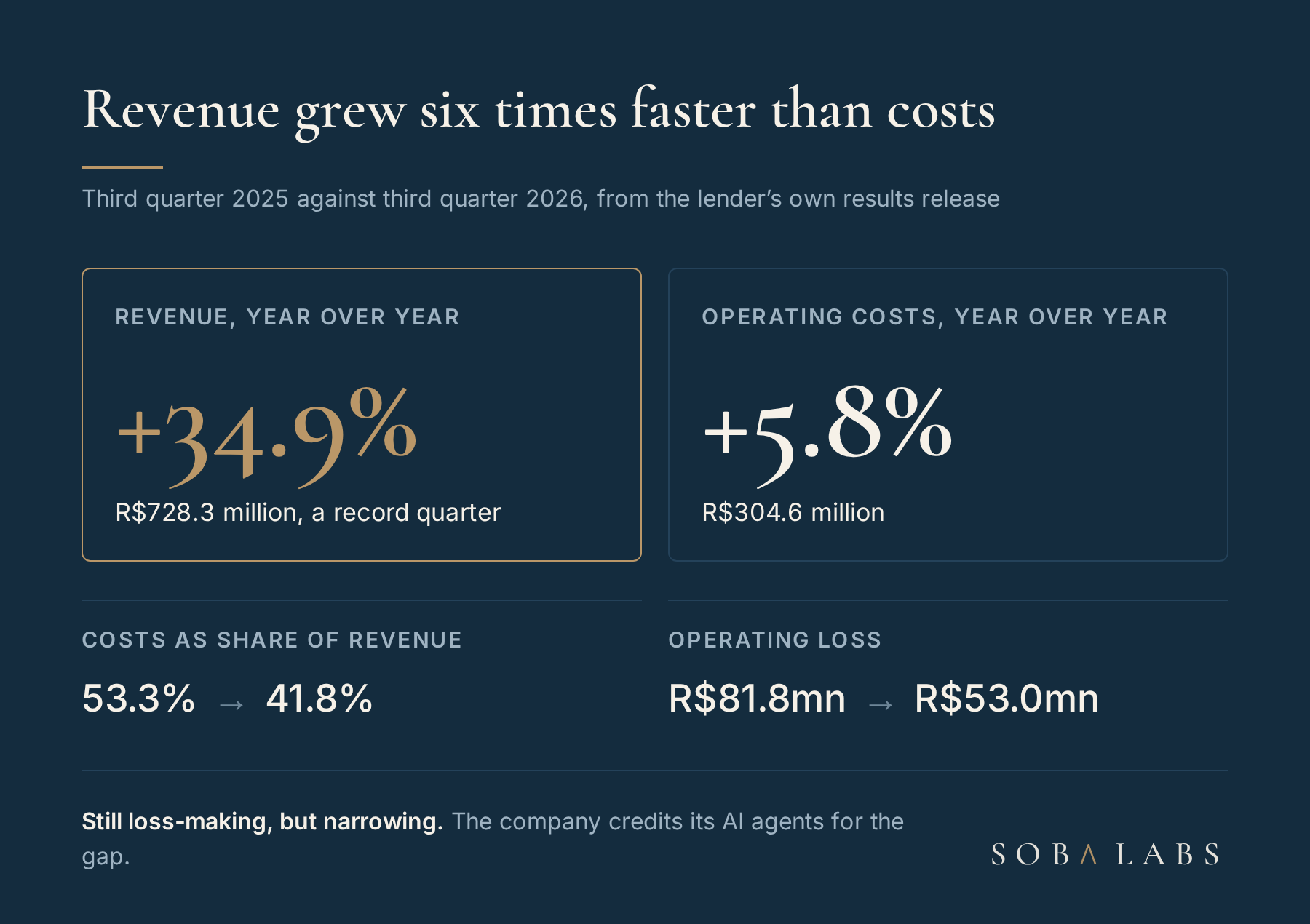
The figures come from Creditas’s third-quarter 2026 results, published on October 29. Revenue reached a record R$728.3 million, up 34.9% year over year, and the loan portfolio a record R$8.5 billion, up 26.8%. Operating costs and expenses were R$304.6 million, up 5.8%, which took them from 53.3% of revenue a year earlier to 41.8%.
That gap between revenue and cost is the whole story in one line. Revenue per employee grew 22% across all of 2025 and is now 68% above that full-year baseline, so the climb is speeding up rather than flattening. The release frames it as “AI deployments compounding into structural productivity gains, not only incremental efficiency.”
One sanity check on size. The same release puts annualized revenue above R$2.9 billion, and on our arithmetic R$2.9 billion over R$1.9 million per head is roughly 1,500 people. That is mid-sized by headcount, far from a global bank with a research lab, which is what makes the numbers worth studying.
What each agent does across the credit lifecycle
The release lists agents running in production across origination, underwriting, collections, customer service, back office and software development. Put next to the second-quarter release from August, the two quarters give a before and after for most functions.
| Function | Agent’s task | Q2 2026 | Q3 2026 |
|---|---|---|---|
| Collections, early | Chats with customers up to 30 days past due | 100% of early-stage chat contacts for Auto delinquencies | Fully on the agent at 1 to 30 days past due |
| Collections, later | Chats with customers 31 to 60 days past due | Not reported | 20% of volume |
| Customer service | First-line credit chat | Not reported | Fully AI-driven |
| Sales | Auto Equity offers and documents on WhatsApp | 20% coverage of Auto Equity origination | Fully automated origination ramping up |
| Underwriting | Auto Finance applications | Document agents above 90% accuracy | Over 50% processed automatically |
| Software | AI-assisted pull requests | 87% of merged code in July | 93% of all PRs in September |
The collections row has the cleanest measurement. In the second quarter the agent beat human operators on conversion and on customer satisfaction (CSAT of 4.5 against 4.0), and human handoffs fell from 25% to 12%, so 88% of conversations closed with no person involved. That is a conversational AI deployment measured against human operators on the same work, which is rare in a public filing. The sales agent carries the same kind of claim. In both quarters it out-converts human consultants in its target segments, and in the third quarter it handles identity, income and residence verification on WhatsApp end to end.
The underwriting row has the milestone. Document-processing agents above 90% accuracy, which is document AI applied to a loan file, enabled what the August release calls touchless credit decisions, and the first loan in Auto Finance was approved with zero human review on July 30. In the October release, the underwriting agent processes over half of Auto Finance applications automatically, with fewer manual touchpoints and shorter turnaround.
Most agents work queues, and one now approves loans
Five of the six rows are a queue a person used to work: a chat waiting for an answer, an overdue account waiting for a reminder, a pull request waiting to be written. That is the pattern we saw in C.H. Robinson’s freight agents, where narrow agents took over quoting and order entry one task at a time. Coverage widens gradually. Collections beyond 30 days past due is at 20%, and the sales agent’s claim to beat consultants is limited to its target segments.
Underwriting is different in kind. An Auto Finance application approved with no human review is a credit decision made by software, and that is the row a risk committee should read first. Most companies will want a human in the loop on approvals for some time, so the honest design question is which applications may skip that person.
What to notice: the 31 to 60 day band opened only after the first 30 days were fully on the agent.
The software numbers are the part most companies skip
The least discussed line in the release is about engineering. AI-assisted pull requests were 93% of all PRs in September, PRs per active developer reached 19.3, almost double the 2025 monthly average, and median commit-to-merge time held at 3.9 hours. The second-quarter release had 9.9 PRs per developer in March and 16.4 in July.
The number that makes this credible is the failure rate, reported below 1%. DORA’s metrics guide defines change fail rate as the “ratio of deployments that require immediate intervention following a deployment,” and the same guide notes that its research has repeatedly shown speed and stability are not tradeoffs. Nearly doubling output per developer at a failure rate below 1% is what you would hope a coding agent does, and seldom see published. The release does not say what the rate is counted against, so treat it as an internal measure.
The agents are built in house, so the same engineers who ship those changes also build the next agent. Faster delivery shortens the time from a new queue to a working agent, which is why this line belongs in a business review and not only in an engineering one.
What the release does not claim
Three caveats keep this honest.
First, the business is still loss-making. The third-quarter operating loss was R$53.0 million, against R$81.8 million a year earlier and R$33.7 million in the second quarter, and the net loss was R$108.4 million, which the release attributes mainly to non-cash accounting adjustments. Productivity is improving faster than profit.
Second, the headline says the cost base was flat. The release’s own highlights put operating costs up 5.8% year over year and down 0.2% quarter on quarter. “Essentially flat” against 34.9% revenue growth is fair, but it is not zero.
Third, nothing in either release isolates AI’s share of the gain. Revenue per employee also moves with the interest rate cycle, portfolio mix and the decision to keep collections, sales and technology in house rather than outsource them. Unlike the six insurers in our AI in insurance review, this release at least publishes per-function agent metrics beside the ratio. That is closer to proper AI ROI measurement than most public companies get, and still short of a cost per agent task.
Lending is where regulators look hardest at automated decisions
A lender in Europe or the United States copying this model inherits rules the Brazilian results do not discuss. The AI Act’s Annex III lists AI systems “intended to be used to evaluate the creditworthiness of natural persons or establish their credit score” as high-risk, so an underwriting agent sold or run in the EU falls in the high-risk tier of the EU AI Act, the strictest tier short of an outright ban. A collections chat agent is not named in that line; a scoring step is.
In the United States, the CFPB’s Circular 2022-03 says creditors may not use complex algorithms when that means they cannot give specific and accurate reasons for a denial. Announcing the bureau’s 2023 guidance on AI credit denials, now on its archive, CFPB Director Rohit Chopra put it in one line: “There is no special exemption for artificial intelligence.”
None of this is new to banks. The Bank for International Settlements notes in its FSI Insights paper on regulating AI in finance that machine learning has been used for many years in credit underwriting, and warns that heightened model risk “can be caused by lack of explainability of AI models.” That is why model risk management teams will ask for every agent’s inputs, outputs and reasons. An agent audit trail for each decision is the artifact that answers them, and it is far cheaper to build in from the first release than to rebuild later.
Fully automated decisions are still rare in finance
For scale, the Bank of England and FCA’s 2024 survey of AI in UK financial services found 75% of firms already using AI, with 55% of use cases carrying some degree of automated decision-making. Of those, 24% were semi-autonomous, designed to involve human oversight for critical or ambiguous decisions, and only 2% of all use cases had fully autonomous decision-making.
Set against that survey, a loan approved with zero human review sits in the rarest category, two years later and in another market. The release describes an AI operating model built around that: agents built in house, one published metric per function, and coverage widened band by band.
What we would copy at a mid-sized company
Three things transfer to a company without a fintech’s engineering team.
Start with the queue you can compare against people. Collections is where an agent and a person do the same task side by side, so conversion, satisfaction and handoff rate can be compared directly, as the collections agent was. Measure the human baseline first. Without it, a 4.5 CSAT means nothing.
Make every write safe to retry. A sales agent that collects documents and updates records will hit timeouts. We saw exactly that building a production AI SDR for Open Loyalty: a CRM write timed out, the agent retried, and one conversation produced two updates. The fix was an idempotency key per conversation and turn, separate decisions for model retries and tool retries, and a timeout case in the evaluation set. In lending, the duplicate is a second payment reminder or a second loan record, so this is not optional.
Track output per person by function. Revenue per employee is the headline, but it hides the mechanism. The useful numbers are the ones per queue: share of chats closed without a handoff, share of applications processed with no manual touch, PRs per developer at a stable failure rate. That is the same discipline we described in Bank of America’s AI math, where each project was costed before it shipped.
The agents earned their keep on the queues, one segment at a time.
The takeaway
A consumer lender of roughly 1,500 people runs AI agents across sales, underwriting, collections, service and software, and its revenue per employee is up 68% on 2025 with costs nearly flat. The release does not isolate AI’s share and the business is still loss-making, but it publishes per-function agent metrics most companies do not. If you run a credit, collections or service desk, start with the queue you can measure against people, make every write idempotent, decide deliberately which approvals may skip a person, and log every agent decision as if a regulator will read it.
Sources
- Creditas Financial Results Q3-2026, Creditas, 29 October 2026: revenue, portfolio, operating costs, revenue per employee, the agent milestones, software delivery metrics and losses.
- Creditas Financial Results Q2-2026, Creditas, 4 August 2026: the collections agent’s CSAT and handoffs, document agent accuracy, the first fully automated approval and July PR figures.
- DORA’s software delivery performance metrics, DORA, updated 5 January 2026: the definition of change fail rate.
- Annex III: High-risk AI systems, European Commission AI Act Service Desk: creditworthiness and credit scoring as high-risk.
- Circular 2022-03: adverse action notification requirements and complex algorithms, Consumer Financial Protection Bureau, 26 May 2022.
- CFPB issues guidance on credit denials by lenders using artificial intelligence, Consumer Financial Protection Bureau (archived), 19 September 2023.
- Regulating AI in the financial sector: recent developments and main challenges, BIS Financial Stability Institute, FSI Insights No 63, 12 December 2024.
- Artificial intelligence in UK financial services 2024, Bank of England and FCA, 21 November 2024.