

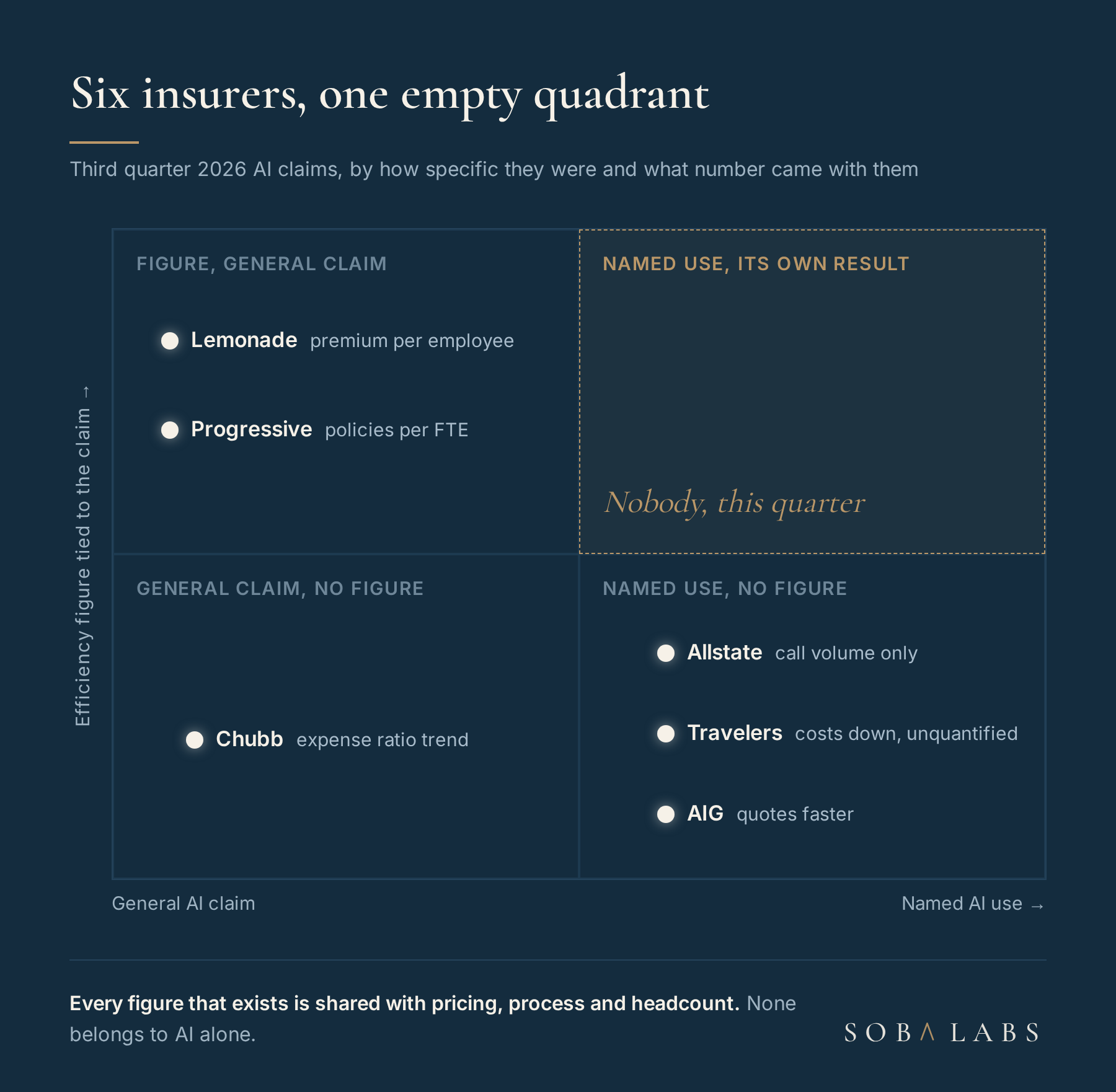
Six US-listed insurers reported their third quarter between October 16 and November 5, 2026, and every one of them talked about AI. None of them published a dollar or ratio figure that belongs to AI alone; the two that come closest, Lemonade and Progressive, report efficiency numbers that AI shares with everything else. FactSet found the same pattern across seven insurers a quarter earlier. Below is what each company said, the number it put beside it, how to tell disclosure from AI washing, and the measures a mid-sized company should demand from its own AI work before it repeats the industry’s sentence.
What six insurers said about AI in the third quarter
We read each company’s shareholder letter, earnings release or call transcript for the quarter and kept two things: what management claimed for AI, and the hardest number printed next to that claim.
| Insurer | Q3 2026 source | What it claimed for AI | The number beside it | AI’s share stated? |
|---|---|---|---|---|
| Lemonade | Shareholder letter, Nov 5 | Operating leverage powered partly by AI | 1,321 staff vs 1,371 in Q3 2022, premium up from $609M to $1,551M | No (“in part”) |
| Progressive | Call, Nov 3 | Dozens of advanced AI initiatives in production | Policies in force per full-time employee up over 10% | No |
| Allstate | Earnings release, Nov 4 | ALLIE expanded to millions of service calls | A call volume, no cost or outcome | No |
| Travelers | Call, Oct 16 | AI on attorney demands and long claim files | Unit costs named as down, none quantified | No |
| Chubb | Call, Oct 21 | Digital programs lowering the expense ratio | Expense ratio called lower, no figure for it | No |
| AIG | Call, Nov 4 | Underwriters review more submissions, quote faster | Expense ratio target below 30% for 2027, credited to operating leverage | No |
Read down the last column and the story is plain. Every company has generative AI in production somewhere, and every one keeps the result folded into a ratio that also moves with pricing, mix, headcount and plain process work. AI may well be working inside all six. From the outside, you have no way to check.
Lemonade shows the clearest operating leverage, and credits it partly to AI
The strongest numbers this quarter come from the smallest company. Lemonade’s shareholder letter puts it in one sentence: “Operating leverage, powered in part by AI efficiencies realized across the organization, is most clearly visible in the efficiency of our team.” The letter’s own chart sets 1,371 employees and $609M of in force premium in Q3 2022 against 1,321 employees and $1,551M in Q3 2026. On our arithmetic from those four figures, premium per employee went from about $444,000 to about $1.17 million, roughly 2.6 times in four years, with 3,520,555 customers at the end of September, up 23% on a year earlier.
The cost of handling claims moved too. In the letter’s gross loss ratio breakdown, loss adjustment expense (excluding prior period development) fell from 7 points of gross earned premium in Q3 2025 to 5 points in Q3 2026, while the gross loss ratio itself rose from 62% to 65%. Losses went up and the cost of processing them went down, which is the shape you would expect if claims handling is where automation bites.
Two cautions keep this honest. The letter credits AI only in part and gives no automation metric of its own: no share of claims settled without a person, no hours saved. And the company still posted an adjusted EBITDA loss of $20 million for the quarter. Lemonade has promised an update on its AI capabilities at its November 17 investor day, which is the date to watch for a number that belongs to AI.
Progressive counts policies per employee, not AI wins
Progressive is the largest writer here and the most careful. On the call, CEO Tricia Griffith said the company has made generative AI tools broadly available to staff and runs dozens of advanced AI initiatives in production, and set up an AI Strategy Council to look at the longer term. That is an AI adoption statement, and the number of initiatives is the weakest metric in it.
The figure she did give is better. Policies in force per full-time employee are up over 10%, which she offered as an example of efficiencies from technology and process work together. She also noted that Progressive has cut its non-acquisition expense ratio by about half a point a year for fifteen years. That second fact is the reason no outsider can isolate AI here: the efficiency trend predates generative AI by a decade, so any AI gain arrives on a line that was already falling. The transcript does not say over what period the 10% was measured.
Allstate, Travelers, Chubb and AIG name the tools but not the result
The other four are specific about where AI works and silent on what it earned.
- Allstate’s release says its language model platform, ALLIE, now handles millions of service calls, with more capabilities planned for early 2027. That is a throughput figure. It says nothing about cost per call, resolution rate or how many calls still reach a person.
- Travelers described AI that reads claim files running to hundreds of pages and sharpens responses to claimant attorneys, a textbook document AI use. On its call, CEO Alan Schnitzer listed unit cost of software development, labor cost at first notice of loss and cost to service a policy as all down, with no figure for any of them.
- Chubb’s CEO Evan Greenberg said on its call that the operating expense ratio keeps falling as its digital transformation programs and other efficiencies appear, across underwriting, marketing, claims, finance and sales. The global property and casualty ex-CAT combined ratio was 81.8%, essentially flat on the year, with a lower admin ratio offset by a higher acquisition ratio.
- AIG’s CEO Eric Andersen told analysts its underwriters are reviewing more submissions and generating quotes faster, and that Claims Assist helps adjusters respond faster. AIG is also uniting its technology, data, digital and AI teams into one organization. Its expense ratio is expected at about 30.5% for 2026. Asked how its target of a general insurance expense ratio below 30% in 2027 splits, the CFO pointed to operating leverage and core expenses, not to AI.
Each of these is a credible intelligent automation story told without its last line. Reading them, you learn where to look, and nothing about what to expect.
What is meant by AI washing?
AI washing is claiming more for AI than the AI does, whether that means saying you use it when you do not or crediting it with results it did not produce. The term has a regulator’s weight behind it. On March 18, 2024, the SEC settled charges against two investment advisers, Delphia and Global Predictions, for false and misleading statements about their use of AI, with $400,000 in total civil penalties. SEC Chair Gary Gensler put it in one line at the time: “Such AI washing hurts investors.”
The case closest to an operating business came in January 2025, when the SEC settled with Presto Automation, a restaurant technology company, over its drive-thru voice product. Presto had claimed the product eliminated the need for human order-taking; the SEC found the vast majority of orders required human intervention, and that the reported rate of orders completed without a person was misleading. The lesson for anyone writing an AI claim is narrow and useful. The share of work that still needs a human in the loop is a number, and leaving it out is where claims go wrong.
None of the six insurers above did what Presto did. They avoided the problem by not attributing a number at all. Our AI washing entry carries the questions that separate the two in a vendor pitch.
Why insurers will not isolate the AI number
The real reason: attribution is hard, and a public company that cannot prove a split will not print one.
Travelers said it most directly. Schnitzer told analysts the company is confident it gives underwriters better insights, but that it is hard to draw a straight line from those insights to the underwriting result, and that “the benefits that we cannot quantify are embedded in the results that we have.” FactSet’s review of second quarter calls reached the same verdict from the outside: across seven insurers, “management comments are more positioning than proof.” The one hard figure it found was a joint one, Travelers crediting AI and innovation together with a 0.5 point improvement in its business insurance underlying loss ratio.
Insurers already run model risk management for pricing and reserving models, so they know how to validate a model. What they have not done in public is the cheaper step of keeping a baseline for each workflow before the model arrives.
AI shopping agents are still a rounding error for insurers
One claim the quarter did test is the idea that AI agents are about to shop for insurance on a customer’s behalf. Griffith said that over the last few weeks Progressive saw agentic inbound interactions “representing a rounding error relative to our overall volume”, and mostly experimentation rather than real shopping intent. A Travelers executive on the same subject called the observable volume minor. Lemonade’s letter goes the other way, calling personal AI agents a potentially transformative shift in distribution.
All three can be true at once, with volume near zero and every carrier preparing anyway. We looked at the retail side of the same shift in who can buy through an AI agent today, and the agentic commerce pattern holds here too. The catalog and policy terms have to be machine readable before an agent can choose you, and that work is cheap to start now.
How to put your own AI in numbers
You probably do not face an analyst call, but you face a board, and it will ask the same question. Measure each workflow before it launches; a ratio read after the fact cannot be split.
When we review an agentic system before it goes live, our checklist refuses any headline claim that it is cheaper than the manual process unless two things exist: a measured manual baseline for that workflow, and the inference and tool cost of each step recorded from the first job. Without the first, the claim cannot be checked. Without the second, a pilot that still needs heavy human review plus full model cost often turns out dearer than the people it replaced.
In practice that means four numbers per workflow: volume, time or cost per item before, the same after, and the share of items that still needed a person. Lemonade’s loss adjustment line is close to the second and third. Presto’s missing number was the fourth. An AI business case built on those four survives scrutiny, and our AI ROI measurement entry walks through why hours saved are not the same as money saved. It is the approach behind Bank of America’s AI math, where each project was costed before it shipped, and it is where our AI readiness assessment starts.
The takeaway
The third quarter of 2026 shows insurers using AI in claims, underwriting and service at scale, and not one of six isolating what it earned. Lemonade’s premium per employee and loss adjustment line and Progressive’s policies per employee are the best public evidence, and both mix AI with everything else. Read the insurance numbers as a direction, not a benchmark, and hold your own projects to the standard the industry has not yet met: a baseline per workflow, cost per step, and the share of work that still needs a person.
Sources
- Lemonade, Q3 2026 shareholder letter (SEC filing)
- Progressive, Q3 2026 earnings call transcript (Stock Analysis)
- Allstate, Q3 2026 earnings release (SEC filing)
- Travelers, Q3 2026 earnings call transcript (The Motley Fool)
- Chubb, Q3 2026 earnings call transcript (The Motley Fool)
- AIG, Q3 2026 earnings call transcript (The Motley Fool)
- SEC, charges against two investment advisers for AI washing (March 18, 2024)
- SEC, settled order against Presto Automation (January 14, 2025)
- FactSet, insurance AI investments as qualitative comments vs quantitative drivers