
The holiday season that opened on 1 November is the first in which AI assistants can put an item in a cart and pay for it at named US retailers from Nike to Walmart, so the question for a retailer is no longer whether agents shop but which ones it lets through. As of 2 November 2026, Google, Microsoft, Meta and Perplexity all run checkout inside their assistants, Walmart has published rules for outside agents and is opening an MCP gateway to them, and Amazon blocks them. Below is each assistant’s checkout, each big retailer’s stance and the market figures behind them, every one fetched from its published source today, followed by the three positions a mid-sized retailer can take before Black Friday on 27 November.
Four assistants can complete a purchase today
Agentic commerce stopped being a demo this year. What separates the assistants is who stays the seller and who holds the card.
Google is furthest along. On 15 October it launched Universal Cart, a cart that collects products from many stores and that, in Google’s words, “is rolling out in the U.S. across Google Search and in the Gemini app”. Checkout runs on Google Pay with merchants such as Nike, Sephora, Target, Ulta Beauty, Walmart and Wayfair, or the cart is handed over to the merchant’s own site, and either way the merchant remains the seller of record. Underneath sits the Universal Commerce Protocol, which Shopify describes as the open standard it co-developed with Google, backed by Walmart, Target, Visa and Mastercard among others.
Microsoft opened Copilot Checkout in January on Copilot.com, with PayPal, Shopify and Stripe as the activation partners. The line every Shopify merchant should read twice: “Shopify merchants will be automatically enrolled following an opt-out window.” If you sell on Shopify and did nothing, you are probably already for sale inside Copilot.
Meta’s Muse agent launched paying through Stripe’s Link, whose agent wallet generates a one-time-use card so the shopper’s real card number stays hidden, and Muse checks with the person before it buys. At Connect in September Meta added Walmart, Best Buy, Sephora, Ulta and Wayfair among others to the stores Muse can shop, plus Shop Pay and PayPal for payment. Perplexity’s in-chat checkout has run since November 2025 through PayPal’s Instant Buy, which keeps the retailer as merchant of record.
ChatGPT handed checkout back to the merchant
ChatGPT went the other way. On 24 March OpenAI said the first version of its Instant Checkout had not offered the flexibility it wanted, and it let merchants run their own checkout while it concentrated on product discovery, as TechInformed reported from OpenAI’s update. The same report notes OpenAI’s commerce documentation still lists Instant Checkout for approved partners, so the accurate reading is that it was scaled back. A ChatGPT shopper today mostly finds the product in chat and pays on the merchant’s site.
That is worth a second look from anyone who planned their agent strategy around one assistant. The best-known assistant scaled back its own checkout within months of launching it, which is the plainest argument we know for not wiring your catalog to a single assistant’s private format and accepting vendor lock-in at the checkout layer.
Walmart is opening a gateway; Amazon closed the door
The retailers split even harder than the assistants. On 21 October Walmart published three things at once: Agent Profiles, so a customer can authorize each agent separately in their account; the Walmart Agent Gateway, built on MCP and starting as a beta for companies and developers; and written terms for agents, covering Walmart and Sam’s Club. The profiles, due within a month, let a customer require approval for every purchase or set a spending limit, with $50, $100 or $200 as Walmart’s examples. The terms are blunt: purchases need customer approval by default, agents never receive card details, and agents that break the rules are blocked.
Amazon is at the other end. On Sunday 20 September, users of Meta’s Muse started seeing an error when they tried to buy on Amazon, TechCrunch reported, reading “Continued access by an unauthorized AI agent violates Amazon’s Conditions of Use, to which our customers have agreed.” PYMNTS counts dozens of outside agents blocked while Amazon builds its own, and finds the middle ground occupied too: QVC lets agents complete purchases, Tapestry sells through Google’s AI tools but keeps agents off its own checkout, and when a shopper picks a Walmart item inside Gemini, Walmart’s own Sparky agent takes over the basket.
The checkout map for November 2026
Five assistants, measured only on what their makers or a named outlet published. A cell that is not public says so.
| Assistant | Checkout in the assistant | Payment rail | Who sells | Status |
|---|---|---|---|---|
| Google Search AI Mode and Gemini | Yes, Universal Cart | Google Pay | The merchant | Rolling out, US, from 15 Oct 2026 |
| Microsoft Copilot | Yes, Copilot Checkout | Activated through PayPal, Shopify and Stripe | The merchant | Rolling out, US, from Jan 2026 |
| Meta Muse | Yes | Stripe Link one-time card; Shop Pay and PayPal added | Not stated | Live since Sep 2026; blocked on Amazon |
| Perplexity | Yes, Instant Buy | PayPal | The merchant | Live, US, since Nov 2025 |
| ChatGPT | Mostly on the merchant’s site | The merchant’s own | The merchant | Scaled back 24 Mar 2026 |
The column that matters for a retailer is the fourth. Wherever the maker states it, the store stays the seller of record, which means the returns, the fraud losses and the customer service still land on you. Shopify’s March announcement makes the scale explicit: its Agentic Storefronts give merchants access to ChatGPT, Microsoft Copilot, AI Mode in Google Search and the Gemini app; PYMNTS adds that AI-driven traffic and orders to Shopify stores each tripled year over year in the second quarter.
How many shoppers actually let an agent pay
Fewer than the announcements suggest, and the numbers are worth holding apart. Adobe expects traffic from AI chat and browser services to US retail sites to rise 130% year over year between 1 November and 31 December, inside a forecast of $275.1 billion in US online sales, as PPC Land summarizes the release. That forecast counts clicks rather than purchases, and Adobe does not disclose the base it grows from.
The measured figures are smaller. L.E.K. Consulting’s April 2026 survey of 2,650 US consumers found that “Only 8% of AI users report having completed a purchase entirely through an AI agent without visiting a brand or retailer site.” The same study puts AI referrals at less than 0.5% of total inbound traffic to the brands it measured, growing at 176% a year, and finds 94% of AI users still validate the answer before they buy. PYMNTS counts about 61 million US consumers who start shopping research with AI, yet 59.7% of the most recent AI-assisted purchases still closed on Amazon’s own website.
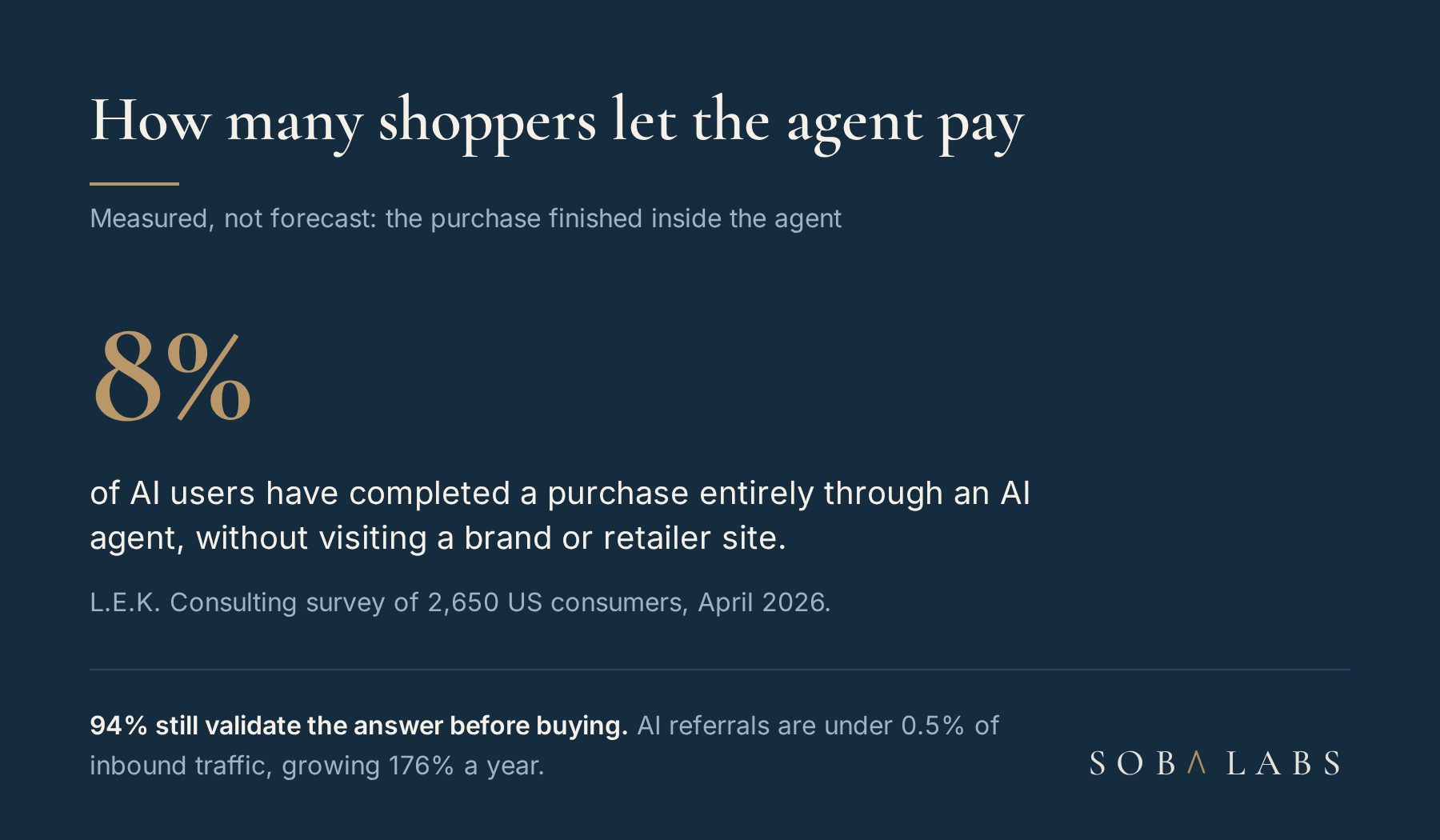
What the numbers say together: research has moved into the assistant, payment mostly has not. The traffic is growing fast from a small base, and the shopper who arrives from an assistant has usually decided already, which is why AI in retail now means being findable and buyable by software as well as persuasive to people.
Three positions a mid-sized retailer can take
The market has already produced every option, so you are choosing one that someone larger has tested.
Open, with rules. Walmart’s model: agents may buy, but each one is identified, scoped and capped. The pieces are agent identity (you know which agent is acting and for whom), agent authorization (what it may do, up to which amount) and agentic payments that never hand the agent a reusable card. You keep the sale and the customer; you take on the work of writing and enforcing terms.
Sell in the assistants, keep your own checkout. Tapestry’s and Walmart-in-Gemini’s model: sell where the assistant’s own checkout reaches you, or put your own agent in charge of the basket, but keep outside agents off your site’s checkout. You keep control of the site and much of the data; you accept the assistant’s rules and some drop-off at the hand-over.
Block. Amazon’s model, and it works for Amazon because it already holds the destination most AI-assisted purchases end at. For a mid-sized store, blocking agents mostly means the purchase happens somewhere else.
What we would do before Black Friday
Most of the work sits in the plumbing. First, find out where you already are: if you sell on Shopify, check your Agentic Storefronts and Copilot enrollment settings, because the default may have answered the question for you. Second, measure before you decide. We built a platform for Wojas, a Polish footwear retailer, that tracks where the brand is cited in generative answers and which competitors appear instead; within six months its GEO visibility rose from 2% to 23%. That is the first number to have, since an assistant can only sell what it can find; our guide to measuring GEO visibility shows how to build the prompt set behind it, and generative engine optimization is the discipline that moves it.
Third, if you open a gateway, treat it like any other production MCP server. An agent reading your product pages can also read text planted in a review or a listing, so prompt injection is a checkout risk now, and we covered the controls that hold up in MCP security in production. Keep a human in the loop above a spending threshold, the way Walmart makes approval its default and Muse asks before it buys. And if your agents are customer-facing rather than shopping-facing, the vendors in the top 5 AI customer service agents are where the same rules get enforced after the sale.
The takeaway
On the figures published by 2 November 2026, four assistants complete purchases inside the chat, ChatGPT scaled its checkout back to the merchant, Walmart is opening an MCP gateway with spending limits, and Amazon blocks outside agents. Only 8% of AI users have bought entirely through an agent, so this holiday season rewards being found and being buyable long before agents replace any storefront. Check what your platform enrolled you in, measure where assistants cite you, and pick open-with-rules or keep-your-checkout deliberately, because wherever the assistant names a seller of record, it is you, and so are the returns.
Sources
- Making it possible for agents to shop on behalf of customers, Walmart, 21 October 2026: Agent Profiles, the Agent Gateway on MCP, the spending-limit examples and the terms for agents.
- Meta’s AI agent has been blocked from using Amazon.com, TechCrunch, 21 September 2026: the Muse block and Amazon’s error message.
- AI agents knock; retailers decide how wide to open the door, PYMNTS, 5 October 2026: the QVC, Tapestry and Amazon positions, Sparky in Gemini, the 61 million and 59.7% figures, Shopify’s AI traffic.
- Universal Cart launch, Google, 15 October 2026: the US rollout across Search and Gemini, the merchants and seller of record.
- Conversations that convert: Copilot Checkout and brand agents, Microsoft Advertising, January 2026: the US rollout, payment partners and Shopify auto-enrollment.
- Introducing Muse, Meta, 8 September 2026: checkout through Link’s one-time-use card and purchase approval.
- The biggest news from Connect 2026, Meta, 24 September 2026: the retailers added to Muse.
- PayPal and Perplexity launch Instant Buy, PayPal, 25 November 2025: in-chat checkout with the retailer as merchant of record.
- OpenAI refocuses ChatGPT shopping on discovery, TechInformed, 30 March 2026: OpenAI’s 24 March change to Instant Checkout.
- Agentic commerce momentum, Shopify, March 2026: Agentic Storefronts across ChatGPT, Copilot, AI Mode and Gemini.
- Adobe’s $275.1bn holiday forecast gets a correction, not new numbers, PPC Land, 16 October 2026: Adobe’s online sales and AI traffic forecasts for 1 November to 31 December 2026.
- Thanks to AI, consumers are arriving at brand and retailer sites ready to buy, L.E.K. Consulting, July 2026: the 8%, 94%, 0.5% and 176% figures from its April 2026 survey.