
Every helpdesk vendor now sells an AI agent, and the demos all resolve the same refund request. The bills tell you which ones companies actually chose. On Ramp’s card and bill-pay data of 28 October 2026, the top 5 AI customer service agents are Sierra, Intercom (now Fin), Zendesk, Gorgias and Freshworks, with Sierra paid by 34 percent of buyers. The metric is the share of businesses buying AI support software that paid each vendor in the past 12 months, fetched on 30 October 2026, with each vendor’s own published price and figures beside it. The sections below cover the ranking, how AI is used in support today, what each price unit charges for, and what this data cannot tell you.
How the ranking was built
Ramp, a corporate card and bill-pay platform, publishes vendor rankings per software category from what its customers pay, drawn from “more than 85,000 American businesses”. Its AI Support Bots page was last updated on 28 October 2026. The metric needs reading carefully, because it is a share of category buyers. Ramp defines it this way: “Adoption Rate measures the share of businesses that purchased from a vendor, out of all businesses that made purchases in that software category over the past 12 months.”
So Sierra’s 34 percent means 34 percent of the businesses that paid any AI support bot vendor. The category itself is small on this instrument, at 1 percent of businesses using any SaaS and 32nd among Ramp’s categories. We ranked on that one metric, and pulled every other figure in this post from the vendor’s own page or a named estimate, each with its date.
Sierra leads, and the enterprise tier is not close
| Rank | Vendor | Share of category buyers | Change on the year | Share of switchers | Share of first-time buyers |
|---|---|---|---|---|---|
| 1 | Sierra | 34% | up 4.1 points | 13% | 40% |
| 2 | Intercom (Fin) | 29% | down 5.7 points | 17% | 9% |
| 3 | Zendesk | 10% | up 2.0 points | 19% | 10% |
| 4 | Gorgias | 8% | down 3.5 points | not in top 5 | 17% |
| 5 | Freshworks | 6% | up 1.2 points | not in top 5 | 8% |
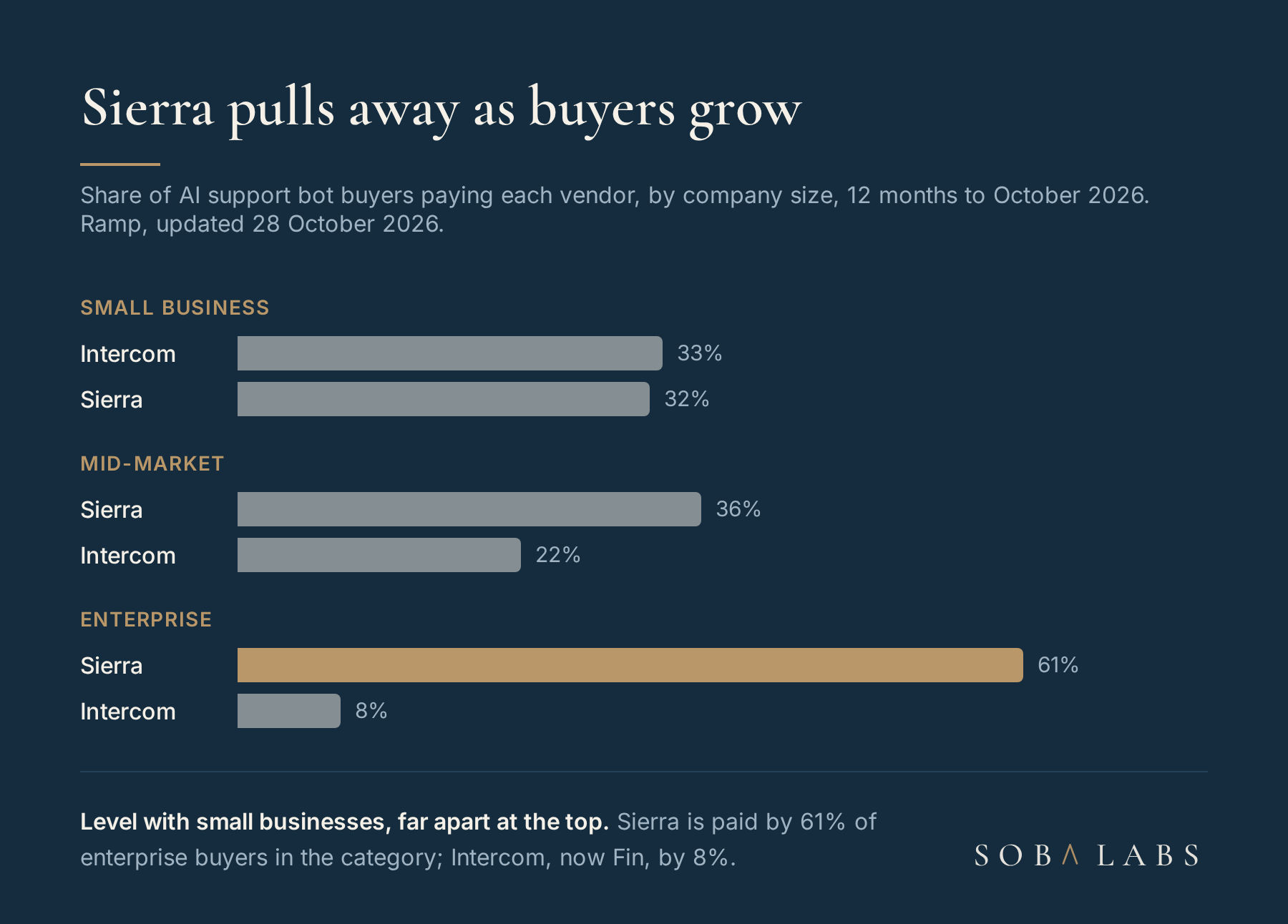
The top two are each paid by about three in ten buyers, and they won them in different places. Sierra is an enterprise vendor that also leads the mid-market: 61 percent of enterprise buyers on Ramp’s page and 36 percent of mid-market ones, against 8 and 22 percent for Intercom. With small businesses the two are level, Intercom at 33 percent and Sierra at 32. The yearly change comes from the page’s own data, and it runs Sierra’s way.
Sierra’s own numbers explain the enterprise column. In its May 2026 funding announcement, the company said it was raising $950 million at a valuation of over $15 billion and that “Sierra is serving over 40% of the Fortune 50”. Sacra estimates Sierra hit $200 million in annual recurring revenue in May 2026, up from about $130 million at the end of 2025. Below the top five the rows thin out fast: Drift, Tidio, Kustomer, PolyAI and Decagon each sit under 5 percent in the page’s full vendor list.
How is AI being used in customer service?
Widely, by the people who run support. Salesforce’s State of Service survey of 6,500 service professionals, published in November 2025, reports: “Service teams estimate 30% of cases are currently handled by AI.” The same teams project 50 percent by 2027. Those are self-estimates of a share of cases, a different measure from Ramp’s 1 percent of US businesses paying a dedicated AI support vendor, and both can be true at once. Some of that AI arrives inside software a team already runs: Zendesk, third on Ramp’s list, includes its AI agents in every Suite and Support plan.
In practice the work splits three ways. A chatbot or LLM agent answers routine questions from approved content (order status, returns, password resets). An agent with tool access completes actions such as a refund or a booking change, which is where conversational AI moves from answering to doing. And contact center AI assists the human team with routing, call summaries and suggested replies. The same three apply on the phone; what to automate there first is in voice agents in production.
Intercom is now Fin, and Fin is now Salesforce’s
The second row needs a note before you put it on a shortlist. According to Fin’s own page, Intercom, founded in 2011, rebuilt itself around its AI agent and changed the company’s name to Fin on 12 May 2026, while Intercom remains the name of its helpdesk. The same page says more than 12,000 companies use Fin’s products, that Fin resolves over 2 million conversations a week with a 76 percent average resolution rate, and that it has passed $400 million in annual recurring revenue. Those are the vendor’s own claims, and the 76 percent is an average across customers whose question mix you do not share. Ramp’s row still reads Intercom, so it may count helpdesk spend as well as the AI agent.
Then Salesforce completed its acquisition of Fin on 10 September 2026. Salesforce also sells its own AI agent platform, Agentforce, which has no row on Ramp’s page, so a Fin contract now sits next to an Agentforce one inside the same vendor. If you run support on a different CRM, ask what the next three years of Fin integrations look like before you sign.
The price unit is the real comparison
Fin, Zendesk and Gorgias publish a price per unit of AI work, and so does Salesforce for Agentforce. The units differ more than the numbers.
| Vendor | Billing unit | Published price |
|---|---|---|
| Fin | Outcome | $0.99 |
| Zendesk | Automated resolution | $1.50 committed, $2.00 pay as you go |
| Gorgias | Automated interaction past the plan limit | $1.50 |
| Salesforce Agentforce | Conversation | $2 |
Fin’s pricing counts an outcome when a customer confirms the issue is resolved, when “They don’t ask for more help after Fin responds”, or when Fin completes a workflow, including handoffs. It charges nothing if Fin cannot answer, fails an action, or the customer asks for a human. Zendesk’s pricing page bills the automated resolution, paid only for requests resolved “without any escalation to a human agent”. Gorgias puts its AI agent on every plan and charges per automated interaction past the included volume. Agentforce pricing lists $2 per conversation, or $500 per 100,000 Flex Credits for actions.
Here is the arithmetic for 1,000 customer conversations a month, assuming every vendor resolves the same 76 percent Fin claims. Fin bills 760 outcomes, about $752. Zendesk bills 760 resolutions, $1,140 committed or $1,520 pay as you go. Agentforce’s per-conversation rate comes to $2,000 for all 1,000. The assumption is generous and the comparison is rough, but it shows why cost per task belongs in the evaluation ahead of the list price.
The trap: an outcome-priced agent bills on its own definition of done. A customer who gave up also asks for no more help, and a workflow that ends in a handoff still counts. Sample those conversations before you trust the invoice.
The switching data says the leaderboard is still moving
Ramp also tracks which vendors companies move to when they leave another one, and the table above shows the answer is spread out: Zendesk takes 19 percent of switchers, Intercom 17 and Sierra 13. Sierra also took 40 percent of first-time buyers, more than twice the next vendor’s share.
Decagon is the row to watch. It sits at 1.3 percent of buyers yet takes 12 percent of switchers and is fifth on Ramp’s growth list, and its January 2026 Series D raised $250 million at a $4.5 billion valuation, with more than 100 new global enterprise customers in its fiscal year. A category where a vendor with 1 percent of buyers takes an eighth of switchers is unsettled, so price your exit into the first contract. AI vendor lock-in in support lives in the knowledge base, the workflow definitions and the conversation history, so make sure all three export.
The model market ran the same way. We ranked the labs on Ramp’s payment data in the AI vendors businesses actually pay for in 2026, where the lead changed hands within five months.
What we measure before a support agent goes live
The resolution rate on a vendor’s page is an average; yours is a number you set. The most useful control in a customer-facing assistant is a confidence gate. Below a threshold, the agent passes the conversation to a person with the context attached, an agent handoff the customer barely notices.
We built that for a patient education assistant, described in our Shen.ai case study. After tuning, about 15 percent of conversations went to human-in-the-loop review, clinicians judged about 80 percent of those escalations appropriate, and lowering the threshold from 0.8 to 0.7 cut unnecessary reviews by about 40 percent. Healthcare sets a stricter bar than a returns desk, and the lever works the same way in both. The escalation rate is a dial you set, and every point of resolution you buy above it is a point where a hallucination can reach a customer unreviewed. The five controls we use on agents like this are in LangGraph agents in production.
Accountability is the other half. A company answers for what its support bot tells customers, as Air Canada found when it argued otherwise; the ruling and the controls that follow from it are in who is accountable when an AI agent gets it wrong.
What a share of category buyers does not measure
The metric counts businesses that paid, and says nothing about how much. A company spending $50 a month on Gorgias and one spending a seven-figure sum on Sierra each count once, so none of these percentages is revenue share. The sample is US businesses on Ramp’s platform, and Ramp does not publish how it assigns a multi-product vendor’s spend to this category.
Use the ranking to calibrate an AI vendor assessment shortlist. Then measure AI adoption inside your own team by resolved tickets, whatever logo is on the invoice.
The takeaway
Ranked by the share of AI support bot buyers paying them in the 12 months to October 2026, the top 5 AI customer service agents are Sierra at 34 percent, Intercom (Fin) at 29, Zendesk at 10, Gorgias at 8 and Freshworks at 6. Sierra leads the enterprise and mid-market tiers and is level with Intercom among small businesses, and both leaders now carry bigger strategic questions: a $15 billion valuation for one, a Salesforce owner for the other. Compare vendors on the unit they bill and set your own escalation threshold before you sign, because a leaderboard this young will move again.
Sources
- Ramp: AI Support Bots vendor rankings, updated 28 October 2026
- Sierra: Better customer experiences, built on Sierra, 4 May 2026
- Sacra: Sierra revenue and valuation estimates
- Salesforce: State of Service report announcement, November 2025
- Salesforce: Salesforce completes acquisition of Fin, 10 September 2026
- Fin: What is Fin AI Agent
- Fin pricing
- Zendesk pricing
- Gorgias pricing
- Salesforce Agentforce pricing
- Decagon: Series D announcement, January 2026