
A marketing team asks a simple question: when a buyer asks ChatGPT, Gemini or Google’s AI Mode about our category, do we show up? Classic SEO reporting cannot answer it, because an AI answer has no position 1 to 10, only a set of brands it mentions and pages it cites. GEO visibility is the share of a fixed set of buyer questions where an AI engine mentions or cites you, measured per engine and beside your competitors, on a schedule. Below is what Google and Bing report for free, what the paid trackers measure and cost as of October 29, 2026, and how we built that measurement into a production platform for a retail brand.
GEO visibility is a share of answers, not a rank
Generative engine optimization is the work of making content an AI system will retrieve, trust and cite. Measuring it needs a different unit from SEO. A search result is a ranked list you can scrape once. An answer engine writes a paragraph, names some brands, links some sources, and may write a different paragraph for the same question an hour later.
So the unit is a prompt set: a fixed list of questions your buyers actually ask, run against each engine on a schedule. Every run produces three observations per question. Were you mentioned in the text? Was one of your pages cited as a source? Which competitors appeared instead?
Ahrefs, whose Brand Radar tool sells this measurement, defines the headline metric plainly: AI Share of Voice is the share of AI responses in your topic set that mention or cite your brand compared with competitors. That definition carries the two things that make the number honest. It is relative to a topic set you chose, and it is relative to competitors. A visibility figure without its prompt set is a number with no denominator.
The working definition: GEO visibility is the share of tracked buyer questions where an engine mentions or cites you, reported per engine and beside competitors.
Why your Google rankings do not answer the question
Existing search data answers only part of the question, for two reasons.
The first is the data itself. Google’s guidance for AI features says sites appearing in AI Overviews and AI Mode are counted in the overall search traffic and reported in the Search Console Performance report, within the “Web” search type. That is useful, because nothing is lost, but there is no separate line for them. Search Console shows impressions, clicks and queries; it does not tell you which of those impressions came from an AI answer or whether you were the cited source.
The second is that ranking well does not predict being cited. In its updated study of AI Overview citations, Ahrefs analyzed 863K keyword results pages and 4M cited URLs and found that 37.9% of the URLs cited in AI Overviews also appeared in the first 10 results. The rest split almost evenly between positions 11 to 100 and pages beyond the top 100. A strong ranking report can sit beside weak AI visibility, and the reverse.
Google’s own eligibility rule explains why SEO still matters as the floor. To be shown as a supporting link, “a page must be indexed and eligible to be shown in Google Search with a snippet,” and the same page adds “There are no additional technical requirements.” Classic search hygiene is the entry ticket; whether an engine cites you is a separate measurement.
Bing now reports citations directly, for free
The one engine that reports citations to site owners is Bing. Its AI Performance dashboard in Bing Webmaster Tools, announced on March 23, 2026, shows Total citations, Average cited pages, Grounding queries, page-level citation activity and visibility trends over time. A later addition maps grounding queries to the pages they cite.
Two things make it worth setting up before any paid tool. It is first-party data rather than a sample, and Microsoft argues the reach is wide: the announcement states that “Microsoft grounding powers nearly every major AI assistant in the market.” Take that as the vendor’s claim, but even read narrowly it covers Copilot and Bing’s own AI answers. The announcement says nothing about clicks, so treat it as a citation report, not a traffic report.
The practical gap it leaves is competitors. Bing tells you which of your pages are cited. It does not tell you who was cited when you were not.
What the AI visibility trackers measure and cost
Competitor share, mention text and cross-engine coverage come from trackers that run your prompt set through the engines and record the answers. The figures below were read from each vendor’s own page on October 29, 2026.
| Tool | What it measures | Engines covered | Starting price |
|---|---|---|---|
| Google Search Console | Impressions, clicks, queries; AI features folded into Web | Google Search, AI Overviews, AI Mode | Free |
| Bing Webmaster Tools | Citations, cited pages, grounding queries | Bing and Microsoft grounding | Free |
| Peec AI | Visibility, position, sentiment, share of voice, sources | ChatGPT, AI Mode, AI Overviews, Copilot, Gemini, Naver AI | $95/mo, 50 prompts, 3 models |
| Semrush AI Visibility Toolkit | AI Visibility Score, mentions, share of voice, sentiment | ChatGPT, Google AI Mode | $99/mo |
| Ahrefs Brand Radar | Mentions, citations, AI share of voice, estimated impressions | AI Overviews, AI Mode, ChatGPT, Perplexity, Gemini, Copilot | $199/mo |
| Profound | Mentions, citations, sentiment, ranking, competitors | Up to 9 engines on Enterprise | Custom; free 7-day trial |
Two differences matter more than the price. Who writes the prompts: Peec and Profound track the questions you give them, while Brand Radar also runs a prebuilt index it describes as 516 million search-backed prompts, which is broad but not necessarily your buyers’ wording. Which engines: Semrush’s toolkit names ChatGPT and AI Mode, Peec’s entry plan makes you choose 3 models, and Profound’s free trial covers ChatGPT, Gemini and AI Overviews. If your buyers live in Perplexity or Copilot, check the plan before you check the dashboard.
Build the prompt set before you buy a tool
The prompt set is the measurement: every tool above charts whatever questions you load, so the number’s quality is decided before the first run.
A prompt set that holds up has four properties:
- Buyer wording, not keywords. “Which waterproof winter boots last more than one season” is a question; “winter boots waterproof” is a query. Answer engines see the first. Your sales calls, site search logs and Search Console queries are the raw material.
- Coverage of the funnel. Category questions (“best leather shoes for work”), comparison questions (“brand A or brand B”) and brand questions (“is brand A good quality”) behave differently. A brand that wins only its own name is not visible.
- Named competitors. Decide up front which three to five rivals you compare against, so share of voice has a stable denominator.
- A fixed core. Add questions over time, but keep a core that never changes, or this month’s number cannot be compared with last month’s.
Answers vary from run to run because the engines retrieve and generate on each request, the same property that makes RAG systems hard to test. Run each question repeatedly and report the share across runs, not a single yes or no. Treat it like any other evaluation dataset: versioned, owned by someone, and reviewed when the business changes.
The four numbers that belong on one report
A GEO report earns its place when it leads to a content decision. We put four numbers side by side, per engine and per topic:
- Mention rate: the share of runs where the brand appears in the answer text.
- Citation rate, by URL: the share of runs where one of your pages is a source, and which pages.
- Competitor share: who is mentioned or cited on the questions where you are not.
- Classic search performance for the same topics: impressions and clicks from Search Console, citations from Bing.
The fourth line is what stops GEO from becoming a separate religion. Google’s guidance for its AI features points site owners back to fundamental SEO best practices, so a topic with weak search performance and weak AI visibility usually has one fix, not two. A topic with strong rankings and no citations points at the page itself: it ranks, but an engine does not find a clean, quotable answer in it.
On the traffic side, the engines that send clicks show up as referrals in your analytics, so segment sessions from the assistants’ domains and watch them beside the visibility trend. And check the crawlers before you blame the content: OpenAI’s crawler documentation states that “Sites that are opted out of OAI-SearchBot will not be shown in ChatGPT search answers”. A robots.txt line written years ago can zero out a whole engine.
How the Wojas platform went from 2% to 23% in six months
We built this measurement into production for Wojas, a Polish footwear and leather goods company, so the shape above is not theoretical. The platform monitors SEO and GEO visibility in one view, tracks citations, compares competitors on the same topics, and generates reports. Within six months, GEO visibility increased from 2% to 23%.
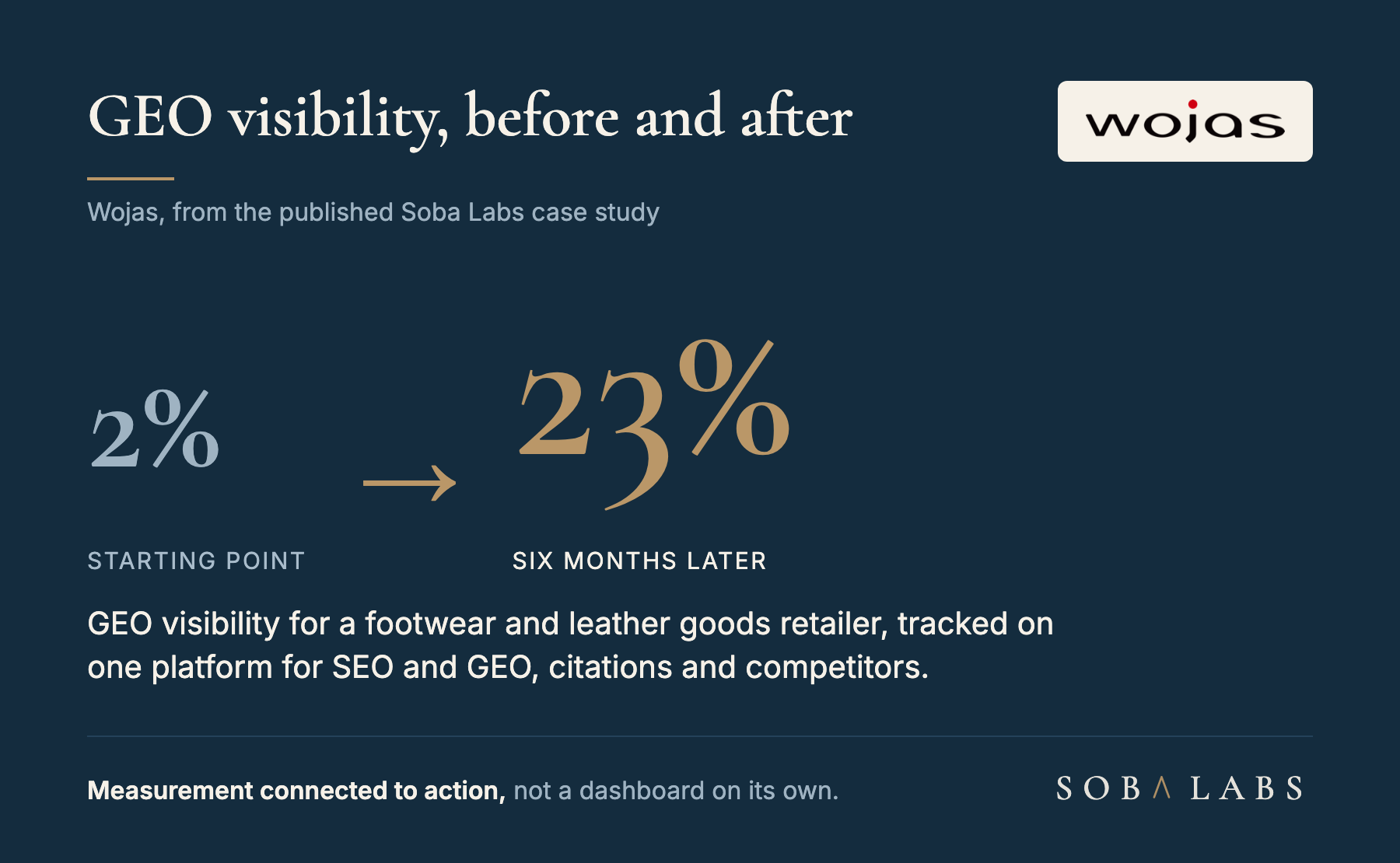
Three design choices did the work. First, classic search data sat beside generative visibility in the same report, so the team never had to reconcile two dashboards. Second, every report connected four questions: where Wojas appears, which competitors appear for the same topics, which citations and pages drive that, and what to do next. Third, an AI agent read the collected reports, citations and competitor gaps and proposed content and strategy changes, while the team kept a human in the loop to review each recommendation against brand priorities before anything was published.
That last point is the one we would repeat to anyone building this. Measurement alone gives you a chart. Measurement connected to a reviewable recommendation gives you a workflow automation loop a content team can act on, and that loop is what the four-month change came from. It is the same discipline we apply to AI ROI measurement in any project: the number is only useful if it changes a decision. This is our work in footwear retail, and the AI in retail pattern carries to any category where buyers ask an assistant before they visit a shop.
What GEO measurement cannot tell you
Be honest about the ceiling before the number reaches a slide.
- It is a sample. Trackers sample answers to your prompt set. A real buyer, phrasing it differently with their own history and location, can get a different answer. Fine for a trend line, wrong for one screenshot in a board deck.
- Citations are not clicks. Bing reports citations, Search Console blends AI features into Web totals, and many AI answers are read without a click at all. Visibility is an upstream signal of demand, not revenue.
- The engines change underneath you. Ahrefs reported a large drop in top-10 overlap between its first study and the update, partly from a new method and partly from a new model behind AI Overviews. Re-baseline after major engine changes instead of reading them as wins or losses.
- A cited summary can still be wrong about you. Engines compress sources, and hallucination does not stop at your brand name. Read the answer text, not just the mention count; we wrote about what AI summaries drop and why it cost us three times.
If you are choosing a tracker as part of a wider stack, our list of the AI vendors businesses actually pay for is the companion to the table above.
The takeaway
Measure GEO visibility as a share of a fixed, buyer-worded prompt set, per engine, beside named competitors, and next to the classic search data for the same topics. Start with the free first-party sources: Search Console for search performance, which already includes AI Overviews and AI Mode without separating them, and Bing Webmaster Tools for citations. Add a tracker from about $95 a month when you need competitor share and engines Bing does not cover. Then wire the report to a reviewed content decision, which is what took Wojas from 2% to 23% in six months. If you want to know where your own team stands before building any of it, start with the AI readiness assessment.
Sources
- Google Search Central: AI features and your website
- Google Search Central: Get started with Search Console
- Ahrefs: 38% of AI Overview citations pull from the top 10
- Microsoft Advertising: the AI Performance dashboard in Bing Webmaster Tools
- OpenAI: Overview of OpenAI crawlers
- Peec AI pricing
- Semrush: AI Visibility Toolkit
- Ahrefs Brand Radar
- Profound pricing