
Freight brokerage runs on email. A shipper asks for a price, a carrier misses a pickup, a customer sends a tender with a PDF attached, and somebody has to read it and act. One of the world’s largest logistics providers has spent three years putting AI agents on exactly that work, and on October 28 it published what came back. Shipments handled per person per day in its North American truckload and LTL business are up more than 65% since the end of 2022, and its whole token bill runs under $2 million a year. Below is what the agents do, which part of the gain they can claim, and what a mid-sized company can copy without 450 engineers.
The result: 65% more shipments per person since 2022
The numbers come from C.H. Robinson’s third-quarter summary, published the morning of its earnings call. North American Surface Transportation, the truckload and LTL division, grew volume 3.5% year over year while the Cass Freight Shipment Index fell 0.3%, the fourteenth straight quarter it outgrew the market. In the same quarter, shipments per person per day rose more than 15%, and more than 65% since the end of 2022. The division ran a 40.3% operating margin, up 110 basis points.
The headcount side is in the call transcript, where the CFO put average headcount 10.4% below a year earlier. The two figures check against each other. Volume up 3.5% on 10.4% fewer people works out to 1.035 / 0.896, about 15.5% more shipments per person, which matches the reported “more than 15%”. So the same freight, and a little more, moved with noticeably fewer people.
The trend is not a one-quarter spike. A year ago, FreightWaves reported the same productivity measure at 40% above its end of 2022 baseline. It has added another 25 points in twelve months.
What the agents actually do on the quote desk
The work automated is unglamorous and high volume, which is why it pays. The newsroom has published counts for the agents one at a time since 2025, and read together they cover most of the life of a load.
| Agent | Task it took over | Published figure |
|---|---|---|
| Quoting | Customer-specific price quotes | 32 seconds per quote, over 1 million quotes (June 2025) |
| Orders | Reads emailed tenders and attachments, builds the order | About 90 seconds; 5,500 truckload orders a day; 600 hours saved daily (June 2025) |
| Appointments | Sets appointments | Over 3,000 a day across 43,000 locations (June 2025) |
| Missed pickups | Calls carriers, then a second agent decides the next step | 95% of checks automated; 350+ hours saved a day (January 2026) |
| Ocean and air quoting | Prices forwarding shipments | 80,000+ quotes for 3,600+ customers (October 2026) |
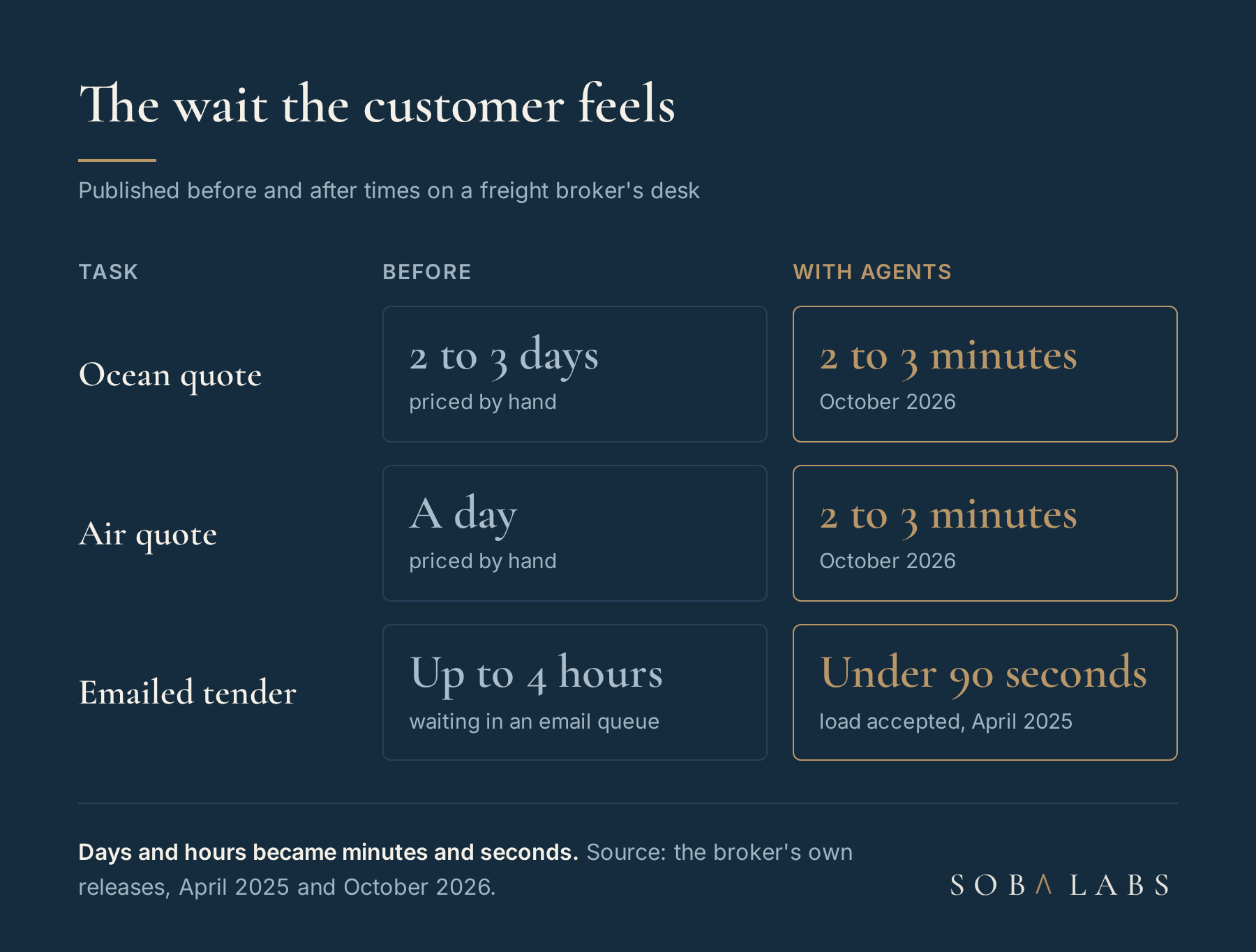
The first three rows come from the June 2025 announcement that the fleet had passed 30 agents at scale, the missed-pickup pair from a January 2026 release that also reports unnecessary return trips down 42%, and the last row from this week’s forwarding release on ocean, air and customs. That release carries the before and after in one line: “Quotes that used to take a day for an air shipment and two to three days for an ocean shipment now take two to three minutes.” On the customs side, time spent is down 23%.
Each row is a narrow agentic workflow with a trigger, a few tools and an output a person can check. None of it is a general assistant answering anything. The quarterly summary says a single shipping task can now require over a dozen agents working in tandem, which is what you get when you build narrow pieces and then chain them.
How is AI being used in customer service?
In freight, mostly by shortening the wait between a customer’s email and a committed answer. On the call, the CEO pointed to an agent that “responds significantly faster to transactional quotes received via email,” and ocean quoting was the example given for faster responses with less manual work behind them. An April 2025 release put the order side in customer terms: shippers that used to wait up to four hours for someone to reach their email in a queue were getting loads accepted in under 90 seconds, more than 5,200 of them.
Where the people went matters as much as where the time went. The transcript records that the productivity push significantly over-indexed operational roles rather than customer-facing ones, and that in many areas resourcing and headcount were added rather than reduced. The agents took over the queue, and the customer conversations stayed with people.
Pricing, not only AI, moved the margin
The caveat: the productivity number and the margin number have different causes, and the quarterly summary says so. Read only the margin and you will over-credit the agents.
The summary credits the quarter to disciplined revenue management, repricing much of the contractual truckload portfolio and capturing spot volumes at higher margins, alongside agentic workflows and the company’s Lean AI approach. The market helped too. MarketBeat’s call summary notes U.S. DAT spot rates excluding fuel rose about 37% year over year in the quarter, and Cass’s September report shows its truckload linehaul index up 10.1%. Truckload adjusted gross profit per shipment rose 17%, which is a pricing result first.
Our reading of the split: shipments per person is an operating measure, and the automation of manual steps per load (agents plus the lean process work around them) drives it. Margin is a financial measure, and pricing plus a tightening truckload market share it with that automation. The market backdrop is moving as well. FreightWaves’ read of the Cass data shows September shipments up 1.9% after 42 months of declines, so the volume gap against the index may narrow as the cycle turns. That makes the per-person figure the one to quote, and the one to track if you build your own. AI ROI measurement works at the level of the workflow. We made the same point about Bank of America’s AI math, where the number was credible because each project was costed before it shipped.
The token bill is a rounding error
The cost is the figure most people do not expect. The chief strategy and innovation officer, Arun Rajan, said on the call: “while our token usage has increased over 40x versus 2 years ago, our annual token cost on a run rate basis is still less than $2 million.” His reason was model choice per task: “We do not need the newest or most extensive model for every use case.” The company also says it is not dependent on any single provider.
Put that against the volume. This week’s forwarding release says the company manages 37 million shipments a year, and $2 million over 37 million shipments is under 5.5 cents of tokens per shipment, even if every one touched an agent. The same transcript reports $360.3 million of personnel expenses in the quarter alone. With model spend that small, the cost per task is set more by tool calls, retries and the hosting and monitoring around each agent than by the model price, and AI FinOps is worth doing mainly to keep that attribution clean as usage climbs 40x. The real spend here is the 450 engineers and data scientists who build the agents.
What we would copy at a mid-sized company
Three things transfer to a company with a tenth of the engineers.
Start at the inbox. Every agent in the table above begins with a message a person used to read: a quote request, a tender, a missed pickup. That is where AI in logistics and most B2B operations pay first, because the input is already digital and the output is checkable. We see the same shape outside freight. For Gamrat, a Polish pipe manufacturer, we designed an assistant for a sales team that prepares 30 to 50 offers a day, where a complex offer takes two to three days. The proposed pilot targets a draft within two hours, with every quoted price linked to an approved source. It is not deployed, and those are targets rather than results, but the bottleneck is the same gap between an email and an answer. Quoting is the first place we look in AI for manufacturing for the same reason.
Build narrow agents, then chain them. One agent per task was how the fleet grew from a few to what this week’s release calls hundreds. On the call, management said it has deployed a lot of agents for individual tasks and that stitching them together to automate entire workflows still leaves plenty of opportunity. Narrow pieces are also what make an agentic process automation program auditable, and the production controls are the ones we wrote up in LangGraph agents in production: explicit state, traces and idempotent writes, so a retried order is not a duplicate order.
Keep a person where the money moves. The agents were described on the call as having specific responsibilities, defined guardrails and human oversight, and the forwarding release says the customs time saved went to brokers’ validation and compliance steps. A human in the loop at the price and the commitment is what lets the rest run fast.
The agents earned their keep on the queue nobody wanted to work.
How far along they say they are
Not far, by their own account. “We have automated only a fraction of the hundreds of processes across the quote-to-cash lifecycle,” Rajan said in the quarterly summary. The forwarding release has the sharper admission: before agentic AI, about ten years of work achieved only about 5% automation of ocean and air booking requests, according to the CTO. Per the same release, booking agents launched in China in August, reach the rest of Asia in the fourth quarter and are expected to be live globally in early 2027. That candor is worth more than the headline. When a vendor promises end-to-end automation in a quarter, ask why a company with this many agents in production calls itself early.
The takeaway
On its own published figures, a freight broker that put narrow AI agents on quoting, orders, appointments and missed pickups now moves more than 65% more shipments per person than at the end of 2022, for under $2 million a year in tokens. In our reading, the margin gain is shared with pricing and a tight truckload market, while the productivity gain comes from automating the manual steps. Start where a person reads a message and types an answer, build one agent per task, keep a person at the price, and track shipments, orders or offers per person over the quarter’s margin.
Sources
- C.H. Robinson extends three-year run of market outperformance in Q3, C.H. Robinson, 28 October 2026: volume against the Cass index, shipments per person, NAST margin, the pricing credit and the automation-fraction quote.
- C.H. Robinson (CHRW) Q3 2026 earnings call transcript, The Motley Fool, 28 October 2026: headcount, token usage and cost, model choice, personnel expense and the role mix.
- C.H. Robinson Worldwide Q3 earnings call highlights, MarketBeat, 29 October 2026: DAT spot rates in the quarter.
- C.H. Robinson debuts Lean AI for ocean shipping, air freight, and customs, C.H. Robinson, 26 October 2026: forwarding quote times and counts, customs time, booking automation history and rollout, and the 37 million shipments.
- C.H. Robinson Lean AI agents for LTL pickup efficiency, C.H. Robinson, 26 January 2026: missed-pickup automation, hours saved and return trips.
- C.H. Robinson scales fleet of AI agents past 30, C.H. Robinson, 12 June 2025: the quoting, orders and appointments agents and their volumes.
- AI performs over three million shipping tasks, C.H. Robinson, 16 April 2025: order acceptance under 90 seconds against a four-hour queue.
- C.H. Robinson’s AI strategy boosts 2026 financial forecast, John Kingston, FreightWaves, 30 October 2025: the 40% productivity figure a year earlier.
- Cass Transportation Index Report, September 2026, Cass Information Systems, October 2026: the truckload linehaul index.
- Cass TL linehaul rates up 10% in September, shipment counts remain positive, FreightWaves, 13 October 2026: September shipments after 42 months of declines.