

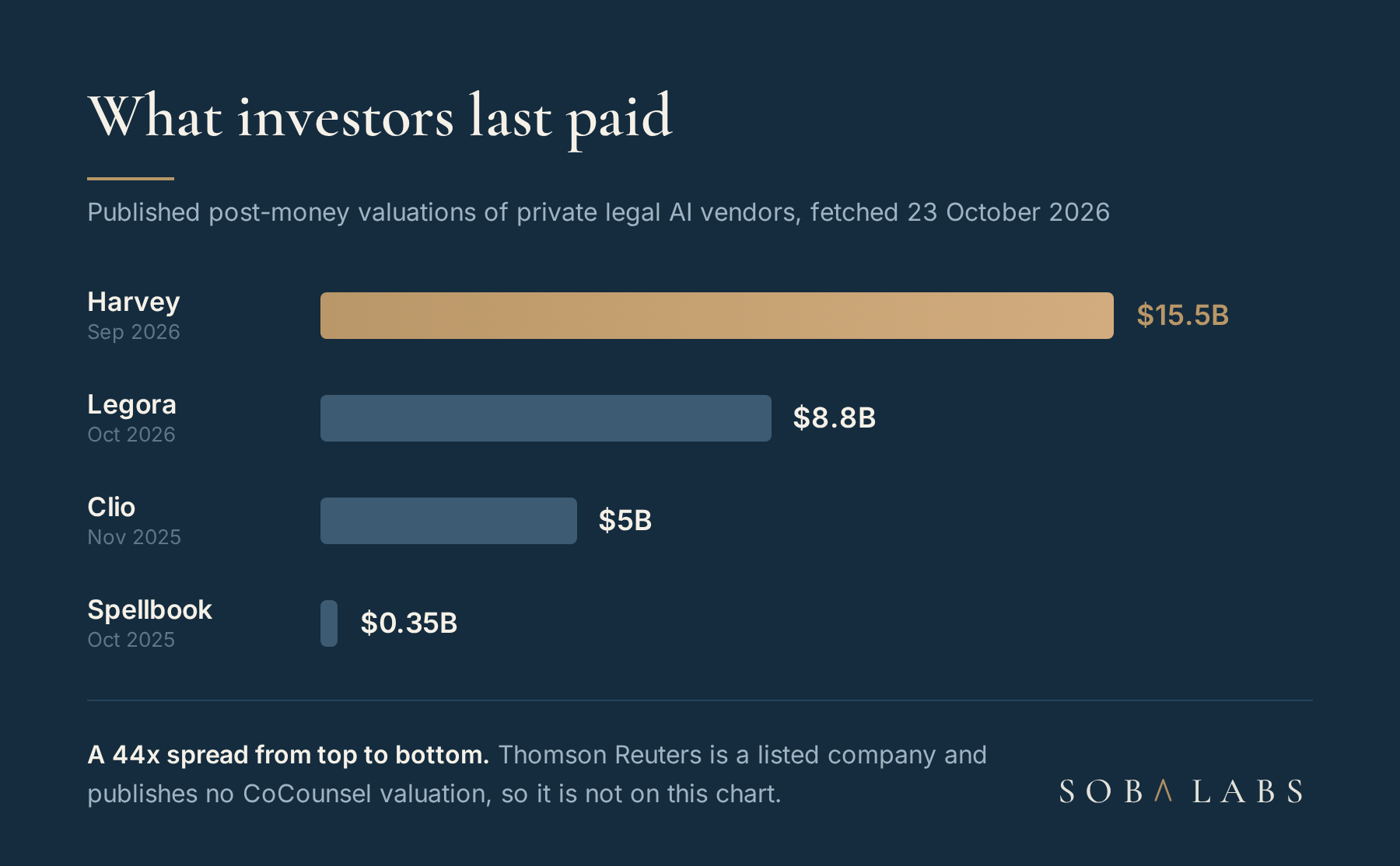
Legal work became the proving ground for AI adoption this year, and this week it produced another $550 million round. The figures behind the headlines are public, published by the vendors themselves and a handful of named outlets, and they tell a mid-sized buyer more than any pitch deck. Measured by what the vendors publish in October 2026, Harvey is valued at $15.5 billion, Legora at $8.8 billion after this week’s raise, Thomson Reuters’ CoCounsel reaches one million professionals, and Clio holds $400 million in recurring revenue. Below is each vendor’s published scale, money and reach, fetched from its source on 23 October 2026, with the caveats a careful buyer should carry before quoting any of it.
How this fact sheet was built
Every figure in this post was fetched on 23 October 2026 from the page that publishes it: the vendor’s own announcement where one exists (Harvey, Legora, Spellbook), Clio’s Legal Trends research, and named coverage where the primary page sits behind a bot wall (Thomson Reuters’ investor site refuses automated readers). Valuations here are prices investors paid in a funding round, not revenue; the gap between the two is the first caveat further down. The method is the same one we used to rank the AI vendors businesses actually pay for across every industry: published, checkable numbers over briefings. This sheet applies it to one vertical, because legal is where the money concentrated this quarter.
Harvey and Legora raised $550 million each, six weeks apart
Harvey announced a $550 million round at a $15.5 billion valuation on September 9, 2026, co-led by Diffusion and Lightspeed Venture Partners. Its announcement puts its reach at 80 percent of Am Law 100 firms and five of the Fortune 10. TechCrunch’s coverage adds the trajectory: more than $1.55 billion raised in total, an $8 billion valuation last December, $11 billion in March, so the company nearly doubled its price in about nine months.
Six weeks later, on October 21, Legora announced a $550 million Series E of its own at an $8.8 billion post-money valuation, led by Atreides Management, up from $5.6 billion at its previous round. The Stockholm company, founded in 2023 with its platform launched in October 2024, says it went from $1 million to $100 million of ARR in under 18 months and added the next $100 million in under six months; ARR now stands at more than $200 million, across more than 140,000 legal professionals at more than 2,400 law firms and in-house teams in over 80 markets. One line in the announcement matters most for anyone reading this from a company rather than a firm: “In-house legal teams, only a small fraction of Legora’s customer base a year ago, made up more than 40% of new customers in the third quarter.” The buyer of legal AI is no longer only a law firm.
The money is concentrating, not spreading. Artificial Lawyer’s read of Legal Complex data found $2.34 billion raised across 103 legal tech deals in the first quarter of 2026, with Relativity, Harvey and Legora alone taking “around 63%, or almost two-thirds of the total”.
The incumbents already own the seats
While the challengers raised, the incumbent published the number the challengers do not have. On February 24, 2026, Thomson Reuters said one million professionals are using its CoCounsel AI technology, and its shares rose more than 10 percent on the news. The same report puts those users across 107 countries and territories. CoCounsel is the genAI assistant wired into the Westlaw and Practical Law estate a large share of firms already rent, which is exactly why its user count dwarfs everyone else’s: distribution, not product velocity.
The other incumbent story is Clio, the practice management platform most mid-sized firms would recognize. In November 2025 it completed its $1 billion acquisition of vLex, the largest deal in legal tech history by LawSites’ account, and closed a $500 million Series G valuing the combined company at $5 billion, with $400 million in annual recurring revenue and a customer base of 400,000 legal professionals. That $400 million is the largest published ARR figure on this sheet, built on subscriptions from small and mid-sized firms rather than Am Law logos.
The vendor table for October 2026
Five vendors, measured only on what they publish. Where a cell is empty in public, the table says so rather than estimating.
| Vendor | What you buy | Published scale | Latest money |
|---|---|---|---|
| Harvey | AI research, drafting and workflows for large firms and in-house teams | 80% of Am Law 100; five of the Fortune 10 | $550M, Sep 2026 |
| Legora | An agentic workspace for legal professionals | 140,000+ professionals; 2,400+ organizations; $200M+ ARR | $550M Series E, Oct 2026 |
| CoCounsel (Thomson Reuters) | The genAI assistant across the Westlaw and Practical Law stack | 1 million professionals in 107 countries | Public company; no round |
| Clio | Practice management plus vLex legal research | 400,000 legal professionals; $400M ARR | $500M Series G, Nov 2025 |
| Spellbook | Contract drafting and review inside Microsoft Word | 5,000+ teams; 10M+ contracts reviewed | $50M Series B, Oct 2025 |
Spellbook is the small-team end of the market and the proof that the category runs deeper than the giants. Its own site counts 5,000+ in-house teams and law firms, and BetaKit’s funding report from October 2025 records a $50 million Series B led by Khosla Ventures at a $350 million post-money valuation, with more than 10 million contracts reviewed for nearly 4,000 customers across 80 countries. Most of this work is document AI at heart: reading, extracting from and drafting against contracts, filings and correspondence.
Four in five legal professionals use AI; the legal-specific share fell
Clio’s Legal Trends Report is the adoption survey the industry actually cites, and the Illinois Supreme Court Commission on Professionalism’s summary of the 2025 edition carries the headline numbers: 79% of legal professionals use AI, unchanged from 2024, with large firms at 87% and solo practices at 71%. The surprise is underneath: “only 40% of legal professionals are using legal-specific AI solutions, down from 58% in 2024.” Read those two together and about half of the lawyers using AI are doing it on general-purpose assistants rather than the vendors above, which inside a firm without an AI usage policy is shadow AI handling privileged material.
Adoption is no longer the question in legal; the question is which tool, on what data, under whose control. Clio’s own report for mid-size firms says the readiness gap sits in the plumbing: “Only 57% of mid-size firms have the cloud-based architecture necessary for full AI-integration.” Its own takeaways page says mid-size firms do not need to be sold on AI, only on which AI tool is right for them, and the falling legal-specific share says many have not found one worth switching to yet.
What the published numbers do not measure
The trap: reading a valuation as a verdict on the product. A valuation is the price one investor set for future revenue; CoCounsel’s million users and Clio’s $400 million ARR are measurements, Harvey’s $15.5 billion is a forecast someone paid for. The four numbers in the chart above are not the same kind of fact as the user counts in the table.
Pricing is the other hole in the public record. Harvey and Legora publish no prices at all. Thomson Reuters sells CoCounsel through an online plans configurator with no static published price. Spellbook’s pricing page is public but names no figure: “Pricing is determined by the number of team members on a license.” A buyer comparing costs in this market is comparing negotiated quotes, not list prices, so the cost side of any AI business case has to come from your own procurement round, not from this sheet. The questions the sheet cannot answer are the ones to put in that round: where matter data lives and under which jurisdiction (data residency), which frontier model sits underneath and what happens to your workflows when it changes, and what leaving costs after two years of accumulated prompts, templates and integrations (vendor lock-in).
How a mid-sized legal team should use this sheet
Three uses survive the caveats. First, segment the shortlist before comparing anything. Harvey and Legora sell to large firms and in-house departments, Clio to the business of running a practice, Spellbook to contract work in small teams; an AI vendor assessment that puts all five in one spreadsheet is comparing answers to different questions. The 40 percent figure above names the real competitor in most evaluations: the general-purpose assistant your people already use, which is free until a hallucination reaches a client.
Second, make verification mechanics the deciding criterion, because in legal work the failure mode is a confident wrong answer. The pattern holds outside law too: the sales-offer assistant we proposed for Gamrat, a Polish pipe manufacturer, is designed to show the source for each quoted price, mark anything it cannot verify, and route each gap to a salesperson instead of guessing. A legal tool earns trust the same way: answers grounded in retrieved source documents the way RAG grounds them, a citation on every claim, and a human in the loop before anything reaches a client or a court. Who answers for the output when it is wrong is a governance question to settle before rollout, and we walked through it in who is accountable when an AI agent gets it wrong.
Third, keep the exit open. The newest valuation on this sheet is two days old, the largest is six weeks old, the top three fundraisers took almost two-thirds of a quarter’s money, and an incumbent with a million seats is defending its estate. Whether you build or buy, assume the leaderboard you signed under will not be the leaderboard at renewal, and keep your documents, templates and evaluation data in a form you can take with you.
The takeaway
On the vendors’ own October 2026 figures, legal AI has a $15.5 billion leader in Harvey, an $8.8 billion challenger in Legora growing fastest with in-house teams, a million-user incumbent in CoCounsel, and a $400 million ARR mid-market consolidator in Clio. The adoption fight is over at 79 percent; the legal-specific share actually fell to 40 percent, so the open question is which tool earns the privileged work. Segment the shortlist, buy on verification mechanics rather than valuation headlines, and price the exit before you sign, because the leader’s price nearly doubled in nine months and the challenger’s rose by more than half in one round, and numbers moving that fast will move again.
Sources
- Harvey raises $550M at a $15.5B valuation, Harvey, 9 September 2026: the round, the Am Law 100 and Fortune 10 reach.
- Harvey hits $15.5B valuation months after reaching $11B, Julie Bort, TechCrunch, 9 September 2026: the total raised and the valuation trajectory.
- Legora raises $550 million Series E at $8.8 billion valuation, Legora, 21 October 2026: the round, ARR, customer and professional counts, the in-house share.
- Legal tech raised $2.3B in Q1 ’26, but 3 companies dominate, Artificial Lawyer, 13 April 2026: the Legal Complex quarterly funding data and the concentration figure.
- Thomson Reuters says one million professionals using CoCounsel, The Canadian Press via BNN Bloomberg, 24 February 2026: the user milestone and the share move.
- CoCounsel plans and pricing, Thomson Reuters: the online configurator with no static published price, fetched 23 October 2026.
- Clio completes historic $1 billion vLex acquisition, announces $500 million Series G at $5 billion valuation, Bob Ambrogi, LawSites, 10 November 2025: the acquisition, round, ARR and customer base.
- 2025 Clio Legal Trends Report summary, Illinois Supreme Court Commission on Professionalism, October 2025: the 79%, 87%, 71% and 40% adoption figures.
- Legal Trends Report for Mid-Size Law Firms, Clio, 2026: the 57% cloud-architecture figure and the which-tool takeaway.
- Spellbook: the 5,000+ teams count and the Microsoft Word positioning, fetched 23 October 2026.
- Spellbook pricing: the seat-based custom pricing statement, fetched 23 October 2026.
- Spellbook raises $50 million USD Series B led by Khosla Ventures, Alex Riehl, BetaKit, 9 October 2025: the round, valuation, contract and customer counts.