The defining feature is not a long model catalogue. It is a production path that can safely use at least two providers for stated reasons.
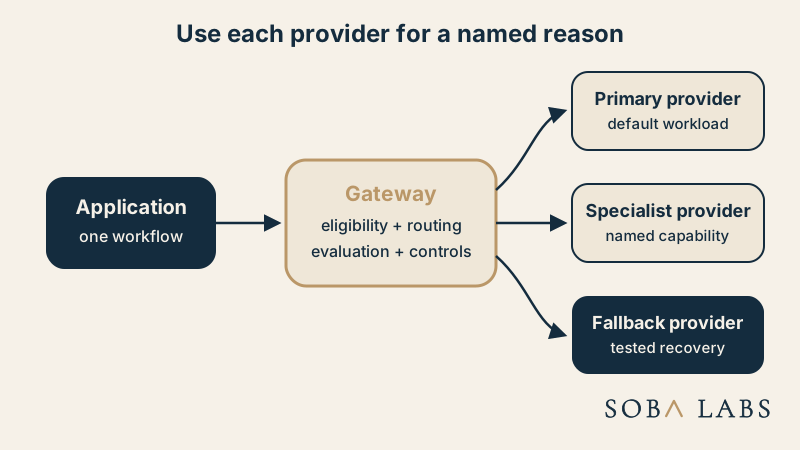
Use multiple AI providers only when each additional provider solves a named production requirement.
Why do teams adopt a multi-provider architecture?
One provider may have the strongest model for a specialist task while another has the required region, latency, or commercial terms. Multiple providers can separate capability choice from a single vendor relationship. They can also provide fallback capacity when the primary service fails, assuming the alternative meets the same policy and task requirements.
Some teams use model routing to send each request to the smallest eligible model. Others keep one primary route and activate a second only during a defined failure. Those are different operating models and need different tests.
What complexity does a second provider add?
Every provider brings credentials, contracts, data terms, limits, error behavior, observability fields, and model changes. The permanent cost is maintaining equivalent controls and evaluations across all active routes. A second integration that is never exercised is not a fallback.
Redundancy exists only when the alternate route is tested with production-shaped traffic. Shared cloud regions, upstream model hosts, or network paths may also create correlated failures.
How do teams keep the architecture manageable?
An LLM gateway can centralize authentication, routing, limits, logging, and provider adapters. Stable application contracts and a common evaluation set improve model portability. Keep business rules outside the gateway so provider changes do not rewrite the workflow.
Normalize only what applications genuinely share. Provider-specific tools or response features should remain explicit rather than hidden behind a lowest-common-denominator interface. Track quality, latency, cost, fallback rate, and policy compliance by route.
When is one provider better?
Use one provider when it meets the required capability, region, reliability, and cost target. A simpler system is easier to secure, observe, test, and support. Multi-provider architecture is justified when the second provider changes a business outcome or reduces a material risk.
Do not adopt it solely to claim independence. It can reduce one form of AI vendor lock-in while creating a new dependency on gateway logic and cross-provider operations. The right design is the smallest provider set that satisfies the system’s actual requirements.
OpenRouter’s provider-routing documentation illustrates how provider order and routing policy affect a multi-provider request path.