A traditional program follows a fixed script; a chatbot answers one message and stops. Agentic AI sits between the two: given a goal, not a script, it decides its own sequence of steps and adjusts each time it sees a new result. The loop looks the same across almost every implementation, shown below.
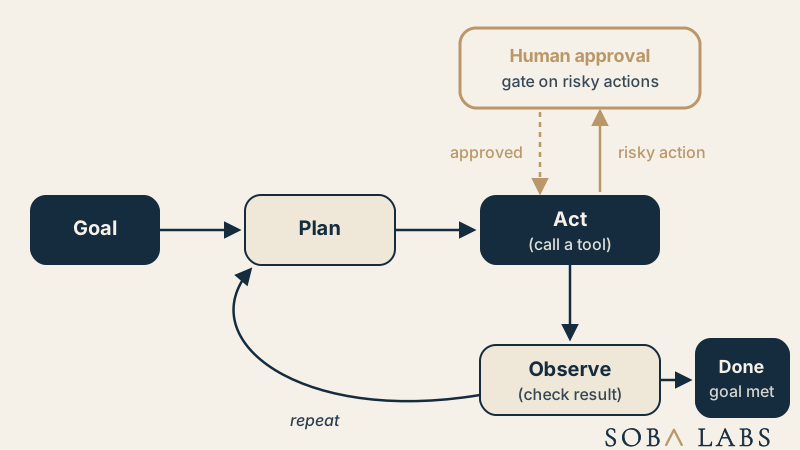
Agentic AI is not a smarter chatbot. It is software that finishes a task, checks its own work, and knows which steps need a person to sign off.
How does agentic AI actually work?
A model reasons over the current state and produces the next step, usually a tool call, a function, an API, a database write, often connected through MCP, the open protocol that standardizes how a model talks to external tools. The system executes the call, feeds the real result back, and the model decides whether the goal is met, whether to try again, or whether to stop and ask a person. That last branch, the human approval gate, is what keeps an agentic system safe against production systems.
Agentic AI vs AI agent vs automation: what’s the difference?
Automation runs a fixed script, no reasoning, fast but brittle the moment reality does not match it. An AI agent is one instance of agentic software built for a specific job. Agentic AI is the umbrella discipline both share. Shorthand: automation is a script, an AI agent is a worker, agentic AI is the discipline that builds workers instead of scripts.
When should a company actually build one?
Agentic AI earns its complexity on work too varied for a script but too repetitive to keep paying a person for: triaging inbound requests, reconciling records across systems that were never meant to talk. It is the wrong tool for a process that already runs the same five steps every time; that is what plain automation is for. It is also the wrong first project without clean, reachable data or appetite to review early output, since an agentic system with no feedback loop drifts, a failure mode covered in why self-reported confidence is not a reliable signal. Our AI readiness assessment scores exactly this question for one workflow before you commit engineering time.
What does it cost, and where does it connect?
Every plan-act-observe cycle is a model call, so a wandering agent burns real spend on cycles that move nothing forward; instrumenting that closely is how we halved our own agents’ token usage. Most real systems are not solo: an agent that adapts its own retrieval, deciding what to query and whether to retry, is running agentic RAG; larger workflows often split across several narrow agents coordinated by an orchestrator rather than one generalist trying to hold the whole task at once.