
The Python agent world gets most of the attention, but a large share of agents ship inside web applications, and those run on TypeScript. The npm registry is countable, so the popularity question has a factual answer. Measured by monthly npm downloads, the Vercel AI SDK leads TypeScript agent frameworks by a wide margin, followed by the Claude Agent SDK and the LangChain and LangGraph JavaScript stack. This post walks through the three frameworks that make that August 2026 ranking, the verified numbers behind each entry, and the reasons download counts both reveal and distort real adoption.
How the ranking was built
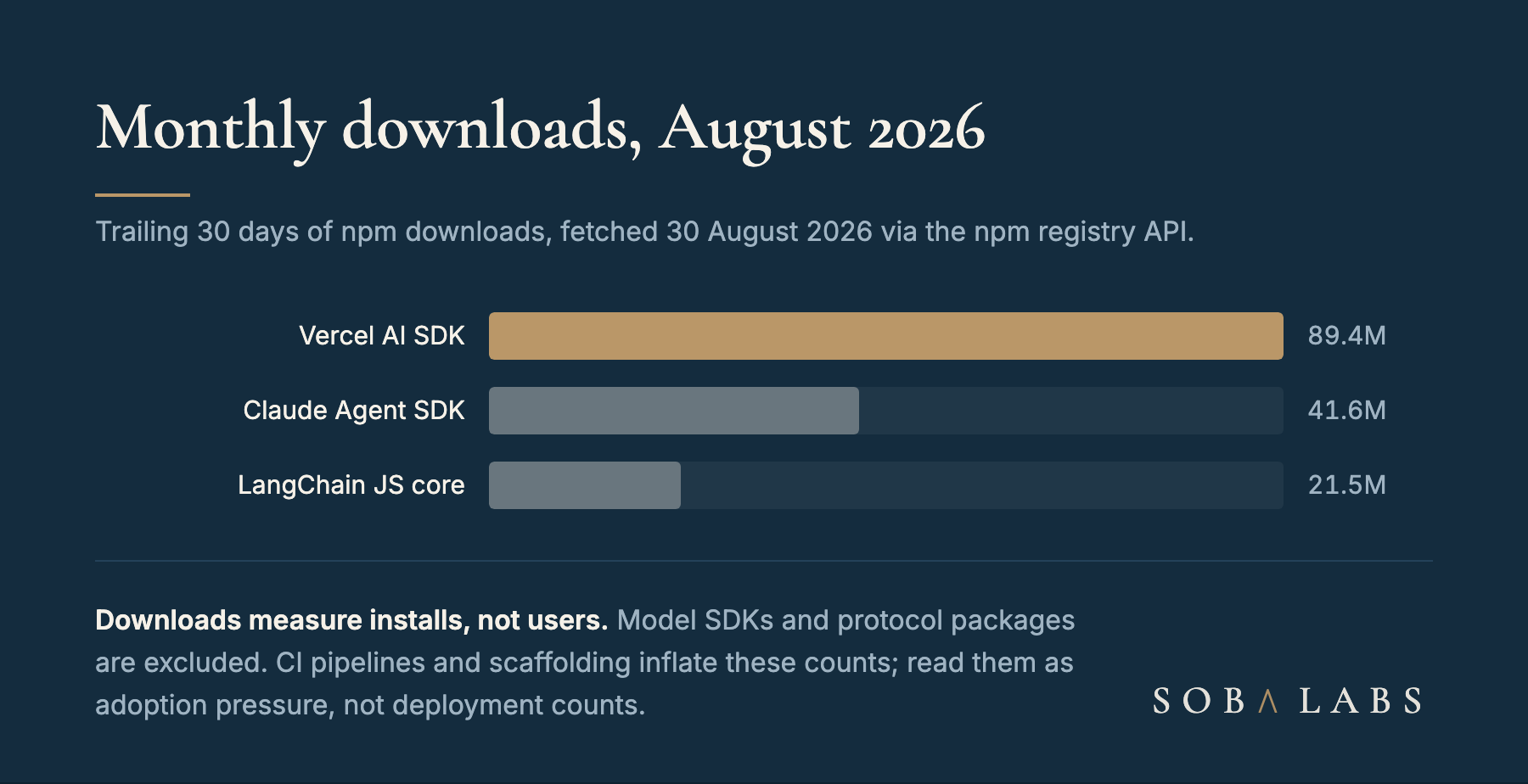
The numbers below are monthly npm downloads fetched on 30 August 2026 from the npm registry downloads API, covering the rolling 30-day window ending 29 August 2026. Every figure is the trailing 30-day count for that package, taken straight from the npm registry and nowhere else. GitHub stars serve as a secondary signal only.
The same scoping rule as any honest framework list applies: model SDKs are out. Packages like openai and @anthropic-ai/sdk are model clients, not agent loops, and several of them would top this chart on raw numbers. Everything listed below ships an agent loop, tool calling, or a full harness. Downloads measure installs, not users, and a framework pulled automatically by CI pipelines and scaffolding tools looks more popular than one installed once by a human. The caveats section at the end covers what the numbers hide. With that said, anyone who disagrees with us can check the ordering below for themselves, because it is not our opinion. It is the registry data.
1. Vercel AI SDK
The ai package recorded 89.4 million downloads in the last 30 days, more than double its nearest framework rival. Vercel describes it as “the TypeScript toolkit designed to help developers build AI-powered applications and agents with React, Next.js, Vue, Svelte, Node.js, and more” (AI SDK docs).
It earns a place on an agent-framework list because it stopped being only a chat-completion wrapper. The current major version ships a dedicated Agents surface with loop control, memory, subagents, tool approvals and MCP tool support. If your agents live inside a web application, this is the default choice, and the download lead shows that most teams did exactly that.
The limitation is the flip side: it is TypeScript first and web-shaped, so it competes only glancingly with the Python data-stack frameworks.
2. Claude Agent SDK
@anthropic-ai/claude-agent-sdk recorded 41.6 million npm downloads in the last 30 days, and it is the same harness that ranks fourth on the Python side. Per Anthropic’s docs, “The Agent SDK gives you the same tools, agent loop, and context management that power Claude Code, programmable in Python and TypeScript” (Claude Agent SDK docs).
That lineage is the whole pitch: built-in tools for files and shell, hooks, subagents, MCP connections, granular permissions, and sessions, the full Claude Code harness embeddable in your own process. The boundary is equally clear. It is Claude native by design, so teams running multi-model fleets treat it as one strong option rather than a default.
Its high download count against modest community buzz fits a pattern this list shows twice: a vendor embedding a package across its own tooling surface moves registry numbers more than forum threads do.
3. LangChain and LangGraph for JavaScript
@langchain/core recorded 21.5 million npm downloads in the last 30 days, with @langchain/langgraph adding 12.8 million more on top. The JavaScript stack mirrors the Python one: LangGraph is the runtime, LangChain the higher-level layer on top of it, and the two packages describe one ecosystem rather than two competitors.
The project’s own definition carries over directly: “LangGraph is a low-level orchestration framework and runtime for building, managing, and deploying long-running, stateful agents” (LangGraph JS docs). Teams that run Python services and TypeScript frontends get the same graph model on both sides, which is a real operational advantage when one product spans the two.
Just outside the top three
- OpenAI Agents SDK (
@openai/agents-core, 6.7 million): fourth place by a nose over Mastra. The docs open with a positioning statement that tells you exactly what it is: “The OpenAI Agents SDK for TypeScript enables you to build agentic AI apps in a lightweight, easy-to-use package with very few abstractions” (OpenAI Agents SDK JS docs). As in Python, the design is deliberately small and tuned for teams already committed to OpenAI models, which is why model-portable frameworks keep winning the teams it loses. - Mastra (
@mastra/core, 5.9 million, about 27,600 GitHub stars): the TypeScript-native full framework, and the sharpest illustration on this page that stars and installs measure different things. Mastra carries more GitHub stars than the Vercel AI SDK (about 26,500) and half again as many as LangChain JS (about 18,100), while shipping roughly a fifteenth of the AI SDK’s downloads. Its README states it plainly: “Mastra is a framework for building AI-powered applications and agents with a modern TypeScript stack” (Mastra on GitHub). Agents with memory and tool calling, deterministic workflows, RAG, evals and a local studio, built to deploy serverlessly. Where the AI SDK gives you primitives and expects you to assemble the loop, Mastra ships the opinionated structure, which is also its tradeoff. - Google ADK for TypeScript (
@google/adk, roughly 0.6 million): a distance behind every entry above it, and the honest reading is that this SDK is simply young. The framework behind it is not small: ADK is Google’s code-first agent framework in five languages, and per the docs “ADK can work with almost any generative AI model” (ADK docs). The Python edition does 20.5 million monthly downloads on PyPI, so read this package as an early bet on Google closing the gap across languages rather than a measure of current TypeScript adoption. - AG-UI (
@ag-ui/core, 6.5 million): more protocol than framework. It standardizes how backend agents stream state into frontend UIs, and its install count shows how much demand that bridge has. It is left out of the ranking by the same rule that excludes model SDKs: it is not an agent loop. - LlamaIndex for TypeScript (
llamaindex, 0.5 million): the JavaScript twin of the RAG-first Python framework, far behind its Python siblingllama-index-coreand its 15.7 million. - The Python giants with no npm story. CrewAI, the biggest Python name after LangChain, has no TypeScript SDK at all. If your team is TypeScript only, the Python rankings do not transfer package by package.
What the download numbers hide
Three distortions matter before you quote any of this:
- CI and scaffolding inflation. Every pipeline run and
npm createre-downloads packages. A framework embedded in templates and tutorials accumulates machine installs that no human ever intended. - Core-package bundling.
@langchain/coreis pulled in as a dependency of other installs, so it overstates standalone adoption. We ranked it as one ecosystem entry with@langchain/langgraphrather than two competitors. - Installs are not production deployments. No registry can tell you which frameworks run in production. Downloads say what people try; only your own traces say what works, which is the argument behind our write-up on scoring agent output with an LLM judge.
There is also a reason to be skeptical of any popularity-based choice, including this one. Popularity data is a starting point for a decision, never the decision.
How to actually choose
The ranking tells you what is safe to bet a career on. It cannot tell you what to build with, because that depends on three questions the registry does not answer:
- Where do your agents live? Inside a React or Next.js product, the AI SDK is the path of least resistance. Standalone agent services with their own state and workflows lean Mastra or LangGraph.
- How much structure do you want up front? Primitives you assemble yourself: AI SDK, OpenAI Agents SDK. An opinionated full framework: Mastra. A complete coding-agent harness out of the box: Claude Agent SDK.
- Which vendor gravity are you already inside? All-in on Anthropic or OpenAI makes their SDKs meaningfully cheaper to operate than neutral alternatives. The downloads do not price that in.
Pick the framework that matches your answers, then verify it against your own workload. The downloads only promise you will not be alone.
What we actually use
Our TypeScript work leans on the OpenAI Agents SDK and LangChainJS, which land fourth and third on this list. That is the honest takeaway of our own experience against the registry data: the frameworks a team uses daily are not automatically the most installed ones, and we are evidence of it. On the Python side, where most of our production agents live, we build on LangChain and LangGraph, written up in deep agents in production, and we are official LangChain Ambassadors and Experts; the ranking above is registry data rather than opinion, and where judgment entered, as in the protocol exclusion, the reasoning is stated so you can disagree with it explicitly.
Sources
- npm registry downloads API, package endpoints queried 30 August 2026
- Vercel AI SDK documentation, introduction
- Claude Agent SDK overview, Anthropic documentation
- LangGraph overview for JavaScript, LangChain documentation
- OpenAI Agents SDK for TypeScript documentation
- Mastra repository and README
- Google ADK documentation