
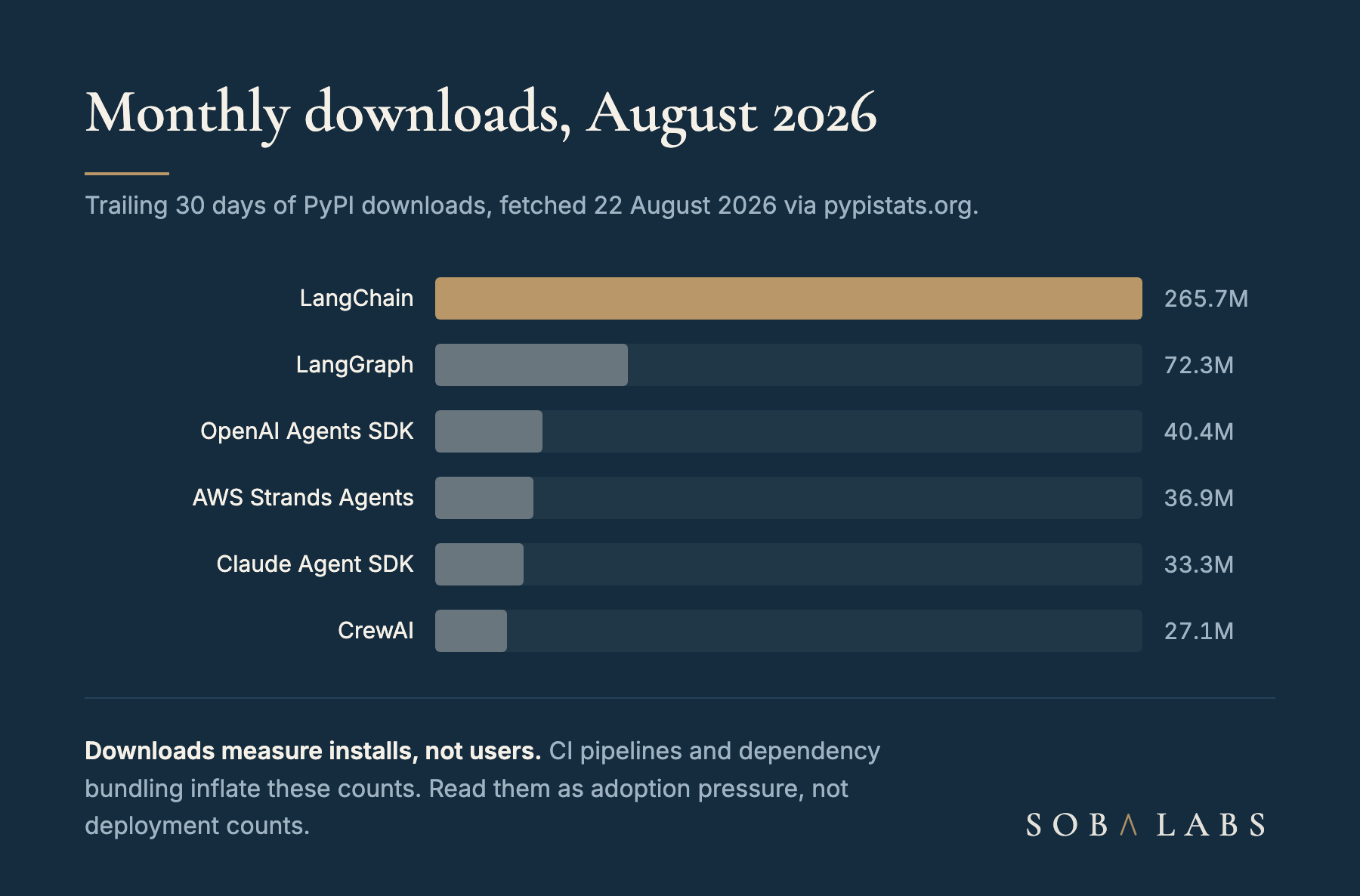
Every vendor claims its framework is the most popular way to build AI agents in Python. The package registry disagrees with all of them, and the registry is countable. Measured by monthly PyPI downloads, LangChain leads Python AI agent frameworks by a wide margin, followed by LangGraph, the OpenAI Agents SDK, AWS Strands Agents, the Claude Agent SDK and CrewAI. This post walks through the six frameworks that make that August 2026 ranking, the verified numbers behind each entry, and the reasons download counts both reveal and distort real adoption. The TypeScript side of the house is a different list with different winners, and it gets its own ranking.
How the ranking was built
The numbers below are monthly PyPI downloads fetched on 22 August 2026, from pypistats.org, which is operated by the Python Software Foundation from the official PyPI BigQuery dataset. Every figure is the trailing 30-day count for that package, taken straight from pypistats.org and nowhere else. GitHub stars serve as a secondary signal only.
One methodological note from the source itself: per pypistats.org, “All aggregate download stats ignore known PyPI mirrors (such as bandersnatch) unless noted otherwise.” So these counts exclude mirror traffic, which removes a large class of inflated numbers, though CI systems and bots remain counted.
Two scoping decisions shape the list. First, this ranking covers agent frameworks, so plain model SDKs are out: openai recorded 456 million monthly downloads and would top every chart, but it is a model client, not an agent loop. Second, the Claude Agent SDK is in, because unlike a model client it ships a complete agent harness, tools and permission model. The same rule excludes instructor, whose 24.3 million monthly downloads would otherwise slot seventh: it adds typed structured outputs to a model client, and it ships no agent loop. Downloads measure installs, not users, and a framework pulled automatically by CI pipelines looks more popular than one installed once by a human. The caveats section at the end covers what the numbers hide. With that said, anyone who disagrees with us can check the ordering below for themselves, because it is not our opinion. It is the registry data.
1. LangChain
Nothing else is close: the langchain package recorded 265.7 million PyPI downloads in the last 30 days, which is more than the other five frameworks on this list put together. GitHub agrees on the awareness side: the LangChain repository holds about 144,700 stars, the largest in the category.
It is the high-level layer: model and tool abstractions, and the integration surface that made it the default first install for anyone touching an LLM in Python. Since the 1.0 line it sits on top of LangGraph rather than beside it, which is why the next entry is less a competitor than the floor underneath this one.
The honest weakness is the same as the strength: it is the biggest target. Teams that outgrew early LangChain abstractions are vocal, and the breadth of that integration surface means you must know which layer you are actually using.
2. LangGraph
langgraph recorded 72.3 million PyPI downloads in the last 30 days, putting second place inside the same ecosystem as first. In the project’s own words it is “a low-level orchestration framework and runtime for building, managing, and deploying long-running, stateful agents” (LangChain docs).
Where LangChain hands you abstractions, LangGraph hands you the graph: explicit state, durable execution, checkpointing and human-in-the-loop interrupts. It is what teams reach for once a linear chain stops describing the problem.
Read this number with a caveat that applies to no other entry here. LangChain installs pull LangGraph in as a dependency, so some unknown share of those 72.3 million belongs to people who never chose it deliberately. The two are ranked separately because they are separately installable packages solving different problems, not because their counts are independent.
3. OpenAI Agents SDK
openai-agents recorded 40.4 million PyPI downloads in the last 30 days. OpenAI’s own positioning is refreshingly blunt: “It’s a production-ready upgrade of our previous experimentation for agents, Swarm” (OpenAI Agents SDK docs).
The SDK is deliberately small: agents, handoffs, guardrails, sessions for persistent memory, and built-in tracing. That minimalism is why it spread so fast. Teams already committed to OpenAI models get a production loop with almost nothing to learn.
The constraint is equally clear. Its deepest integrations assume OpenAI models, so teams that need model portability tend to look elsewhere, which is exactly the gap the next two entries are built to fill.
4. AWS Strands Agents
The newcomer with the most surprising number: strands-agents recorded 36.9 million PyPI downloads in the last 30 days, within reach of the OpenAI SDK despite its repository existing only since May 2025. AWS describes it as built “from production systems inside Amazon”, open sourced after internal use (Strands Agents), and it works with any model on any cloud.
That download count deserves a caveat of its own: the package is wired into AWS tooling and examples, which pulls automated installs, and its GitHub star count of about 7,000 is an order of magnitude below its download peers. Strands is either one of the fastest-growing agent SDKs in existence or the most machine-installed one. Probably both.
5. Claude Agent SDK
The quiet giant: claude-agent-sdk recorded 33.3 million PyPI downloads in the last 30 days, yet it rarely appears in framework comparisons. Anthropic’s docs subtitle it “Build production AI agents with Claude Code as a library”, and the overview states that “The Agent SDK gives you the same tools, agent loop, and context management that power Claude Code, programmable in Python and TypeScript” (Claude Agent SDK docs).
It was rebranded from the Claude Code SDK, and that lineage explains both its strength and its boundary. You get the full Claude Code harness: built-in tools for files and shell, hooks, subagents, MCP connections, granular permissions, sessions. The tradeoff is that it is Claude native by design; teams running multi-model fleets treat it as one strong option among several rather than a default.
Its high download count against modest community buzz fits the same pattern as Strands: a vendor embedding the package across its own tooling surface moves the registry numbers more than forum threads do.
6. CrewAI
crewai recorded 27.1 million PyPI downloads in the last 30 days and about 57,400 GitHub stars, second only to LangChain on the stars signal. CrewAI’s docs open with a direct claim: “CrewAI is the leading open-source framework for orchestrating autonomous AI agents and building complex workflows” (CrewAI docs).
Its identity is role-based multi-agent teams: you define agents with roles and goals, then compose them into crews, with an event-driven Flows layer underneath for deterministic structure. For teams whose mental model is literally a team of specialists, CrewAI is the shortest path, and the star count shows it owns that niche.
The tradeoff is architectural: the abstraction is opinionated, and teams needing fine-grained control of state and control flow tend to graduate to a lower-level framework.
Just outside the top six
- Google ADK (23.2 million): the closest miss, and the one most likely to climb. Google’s Agent Development Kit is code first and multi-language, available in Python, TypeScript, Go, Java and Kotlin, and it is not locked to Gemini: per the docs, “ADK can work with almost any generative AI model” (ADK docs). Sixteen months after its repository appeared in April 2025 it is already within striking distance of sixth place.
- LlamaIndex (
llama-index-core, 15.7 million monthly downloads): self-described as “the leading framework for building LLM-powered agents over your data” (LlamaIndex docs). It is the RAG-first option, and its agents sit on top of that data layer. - Pydantic AI (14.5 million): the typed, Python-native agent loop from the Pydantic team, now broadened into a full AI SDK. The fastest riser among the also-rans.
- DSPy (6.6 million) and LiveKit Agents (
livekit-agents, 4.9 million): DSPy rewrites prompts as programs and LiveKit owns voice agents, and both are real agent frameworks growing fast enough to threaten this list next quarter. - Microsoft Agent Framework: the consolidation of two earlier ecosystems. Microsoft’s docs state plainly that it “is the next generation of both Semantic Kernel and AutoGen” (Microsoft Learn). The legacy
autogen-agentchatpackage shows only 1.1 million monthly downloads, which tells you where that migration stands. - Agno (2.3 million downloads but about 41,800 GitHub stars): the clearest example in the category that star count and install count measure different things.
What the download numbers hide
Three distortions matter before you quote any of this:
- CI inflation. Every pipeline run re-downloads packages. A framework embedded in cloud tooling and tutorials accumulates machine installs that no human ever intended. This is the most plausible explanation for Strands’ high downloads against low stars.
- Ecosystem bundling. Core packages like
langchain-coreare pulled in as dependencies of other installs, so summing every package in an ecosystem double counts. We rank one installable package per entry and leave the shared core out of the list entirely, which is also why the two LangChain entries are not independent of each other. - Installs are not production deployments. A LangChain survey of 1,300+ practitioners (June 2026) found about 51% of respondents using agents in production, but no registry can tell you which framework those deployments actually run. Downloads say what people try; only your own traces say what works, which is the argument behind our write-up on scoring agent output with an LLM judge.
There is also a reason to be skeptical of any popularity-based choice, including this one. Popularity data is a starting point for a decision, never the decision.
How to actually choose
The ranking tells you what is safe to bet a career on. It cannot tell you what to build with, because that depends on three questions the registry does not answer:
- How much control do you need? Opinionated speed: CrewAI. Fine-grained state, human-in-the-loop steps and durability: LangGraph. Minimal loop you fully own: OpenAI Agents SDK. A complete coding-agent harness out of the box: Claude Agent SDK.
- Which vendor gravity are you already inside? All-in on AWS, Google Cloud, OpenAI or Anthropic makes Strands, ADK, the OpenAI SDK or the Claude SDK meaningfully cheaper to operate than their download ranks suggest.
- What does your team already read? A framework your engineers can debug on a bad day beats a marginally more popular one they cannot. That question outranks every number above.
Pick the framework that matches your answers, then verify it against your own workload. The downloads only promise you will not be alone.
What we actually use
Our own stack is why this post exists. At Soba Labs we build most of our production agents on LangChain and LangGraph, and reach for Pydantic AI or the OpenAI Agents SDK when a workload fits them better than it fits a graph. What that looks like in practice is written up in deep agents in production and context engineering in deep agents. Soba Labs are also official LangChain Ambassadors and Experts, so read the number one spot with that in mind. The download figures above are registry data and not our opinion, but the framing around them is ours, and the honest version of this ranking from a CrewAI or Strands shop might reorder the commentary while keeping the same numbers.
Sources
- pypistats.org, Python Software Foundation download statistics, package APIs queried 22 August 2026
- LangGraph overview, LangChain documentation
- OpenAI Agents SDK documentation
- Strands Agents documentation
- Claude Agent SDK overview, Anthropic documentation
- CrewAI documentation, introduction
- Google ADK documentation
- Microsoft Agent Framework overview, Microsoft Learn
- LangChain State of AI Agents report, June 2026