
Inside nine weeks this summer, OpenAI, Anthropic, Amazon and Microsoft each launched an organization that embeds engineers at customer companies to build AI for them, with roughly nine billion dollars committed between them. If you run a mid-sized company, the sales calls are coming, and the question under them is the oldest one in operations: rent the capability or grow it. Rent the embedded team when the calendar decides and build your own when the workload is yours for years, and judge every offer on one clause: who keeps the capability when the engagement ends. This post reads the four announcements, the salary data on both paths, and the question we ask before recommending either.
What is a forward deployed engineer?
A forward-deployed engineer is an engineer who builds inside the customer’s operation instead of at the vendor’s headquarters. The role comes from Palantir, which TechCrunch’s coverage of Amazon’s move credits with pioneering the model; Palantir’s own job listing says its engineers “embed themselves in the customer’s reality until the problem is theirs”, and warns candidates to expect 25 to 50 percent travel. The useful definition is narrower than “consultant with a laptop”. KDnuggets’ October analysis of the role draws the line in one sentence: “An FDE is defined by whether what they learn at the customer changes what the company builds next. Without that feedback loop, the role is consulting.” That piece also carries the demand curve: by April 2026, Indeed postings for the title were running 5,230 percent above their January 2025 level, about 729 percent higher than a year earlier, an index against a small base on a single job board rather than a headcount, as the piece itself warns. The phrase was a Palantir oddity three years ago. It is now a hiring category, which is why forward-deployed engineering suddenly has a definition page and a price.
Nine weeks and nine billion dollars say deployment is the bottleneck
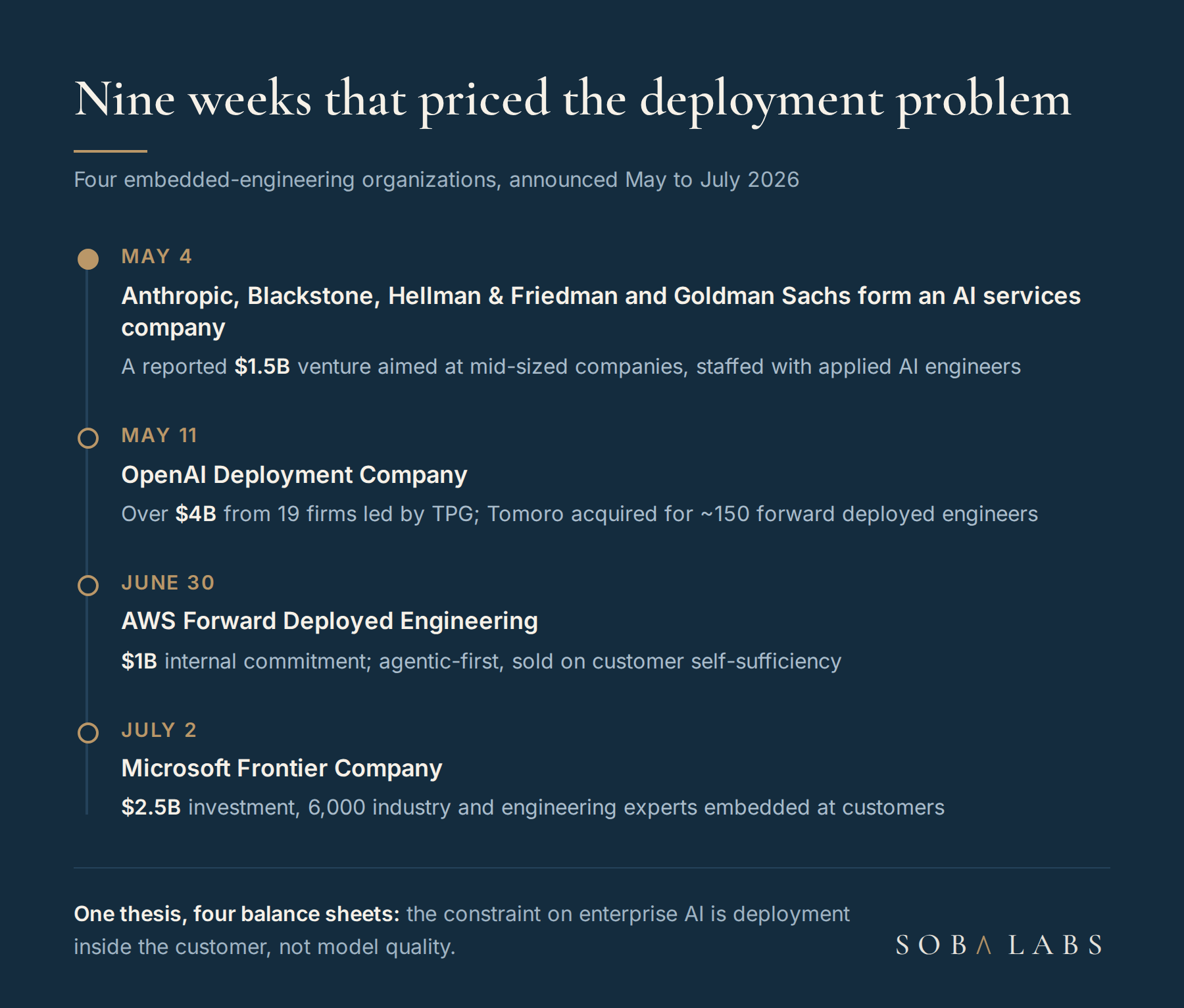
The announcements landed in a cluster. On May 4, Anthropic announced an AI services company with Blackstone, Hellman & Friedman and Goldman Sachs, aimed at community banks, mid-sized manufacturers and regional health systems that, in its words, “lack the in-house resources to build and run frontier deployments”, staffed by its own applied AI engineers working alongside the new firm’s. Fortune’s reporting puts the venture at 1.5 billion dollars, a figure the Wall Street Journal reported and Anthropic has not confirmed. On May 11, OpenAI formed the OpenAI Deployment Company with more than 4 billion dollars from a syndicate of 19 firms led by TPG, buying the London consultancy Tomoro to start with about 150 forward-deployed engineers and deployment specialists on day one. OpenAI’s COO Brad Lightcap gave the reason in one line: “Our customers tell us they need help going from pilot to production.”
Amazon followed on June 30, per the TechCrunch coverage above, with a 1 billion dollar internal commitment to an AWS Forward Deployed Engineering organization, and Microsoft closed the run on July 2 with Microsoft Frontier Company, a 2.5 billion dollar investment embedding 6,000 industry and engineering experts at customers in the name of what it calls Frontier Transformation, its word for AI transformation delivered as a service.
Read the four together and the thesis is identical: the constraint on AI adoption has moved past model quality to integration, process redesign and agent deployment inside companies that have never run one. All four vendors spent the money on people. That is the most expensive market research you will ever get for free, and it is worth taking seriously precisely because you are the market it describes.
The frame that misleads: this is not a software purchase
The reflex is to file this next to every other build versus buy decision and run the usual procurement play. That frame fits platforms, and we have written it up for the platform layer in Copilot Studio or a custom agent. It does not fit here, because what is being sold is a team and its learning loop, and the loop has a quiet second beneficiary. KDnuggets’ definition above cuts both ways: the thing that makes an embedded engineer more than a consultant is that what they learn at your operation flows back into what the vendor builds next. Your deployment also trains the vendor’s playbook. That is a fine trade when the price reflects it, but it belongs on the table, in writing, next to the fee.
Renting buys weeks, and manufactures a dependency
The honest case for the embedded team is speed. One agency’s own decision framework states the gap plainly: a vendor that has shipped AI before can have a focused single-workflow agent in production in 4 to 8 weeks, while an in-house team starting from scratch typically needs 4 to 8 months, two to four of them just to hire the first engineer. When a competitor is already answering customers in minutes, that difference is the decision, and renting is correct.
The cost of that speed is a dependency, and the vendors know it, because the biggest one now advertises against it. Amazon’s announcement says its model “is agentic-first, it compresses timelines from months to days, and it is designed so customers are self-sufficient when a deployment ends”.
The tell: when the largest cloud vendor sells self-sufficiency as a differentiator, it is telling you what the standard engagement has been leaving behind: solutions without the people who can change them.
An embedded pod that leaves nothing behind has moved your starting line to the day they walk out, with a system in production that nobody on payroll can safely touch.
Building is slower than the fear and cheaper than the headlines
The salary headlines describe the vendors’ hires, not yours. Analysis of 924 postings by Recruiting From Scratch puts the median forward-deployed engineer salary at 195,000 dollars, with the middle half between 160,000 and 215,000. The 300,000 to 550,000 dollar packages, per the Perspective AI analysis KDnuggets cites, are total compensation for mid-level and senior people in the role, with staff and principal roles at frontier labs listed from 600,000 upward; those are the packages the four organizations above pay, and they are why you will struggle to hire the title in its current form. For the build path you do not need to: Pin’s compensation roundup has mainstream AI and ML engineers at a 170,750 dollar midpoint on the Robert Half 2026 Salary Guide, and cites ManpowerGroup’s survey of 39,063 employers finding AI skills the hardest in the world to hire for. The realistic plan is two good engineers and a quarter of patience, and an AI strategy that survives a three month hiring cycle before it produces anything.
The clause that decides: where does the learning land
Strip the logos off and the two paths differ on exactly one durable thing. Money, speed, even quality wash out over a few years. What compounds is which organization gets smarter about your operation. The deliverable worth paying for is not the agent, it is the team that can change the agent after the vendor leaves. An embedded engagement where your people pair on every build, where the prompts, evals and runbooks land in your repositories, and where a named employee owns each workflow at handover, is a build program with rented acceleration. The same engagement without those terms is a subscription with better marketing, and its renewal price reflects who holds the knowledge. In the May 4 announcement above, Anthropic’s CFO Krishna Rao described enterprise demand for Claude as “significantly outpacing any single delivery model”, which is vendor language for the same point: the choice in front of you is the delivery model.
How we run this decision in practice
We are a vendor on one side of this market, a small one, so read this knowing where our interest sits. The sequence we use with mid-sized clients has three steps. First, design the operation before staffing it, because an embedded team cannot fix an undesigned process any more than a hire can; we learned that one on ourselves and wrote it up in don’t hire until your operations are designed. Second, rent the first workload: the 4-to-8-week path exists, use it, but contract the handover artifacts from day one. Third, grow the owners: by the second workload, someone on payroll runs the changes, and the vendor’s job shifts from building to reviewing. The test of the whole arrangement is your AI operating model: if, twelve months in, every change still routes through the vendor, you did not buy acceleration, you bought a ceiling.
The takeaway
The nine billion dollars the four vendors just spent says the hard part of AI is deployment inside companies like yours, and that is also the strongest argument against outsourcing all of it. Rent an embedded team to get to production in weeks; build the two-engineer core that owns the system for years; and put the handover, the artifacts and a named internal owner in the contract before anyone writes a prompt. A vendor that resists those clauses has told you which business model you are funding. The cheapest moment to decide who keeps the capability is before the engagement starts, because afterward the answer defaults to the people who built it, and they will have left.
Sources
- Anthropic, Blackstone, Hellman & Friedman and Goldman Sachs launch an enterprise AI services company, Anthropic: the May 4 announcement, its mid-market focus and the applied AI engineer staffing model.
- OpenAI launches a deployment company with over 4 billion dollars from TPG and others, The Next Web: the May 11 announcement, the investor syndicate and the Tomoro acquisition.
- AWS commits 1 billion dollars to forward deployed engineering, Amazon: the FDE organization and the self-sufficiency positioning.
- Microsoft Frontier Company, Microsoft: the 2.5 billion dollar investment and the 6,000 embedded experts.
- Forward deployed engineer: AI’s hottest new career, or consulting with a better title, KDnuggets: the Palantir origin, the posting growth figures and the definitional feedback loop.
- Forward deployed engineer salary in 2026, Recruiting From Scratch: the 195,000 dollar median from 924 postings.