
IBM told every boardroom this spring that 76% of organizations now have a Chief AI Officer. A September census of the 2026 Fortune 500 found 24. Both numbers are real, and the space between them is exactly the decision a mid-sized company has to make. Most mid-sized companies do not need a Chief AI Officer title; they need one named AI owner with budget and authority, and the title only when AI becomes the product or the compliance load. This post reads the survey against the census, shows where the hiring actually happens and what the seat is paid, weighs the analysts’ case against the title, and gives the three questions that settle it.
The 76% survey and the 24-name census are both true
The headline number comes from IBM’s 2026 CEO study, run by the IBM Institute for Business Value with Oxford Economics: a survey of 2,000 CEOs across 33 geographies and 21 industries, conducted February to April 2026. It found 76% of surveyed organizations have a Chief AI Officer in 2026, up from 26% in 2025, and every surveyed CEO who has one expects the role’s influence to grow by 2030.
The counterweight landed in September. ProfessionLens checked all 500 companies on the 2026 Fortune 500 list for “press or company evidence of a current, enterprise-wide Chief AI Officer” and found 24, which is 4.8%. Counting fused titles such as Chief Data and AI Officer raises it to 54, and divisional holders to 68. Among the 20 largest companies, only Meta has one, Alexandr Wang, appointed in June 2025. Boeing, Target and Eli Lilly are on the list; Apple, Alphabet, Walmart and Bank of America are not. Twelve companies had a Chief AI Officer who has since left or whose role was folded.
The gap: when three in four CEOs say they have a Chief AI Officer and fewer than one in twenty of the Fortune 500 shows the actual title, most of those CEOs mean a person who owns AI alongside another job. The function is spreading much faster than the seat.
A survey records what leaders say their org chart means. A census records who holds the exact title on one day. The decision in front of you is which of the two your company actually needs: the ownership, or the seat.
The hiring wave is a mid-market wave
Where the title is being created, it is not mainly a Fortune 500 story. Lusha’s September 2026 read of its live contact database counted 1,180 people holding the exact title Chief AI Officer, of whom 532, or 45.1%, were appointed since September 1, 2025. Head of AI runs at the same pace, 44.1%. For comparison, the Chief Technology Officer title turned over at 11.6% in the same window, so the AI seat is being filled at almost four times the CTO rate.
The size split is the part a mid-sized company should read twice. Two thirds of AI leadership titles sit in companies under 200 people, mostly founders and small firms where titles are cheap. But the recent-appointment share peaks in the middle: 51.7% in companies of 201 to 1,000 people and 53.4% at 1,001 to 10,000, against 40.9% below 200. The last twelve months are when the title crossed into companies with an HR function and a board that had to sign off on a new C-suite seat. If you run a company in that band, your peers are appointing right now. That is a fact about AI adoption pressure, not yet an argument that they are right.
A $1.9 million seat that mostly does not report to the CEO
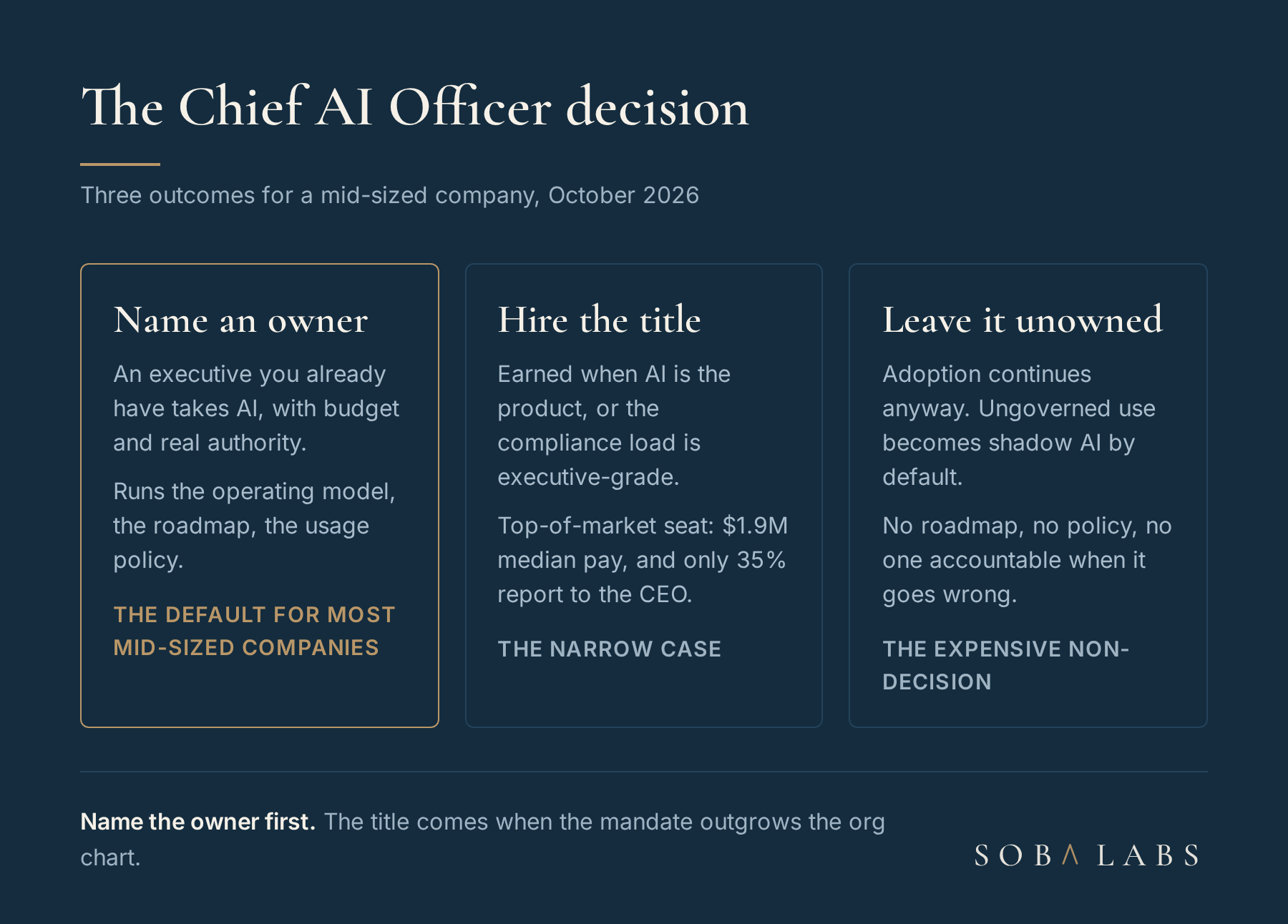
Equilar’s October 2026 analysis of executive compensation puts median total direct compensation for the role at $1.9 million, up from $1.6 million a year earlier, on a $521,250 median base salary. Treat the figure as the top of the market rather than a mid-market quote; the direction is the point: the seat is priced like a chief, and for a mid-sized company that figure is a large share of the whole AI budget.
The same data carries the warning. Only 35% of Chief AI Officers report directly to the CEO; 60% report to another C-suite executive and 5% sit a level below that. Sixty percent were appointed in 2025 or 2026, just 5% have held the title since 2023, and only 55% received any performance-based equity, a low share for a C-suite role. The sentence to remember from the same analysis: “The title has arrived faster than the reporting line that usually comes with it.” A chief who reports to another chief, with no performance equity, is an initiative wearing a title. If you do create the seat, the reporting line and the budget are what make it real, which is also the empowerment condition executive search firm Egon Zehnder attaches to the role: authority and backing from both the C-suite and the board, or the appointment changes nothing.
Analysts expect the title to go where the Chief Digital Officer went
The case against the dedicated title has little to do with how much AI matters. Title-first appointments repeat a pattern that already played out once. Egon Zehnder’s March 2026 note, cited above, walks through the Chief Digital Officer precedent: as digital maturity rose, responsibility diffused into the line, some CDOs became Chief Digital and Information Officers or Chief Product Officers, others saw the position dissolved, and demand for the standalone role has sharply contracted in the last couple of years.
The analysts quoted by IT Brew in August 2025 say the same thing about the AI seat. R “Ray” Wang of Constellation Research: “We see it as a temporary role”, lasting “a three-to-five-year period, which then gets subsumed to other parts of the CIO role”. Ema Roloff of Roloff Consulting reads many of the appointments as a rebrand of the technology leadership a company already had, one that can split AI off from the systems it has to live in. And Randy Bean of Data & AI Leadership Exchange puts the failure mode plainly: “Hiring a chief AI officer without a long-term, thought-through strategy is more likely to tank your company”.
IBM’s own survey points the same direction, which is rarely said out loud: 85% of the surveyed CEOs expect all functional leaders to become technology experts in their domain. If every chief must own AI inside their function within a few years, the dedicated seat is how you get there rather than where you end up. A transitional role can still be worth hiring. You just budget it like a transition, with a mandate that has an end state, not like a permanent chair.
What is an AI chief of staff?
The adjacent title you will meet in vendor decks is not an executive at all. An AI chief of staff, as the assistant vendor folk defines it, is a personal AI that handles the coordination work a human chief of staff would: inbox triage, scheduling, follow-ups, meeting prep, research. It is a software category, and a crowded one. The vendor alfred’s own explainer, updated October 9, 2026, is honest about the boundary: “Tracking, chasing, prepping and summarizing can move to software. Deciding and persuading cannot.”
The distinction matters for this decision because the two get sold in the same breath. The software genuinely absorbs follow-through work, and a mid-sized executive team should probably run some of it. But it removes none of the judgment work that the Chief AI Officer question is about: which bets to make, what AI strategy survives contact with the budget, who tells the board why the pilot died. Buy software for the chasing. The owning is a person, and the numbers that owner should be able to defend are the ones we unpacked in Bank of America’s AI math.
Three questions decide it, and none of them is about the title
First: is AI the product? Where models or AI-built products are the revenue line, a dedicated executive earns the seat. Meta is the census’s clearest case, and the only holder among the 20 largest US companies. For a company that applies AI rather than sells it, the bar is higher.
Second: is the compliance load executive-grade? A lender scoring credit or a hospital group deploying clinical AI carries AI governance obligations, EU AI Act duties among them, that need an accountable owner with real authority. The title can help there, because regulators and boards understand chiefs. Below that load, governance is a function the owner runs, not a chair.
Third: who owns it today? If the honest answer is nobody, you already have an AI program, you just do not control it: employees adopt on their own, and ungoverned adoption is shadow AI by default, a dynamic we walked through in Should employees build their own AI agents. Skip the search firm for now. Name an owner from the leadership you have this quarter, give them budget and authority, and have them run the basics: an AI operating model, a 12-month AI roadmap, a usage policy, and an honest read of where you sit on an AI maturity model. Our free AI readiness check is built to put a first number on that read. Name the owner first; grant the title only when the mandate outgrows the org chart. The sequencing logic is the same one we argued for hiring in general in Don’t hire until your operations are designed: the role comes after the design, never instead of it.
How we answer it at our own scale
We run the smallest possible version of this decision. Nobody at Soba Labs holds an AI title. The founder owns the AI agenda the way this post recommends: one named owner, explicit authority, and the controls in the system rather than the org chart. The work itself runs AI-natively, agents produce the site’s posts and research on a schedule, and every public change ships as a pull request through a gate of tests and audits the writing agent cannot merge. Ownership turned out to be a mandate plus a control plane, with no hire anywhere in it. At our size the question costs nothing to get right, which is exactly why we would rather mid-sized companies settle the ownership question before they price the seat.
The takeaway
The survey and the census agree once you read them as different measurements: AI ownership is becoming universal while the dedicated title stays rare, concentrated where AI is the product or the regulatory load is heavy, and turning over fast enough that analysts call it transitional. So answer the ownership question, not the org chart question: one named owner with budget and authority now, software for the follow-through, and the Chief AI Officer title only when the first two questions say the mandate needs its own seat. Whether that owner then builds the capability in-house or rents it from a vendor’s embedded engineers is the next decision down, and we mapped it in Forward-deployed engineers or your own team.
Sources
- IBM Study: CEOs are Reshaping C-suite Roles for the AI Era, IBM Newsroom: the 76% and 26% figures, the 2,000-CEO method, the 85% functional-leader expectation.
- 24 of the Fortune 500 use the Chief AI Officer title, ProfessionLens: the census of 24 enterprise-wide title holders, 54 with fused titles, the Meta, Boeing and Eli Lilly examples.
- How new is the Chief AI Officer? 45% got the job in the last twelve months, Lusha: the 1,180-contact count, the 45.1% appointment rate, the company-size bands.
- Where Does the Chief AI Officer Stand in 2026?, Equilar: the $1.9 million median pay, the 35% CEO reporting line, the appointment vintages.
- Why some aren’t sold on the chief AI officer role, IT Brew: the Ray Wang, Ema Roloff and Randy Bean positions.
- Is the Chief AI Officer the New Chief Digital Officer?, Egon Zehnder: the Chief Digital Officer precedent and the empowerment condition.
- AI chief of staff, folk glossary: the software-category definition.
- Can AI Act as My Chief of Staff? What It Does and Doesn’t Do, alfred: the judgment versus follow-through boundary.