The distinction is important because rerunning the same prompt is not the same as replaying the same system event. Model sampling, changing APIs, time, retrieved documents, and environment state can all produce a different path. The NIST AI Agent Standards Initiative provides the broader context for reliable and secure agent operation.
What must an agent record for deterministic replay?
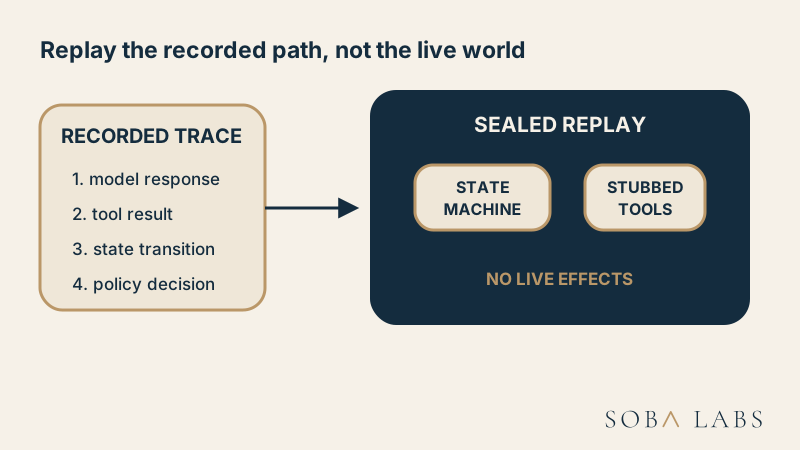
Capture ordered events, workflow and prompt versions, model responses, tool requests and results, policy decisions, timestamps, and the durable state before each transition. The agent audit trail should link each decision to the effect it caused. Replay quality is bounded by the evidence captured during the original run.
Secrets and personal data still need protection. Store references or redacted values when full payload retention is unnecessary, and document when redaction limits what can be reproduced.
How does replay reconstruct the execution path?
The replay runner restores an agent checkpoint and feeds recorded events into the same agent state machine. Instead of calling a live model or tool, it returns the captured response associated with that step. Re-executing a prompt is not deterministic replay.
This keeps the control path stable enough to inspect routing, parsing, authorization, and state transitions. A second mode can deliberately substitute one component to test a proposed fix, but that is a controlled experiment rather than a faithful replay.
How should replay handle external side effects?
Run replay in an isolated environment without production credentials, writable queues, or live messaging routes. Stub payments, emails, record changes, and other effects using their recorded outcomes. A diagnostic replay must never create a second real-world action.
If the original outcome is uncertain, mark it as uncertain rather than fabricating success. The investigation can then reconcile the external system separately and update the trace with verified evidence.
When does deterministic replay provide the most value?
Use it for intermittent failures, incident investigation, regression testing, runtime upgrades, and comparisons between workflow versions. It is especially useful when the agent trajectory contains many branches that are hard to reproduce manually. A production failure becomes actionable when the team can rerun its control path on demand.
Replay does not replace evaluations or monitoring. It explains a known execution, while evaluations test a broader distribution of cases. Together they let teams turn one incident into a repeatable test and confirm that a fix blocks the observed failure without creating a new path.