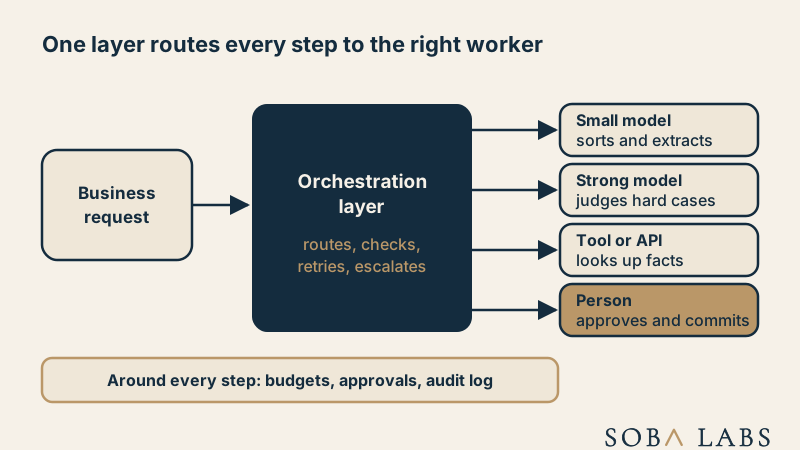
Most companies reach the term the same way: the first agent works, a second one follows, a cheaper model gets added for simple cases, and suddenly nobody can say which component did what. Orchestration is the answer to that question, shown below.
How does AI orchestration work?
A request enters, and the orchestrator breaks it into steps. Each step goes to the cheapest component that can do it well: a small model for classification, a stronger model for judgment, a deterministic tool for lookups, a person for anything that commits money. The orchestrator carries state between steps, checks each result, and retries, reroutes or escalates on failure. Anthropic describes the core pattern as a central model that “dynamically breaks down tasks, delegates them to worker LLMs, and synthesizes their results” (Building effective agents, 19 December 2024, read 9 November 2026). The orchestrator owns the flow; the components only own their step. That is the orchestrator-worker pattern, whether the workers are agents, models or people.
AI orchestration vs workflow automation vs multi-agent systems: what’s the difference?
| Workflow automation | AI orchestration | Multi-agent system | |
|---|---|---|---|
| Who decides the next step | A fixed script | A controller, often a model, within rules | Agents negotiate among themselves |
| Handles unexpected input | Fails or stops | Reroutes or escalates | Adapts, less predictably |
| Audit trail | Simple | Designed in | Hard unless added |
| Best for | Stable, repetitive steps | Business processes with judgment calls | Open-ended research or planning |
Workflow automation is the right tool when nothing varies. Orchestration earns its cost when steps need judgment but the business still needs predictability. A free-form multi-agent system gives up some of that predictability for flexibility.
What should a buyer ask before choosing an orchestration layer?
Four questions. Can it route by cost, sending easy cases to a cheap model as in model routing? Can a person approve a step before it commits, as with human in the loop? Does every run leave a record a reviewer can replay? And can you swap any model without rewriting the flow? If the answer to the last question is no, you bought a vendor, not an orchestration layer.
How do we orchestrate agents in our own scheduled work?
Our unattended agent runs, which research, measure and publish on a schedule, follow one split. A single controller agent owns every file write, every paid API call and the running spend total; worker agents do research and judgment and each returns one compact result. Workers run in parallel only when none needs another’s output. A silent worker is replaced once on the same brief after a fixed time ceiling, never waited on forever: an optional worker that fails twice is skipped and named in the report, a required one ends the run as failed with its work saved. The controller never reads what the workers read, only what they conclude, so its context stays on the decision. The same split runs through our supervisor agent builds.