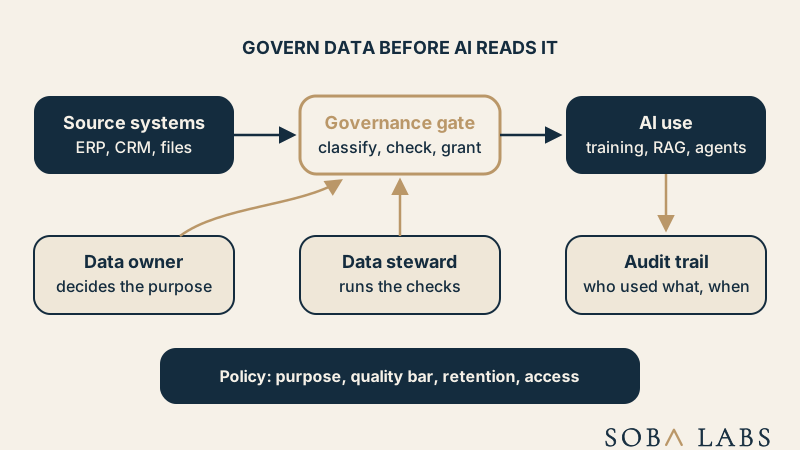
Why does data governance matter more once you use AI?
A report shows data to a person who knows its gaps. An AI system reads it at scale, repeats it to customers, and acts on it. AI turns quiet data problems into visible business errors. A stale price list becomes a wrong quote, an over-shared folder becomes a data privacy incident, and an undocumented field becomes a model feature nobody can explain. That is why most data readiness work is governance work.
Data governance vs data management vs AI governance: what’s the difference?
| Data governance | Data management | AI governance | |
|---|---|---|---|
| Decides | Who owns data, who may use it, quality bar | How data is stored, moved and protected | Which AI systems run, with what oversight |
| Main roles | Data owners, stewards, sponsor | Engineers, database admins | Risk, legal, product owners |
| Typical output | Policies, data catalog, access rules | Pipelines, backups, schemas | Model inventory, risk reviews, approvals |
AI governance depends on data governance and cannot replace it. For high-risk systems the EU AI Act makes the link explicit: Article 10 requires training, validation and testing data to follow data governance and management practices, including data collection origin, preparation and an examination of possible biases (Regulation (EU) 2024/1689, read 12 November 2026).
What does a working data governance program contain?
Four parts are enough to start. Owners: one named person per data domain who decides use. Policies: purpose, retention and access rules written down. A catalog: a list of what data exists, where, and how sensitive it is. Controls: data quality checks and access grants applied where data flows, plus a record of who used what. Start with the data your first AI use case reads, not with the whole company. A program that tries to classify everything before anything ships usually stalls.
How do we govern the data our own agents read?
We split our internal knowledge by audience before any agent or person gets access. Material that touches money, legal matters or one person stays in a restricted store; engineering patterns sit where every agent can read them. When a store has to be shared, we copy reviewed files into a fresh one rather than granting the old one, because version history keeps everything ever written. Each copy passes an automated scan for client names, money figures and personal data, and a person signs off on the file list. Agents that capture lessons route each one to the most restrictive store it matches. Access follows the audience of the data, not the convenience of the tool.