Why did AI turn data sovereignty into a buying question?
Because everyday AI use moves data. Every prompt, uploaded contract and retrieved record passes through the provider’s infrastructure, and Red Hat’s definition of sovereign AI notes that for AI the question covers training data, inference traffic and model weights alike (read 26 October 2026). A company that would never migrate its ERP abroad can leak the same information one prompt at a time. The AI stack made data movement ambient, so control has to be designed rather than assumed. Enterprise vendors now compete on answers, from EU-hosted processing to zero-retention agreements.
Data sovereignty vs residency vs sovereign AI: what is the difference?
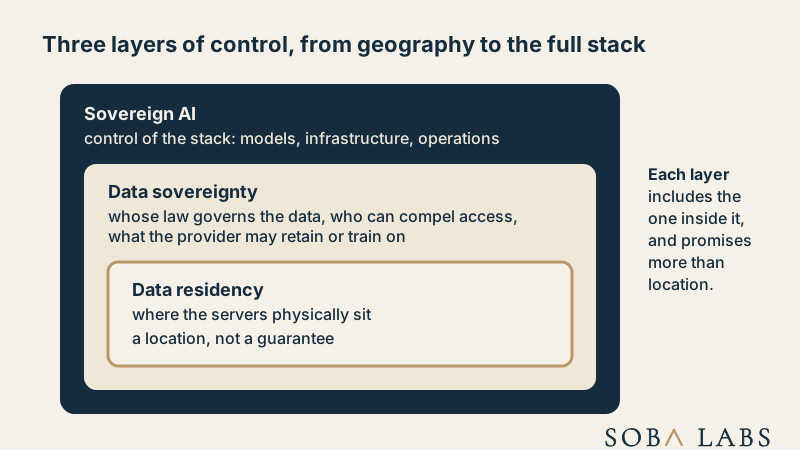
Three nested layers. Data residency is geography: where the servers are. Sovereignty is law and control: which jurisdiction can compel access, what the provider may retain, who holds the keys. Sovereign AI is the widest layer: a nation’s or organization’s control over the whole stack, which IBM defines as covering infrastructure, data, models and operations (read 26 October 2026). Buying a local data center address fixes residency and not much else; sovereignty lives in the contract, the corporate structure behind the service, and the architecture.
What does it mean in practice for a mid-sized company?
Four questions to any AI vendor. Where are prompts and outputs processed and stored? Under which jurisdiction does the operating entity fall, including its parent? What is retained, for how long, and is anything used for training? And who can access the data for support, and from where? EU AI Act obligations and GDPR transfer rules make the answers load-bearing in Europe, and data localization rules in the Gulf shape what public-sector buyers there can accept. Map the answers against your own AI compliance duties before the pilot, not after, and weigh the exit: a sovereignty commitment that only one vendor can meet is also vendor lock-in.
How do we handle data sovereignty at Soba Labs?
By choosing per workload, not per policy document. Our production systems for clients run on the hosted model APIs their data terms allow, and the agent we built for a loyalty software company writes its outcomes into the client’s own CRM, so the records of consequence stay in systems the client controls. The practical unit of sovereignty is the workload: decide for each one what may leave, to whom, and what must stay. For a Polish manufacturer we helped move operational data onto its own PostgreSQL foundation before any agent work, because control of the system of record is what makes every later AI decision reversible.
What should a buyer be skeptical about?
Sovereignty as a sticker. “EU region available” says nothing about support access from abroad, subprocessors, or what a parent company can be compelled to hand over. Equally, full self-hosting buys control at the price of capability and upkeep, and most mid-sized companies need neither extreme. The honest posture is a data map, a short list of workloads that genuinely need hard guarantees, and ordinary hosted AI for the rest.