Virtual try-on sells certainty. The product photo shows the item; the try-on shows the buyer their own decision.
How does virtual try-on actually work?
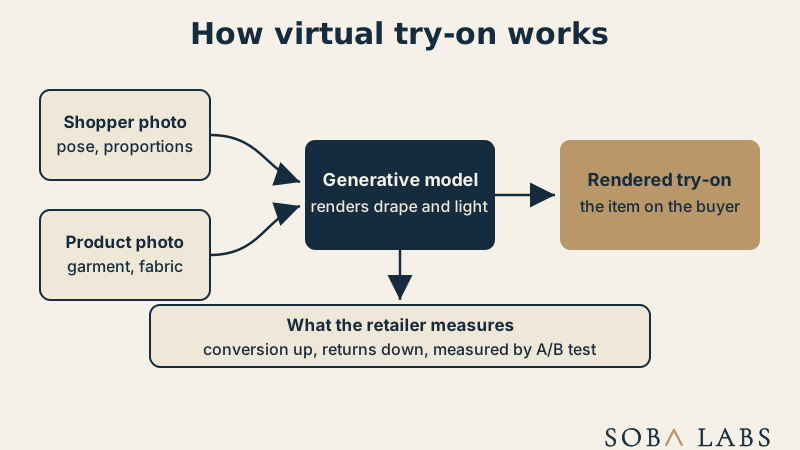
Two inputs, one generated output. The shopper supplies a photo, the retailer supplies the product image, and a generative AI model estimates pose and proportions, then renders the garment onto the person with fabric drape and lighting that read as real. The hard part is honesty: the render must show how the item fits, not how it flatters, because a flattering lie converts today and returns tomorrow. Earlier augmented reality versions overlaid a 3D model on a camera feed and worked best for rigid items like glasses; the generative approach handles cloth.
What does virtual try-on change for a retailer?
It attacks the two numbers online fashion lives and dies by: conversion and returns. A shopper who has seen the jacket on their own shoulders hesitates less and sends fewer wrong guesses back. Vendor case studies claim return reductions from 20 to over 60 percent and photoshoot savings up to 90 percent; both come from the vendors’ own marketing and belong in a business case only after an A/B test on your own traffic. The honest expectation is a measurable lift on fit-driven categories, not a storewide transformation, which is why it pairs naturally with the broader playbook in AI in retail.
Why did virtual try-on become urgent in 2026?
Because the channel moved. OpenAI launched try-on inside ChatGPT, letting shoppers generate images of themselves wearing items without visiting the retailer’s site (Retail Dive, 9 October 2026, read 19 October 2026), and Gap rolled out conversational shopping agents on its Old Navy and Banana Republic brands the same week. The fitting room is becoming a feature of the assistant, not the store, part of the shift toward agentic commerce where discovery, advice and checkout happen in one conversation. A retailer that waits may find the try-on experience happening on someone else’s surface, with someone else’s product data.
What should a retailer check before buying a virtual try-on tool?
Start with rights and storage: shoppers upload photos of themselves, so where those images live, how long, and whether the vendor trains on them is a privacy answer you must be able to give. Then measure fidelity on your own catalog, because models tuned on dresses can mangle tailoring. Check integration cost against your product image pipeline, and insist on a holdout test before believing any lift number. Buy it as an experiment with a kill switch, not a replatforming, the same sizing discipline as any AI business case.