

pgvector’s Python client was downloaded 41.7 million times last month, 37% of the 113.9 million across the ten vector databases we ranked on November 17, 2026, and Qdrant was second with 15.5 million. Every retrieval system needs somewhere to keep its embeddings, and the clients builders install to reach that store are counted in public. Docker Hub pulls reorder the middle of the list, and the two counters disagree for reasons worth knowing before you pick. We give the ranking, what each number counts, the index choice that comes with the leader, and how we would choose.
pgvector’s client has 11.7 times the downloads of Milvus’s
We ranked on one number, the last_month count that pypistats reports for each package. We read every one at about 12:00 UTC on November 17, 2026, from the page at pypistats.org/packages/<package> (pgvector’s is the example), and the pypistats API documentation says all download stats exclude known mirrors and update once daily. In scope is any database or library presented as a vector store or search tool that has a Python client on PyPI, plus pgvector because it is a separate extension. General-purpose databases that added a vector feature are out, and so is pynndescent (7,588,123 downloads), whose PyPI summary names a method, “Nearest Neighbor Descent”, rather than a store.
| Rank | Database | PyPI package | Downloads, last month | Share of the ten |
|---|---|---|---|---|
| 1 | pgvector | pgvector |
41,652,269 | 36.6% |
| 2 | Qdrant | qdrant-client |
15,517,532 | 13.6% |
| 3 | FAISS | faiss-cpu |
12,530,906 | 11.0% |
| 4 | Chroma | chromadb |
8,639,572 | 7.6% |
| 5 | sqlite-vec | sqlite-vec |
7,398,774 | 6.5% |
| 6 | LanceDB | lancedb |
7,093,977 | 6.2% |
| 7 | turbopuffer | turbopuffer |
6,464,817 | 5.7% |
| 8 | Pinecone | pinecone and pinecone-client |
6,212,771 | 5.5% |
| 9 | Weaviate | weaviate-client |
4,826,558 | 4.2% |
| 10 | Milvus | pymilvus |
3,564,726 | 3.1% |
The ten add up to 113.9 million downloads. pgvector alone is larger than the next three together (36.7 million). Pinecone’s client appears on PyPI under two names, pinecone (4,446,324) and the older pinecone-client (1,766,447), and we added them. Every package put between 21% and 26% of its month into the last seven days, close to the 23% a steady pace gives, so none of these totals is a one-week spike.
Downloads count clients, so read what each package connects to
The table counts packages that applications install. Three differences matter.
pgvectoris a thin client for an extension. GitHub describes the project as open-source vector similarity search for Postgres. The Python package is how code, and in our experience the ORMs and RAG frameworks built on it, reach that extension, so we read its lead partly as Postgres being the database teams already run.- FAISS, sqlite-vec and LanceDB live inside your process. FAISS’s own README opens with “Faiss is a library for efficient similarity search and clustering of dense vectors.” The sqlite-vec project calls itself a vector search extension for SQLite, and LanceDB describes itself as an embedded retrieval library. None of them has a server to run.
- Pinecone is hosted. Its home page describes it as a fully managed vector database, so its client talks to a service you rent, and nothing in the table says how many people run one.
A client download also counts a CI job that reinstalls the package on every run. These numbers show how often a tool is tried. They cannot show how many production systems depend on it.
Docker pulls reorder the middle of the list
Docker Hub gives a second counter for five of the ten. We read the lifetime pull_count of each server image from its repository API on the same day, at hub.docker.com/r/<namespace>/<image> (the pgvector image is the example). Docker’s usage page defines a pull as covering version checks as well as downloads, and says “A pull for a multi-arch image will count as one pull for each different architecture.” That page describes account usage, so we assume the public counter follows the same rule. Either way a deployment that polls a tag collects pulls without gaining a user.
| Database | Docker Hub image | Pulls, all time | Share of the five | PyPI rank of the ten |
|---|---|---|---|---|
| pgvector | pgvector/pgvector |
336,461,507 | 64.8% | 1 |
| Milvus | milvusdb/milvus |
80,375,254 | 15.5% | 10 |
| Qdrant | qdrant/qdrant |
58,346,137 | 11.2% | 2 |
| Weaviate | semitechnologies/weaviate |
35,099,581 | 6.8% | 9 |
| Chroma | chromadb/chroma |
9,063,730 | 1.7% | 4 |
The figure below puts both counters on the same base, each database’s share of these five.
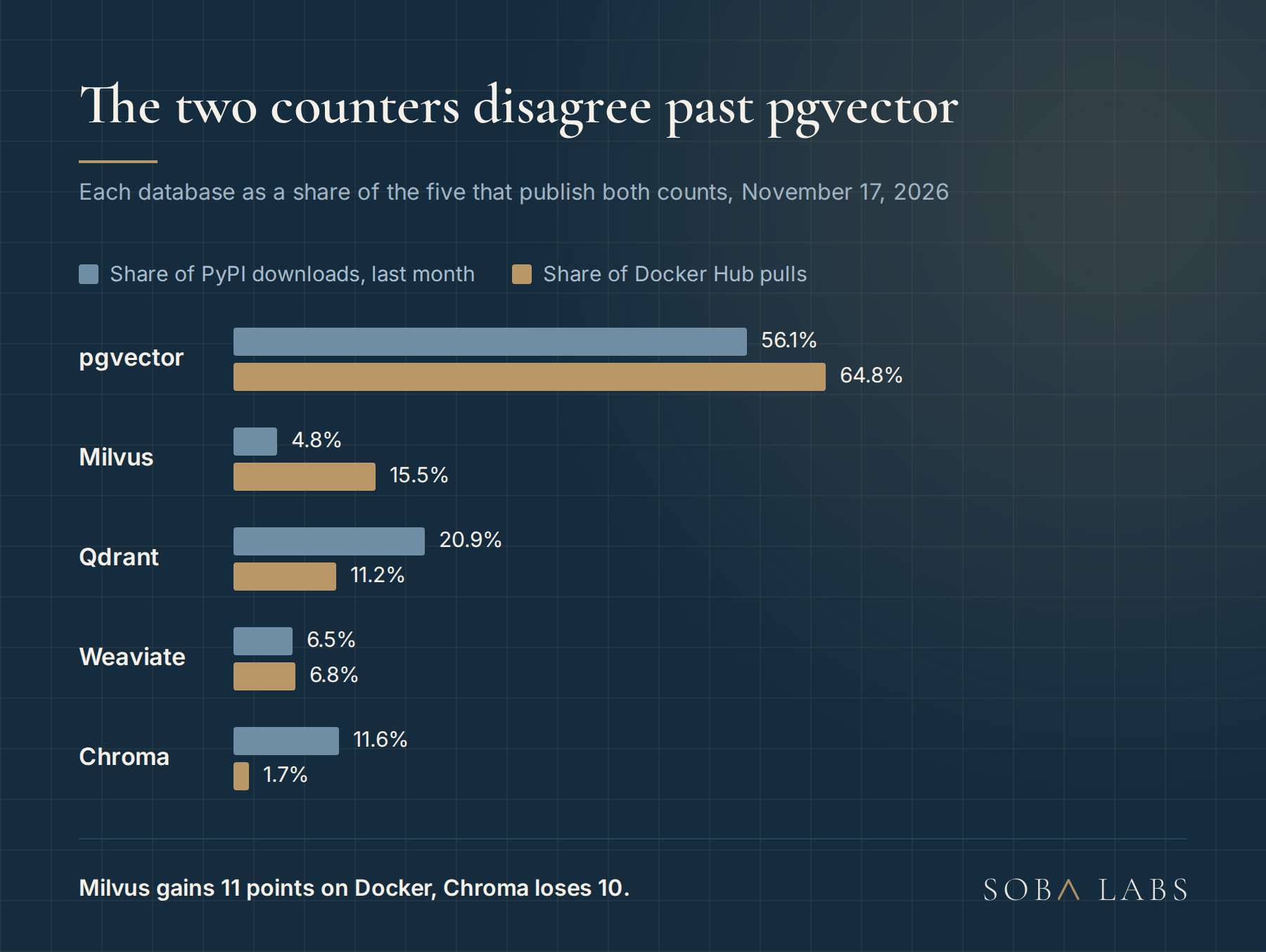
pgvector leads on both counters, which is the one stable finding. Past it the counters disagree. Milvus is last of the ten on PyPI and second on Docker, and Chroma is fourth on PyPI and last on Docker. Counters alone cannot say why. One reading is that many Chroma users never run its server, since Chroma also runs inside the application, and its documentation describes client-server as a separate mode. Another is age: Chroma’s image was last updated on October 22, 2026, while the other four were updated between November 12 and 17.
The pgvector/pgvector description on Docker Hub repeats the extension’s one-line description, so we expect many of its 336 million pulls to come from people who wanted Postgres and took the image that already includes the extension. That makes its Docker share mostly a statement about Postgres, with a smaller one about vectors.
pgvector gives you two index types, and the choice is a trade
The first choice is the index type, because without one a nearest-neighbor query scans the whole table. The pgvector README says “An HNSW index creates a multilayer graph. It has better query performance than IVFFlat (in terms of speed-recall tradeoff), but has slower build times and uses more memory.” The IVFFlat index “has faster build times and uses less memory than HNSW, but has lower query performance (in terms of speed-recall tradeoff).” In version 0.8.7 the HNSW index for cosine distance is one statement:
-- pgvector 0.8.7
CREATE INDEX ON items USING hnsw (embedding vector_cosine_ops);
HNSW can be built on an empty table, which makes it the default for a team that is still loading data. IVFFlat needs rows first, because it divides the vectors into lists, and the README’s starting point for the list count is rows / 1000 up to a million rows and sqrt(rows) beyond. Pick IVFFlat when the build time or memory of a very large table is the problem, and measure recall on your own queries before you commit.
Qdrant, Chroma and LanceDB are the dedicated options
Past Postgres, the ranking is a list of products built only for this job. Qdrant’s indexing documentation states “Qdrant currently only uses HNSW as a dense vector index.” You tune one graph index through its parameters, and keyword and sparse search (hybrid search and sparse retrieval) sit beside it. Its 15.5 million downloads and 58 million pulls put it second on PyPI and third on Docker.
Chroma’s documentation describes it as open-source data infrastructure for AI, and its fourth place on PyPI sits next to a last place on Docker. LanceDB, like FAISS, is an embedded library, so it has no server image for the Docker column to count. Milvus is the mirror image, tenth on PyPI and second on Docker, and turbopuffer reaches seventh on PyPI.
What the database does not fix: chunks, rerankers and context
None of these counters says anything about retrieval quality. A vector index returns the nearest chunks of whatever you embedded, so the work that decides whether an answer is right sits above it: how you split documents, whether you add a sentence of context to each chunk, and whether a reranker reorders the top results. We covered those choices for the LangChain stack in enterprise RAG on LangChain. They hold whichever database sits underneath, and they matter more as agentic RAG and graph RAG put more queries through the store.
Start where your data lives, and move when you can measure why
Our rule is to start where your data already lives.
The rule we use: if you already run Postgres, add pgvector and prove the workflow there; move to Qdrant or Milvus when filtering, scale or operations demand a dedicated server; use an embedded library such as FAISS or LanceDB when the index lives inside one application.
We used pypistats and Docker Hub counts in our ranking of self-hosted inference servers and pypistats alone in the Python agent frameworks ranking, and the same caveat holds in both. A download count tells you what builders tried first, and only your own recall and latency tests tell you what to keep.
The takeaway
pgvector is the most used vector database on both counters. It holds 37% of the ten clients’ downloads and 65% of the five images’ pulls, and we think that reflects teams adding vectors to the Postgres they already operate. Qdrant leads the dedicated options, Milvus is far bigger on Docker than on PyPI, and the embedded libraries have no counter in the Docker column. Start where your data already lives, and choose the index type before the vendor.