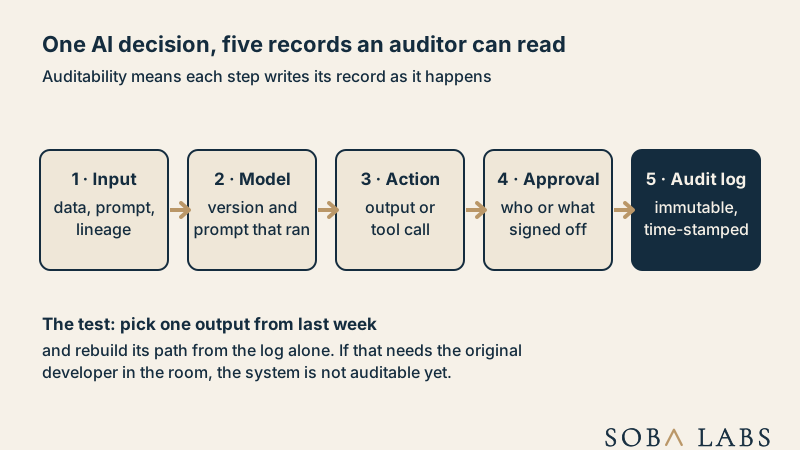
What makes an AI system auditable?
Auditability is a design decision, not a report you write later. The system has to record its inputs, data lineage, model and prompt versions, outputs, and every human intervention as it runs, because none of that can be reconstructed afterwards. In practice that means versioned datasets and prompts, time-stamped decision logs, and a record of who or what authorized each consequential action. A company that already keeps an agent audit trail for its agents has done most of this work.
Auditability vs explainability vs traceability: what is the difference?
The three overlap but answer different questions. Explainability asks why the model produced one specific output. Traceability asks where the data, model and decision came from and keeps the chain of records. Auditability is the umbrella property: can an independent party use those records to verify the system behaves as claimed? A system can be explainable in a demo and still unauditable in production, because the demo never kept logs.
Why are buyers suddenly asking for it?
Because the people who sign off on AI now carry the accountability. In a Datarails survey cited by the planning vendor Prophix’s chief executive in October 2026, 75 percent of finance leaders named lack of auditability as the main barrier to trusting AI with mission-critical finance tasks (CFO Dive, read 12 October 2026). The pattern repeats in every regulated function: adoption runs ahead of the evidence trail, and the evidence trail is what sign-off actually needs. Regulation points the same way: the EU AI Act requires logging and record-keeping for high-risk systems, and the NIST AI RMF treats documentation and measurement as core functions. Accountability that cannot be evidenced is an intention, not a control.
How do you make an AI agent auditable?
Start where the consequences are. Log the full chain of each run: the task, the model and prompt versions, every tool call with its arguments and result, and the final action, the way LLM tracing tools already capture it. Gate the irreversible steps behind tool approval so the trail shows a named approver, and keep the records in a store the agent itself cannot edit. Then test the property the way an auditor would: pick one output from last week and try to reconstruct how it happened. If that takes a day, the system is not auditable yet; deterministic replay is what makes that reconstruction cheap.