What does a citizen developer actually build?
Mostly the long tail IT never gets to: internal forms, dashboards, approval workflows, and notifications. Generative AI widened that range to working software. With a no-code AI agent builder, the same business user can now assemble an agent that reads documents, drafts replies or routes cases, and platforms like Copilot Studio exist precisely to put that in non-developer hands. Vibe coding tools push the ceiling higher still, generating whole internal apps from a description.
Why are companies formalizing citizen development now?
Two pressures meet. IT backlogs keep growing, and AI has lowered the skill bar for building. The pattern that works is bottom-up: Dropbox’s CTO credits full AI adoption across the company’s engineering, product and design teams to a bottom-up movement of championed power users rather than IT-mandated tools, with employees building hundreds of custom applications that automate finance and HR work, and coding agents running in a monitored internal environment (Fortune, read 12 October 2026). The companies that benefit treat those builders as a program with named owners, not as an accident to tolerate.
What governance keeps citizen developers safe?
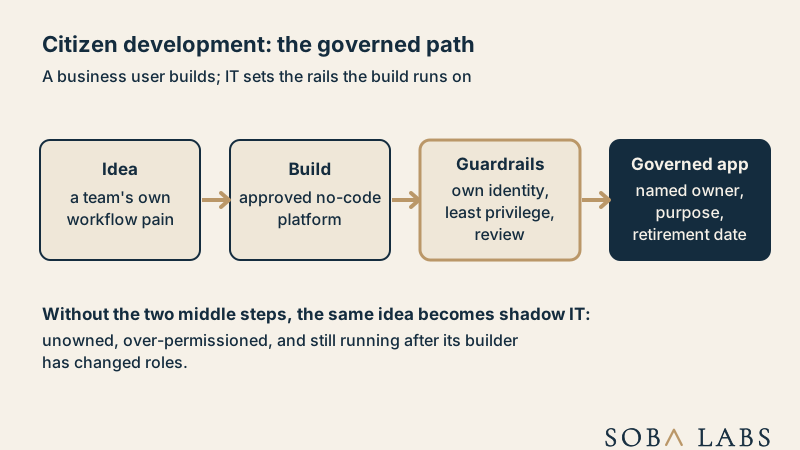
The risk is not that business users build; it is that they build unseen. Ungoverned tools are shadow AI, and an unowned agent keeps running long after its creator changed roles. A workable program needs four things: one approved platform, least-privilege access to data, a named owner and retirement date per app, and review before anything touches customers or money. Write those rules into the AI usage policy before the first agent ships, not after the first incident. Every agent a business user creates still needs an owner, an approved purpose and a plan for switching it off.
Citizen developer vs professional developer: where is the line?
Scope and blast radius. A citizen developer automates their own team’s workflow inside approved systems. The moment a build handles payments, customer data at scale, or irreversible actions, it is an engineering project with tests, review and an on-call owner. We wrote up that boundary decision in Copilot Studio or custom agent: the honest answer is usually both, each on the right side of the line. Citizen development complements professional engineering; it stops being cheap the day it replaces it.