The original ReAct paper describes interleaving reasoning traces with task actions so actions can bring back new evidence and reasoning can update the plan. It is now a familiar pattern in agent frameworks, but the loop itself matters more than the framework that wraps it.
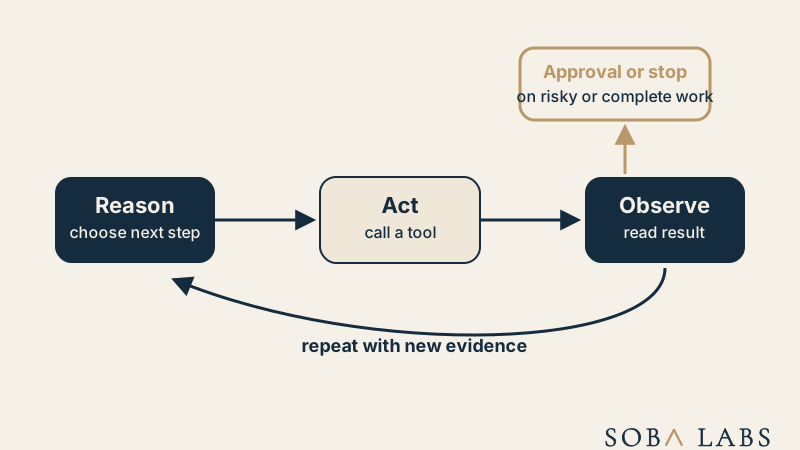
A ReAct agent does not trust its first plan. It acts, learns from the result, and decides the next step with new evidence.
How does the ReAct loop work?
The agent receives a goal and its current context. It reasons about the next useful action, such as searching a knowledge base, reading a record, or calling an API. The agent harness validates and executes that tool call, then returns the actual result as an observation. The model uses the observation to decide whether to act again, answer, or stop.
Each observation replaces a guess with evidence from the real system. That is why a ReAct loop handles tasks where the next action depends on what the last one revealed. Agentic AI applies this basic pattern to work that needs a goal rather than a fixed script. An AI agent can use ReAct internally without exposing its private reasoning as part of the user-facing answer.
ReAct versus plan and execute: which should you use?
ReAct makes a local decision after every observation. A planner-executor pattern makes a higher-level plan first, then sends individual steps to an executor. ReAct adapts quickly when results change, while planning makes a complex job easier to inspect before tools run.
The right choice follows the task. A short investigation with uncertain evidence often benefits from a ReAct loop. A migration, report, or workflow with known stages can benefit from a plan and checkpoints. A system can also combine both: a planner sets the broad route while an executor uses ReAct within each step.
What makes a ReAct agent safe in production?
The model cannot be the only authority on whether it should keep acting. The runtime needs deterministic limits around the loop. Set an iteration budget, timeout, and spend ceiling. Validate tool arguments against a schema. Require tool approval before external messages, money movement, or writes to production systems. Record every action and observation with LLM tracing so a failure has an auditable path.
A repeated action is a signal to stop and inspect, not proof that the agent is trying harder. If the agent needs to improve a draft rather than call another tool, a reflection agent pattern supplies a separate critique loop with its own stop condition. The important thing is to make both loops bounded and visible.
Where does ReAct fail?
It can waste calls on work a deterministic workflow would complete faster. A weak observation can also send it in circles, and long runs can fill the context window with old tool output. Use a plain workflow when the process is stable. Use context compaction and a clear state record when a long task still needs ReAct. Evaluate the complete loop on real tasks, including failures and approval paths, before granting more autonomy.