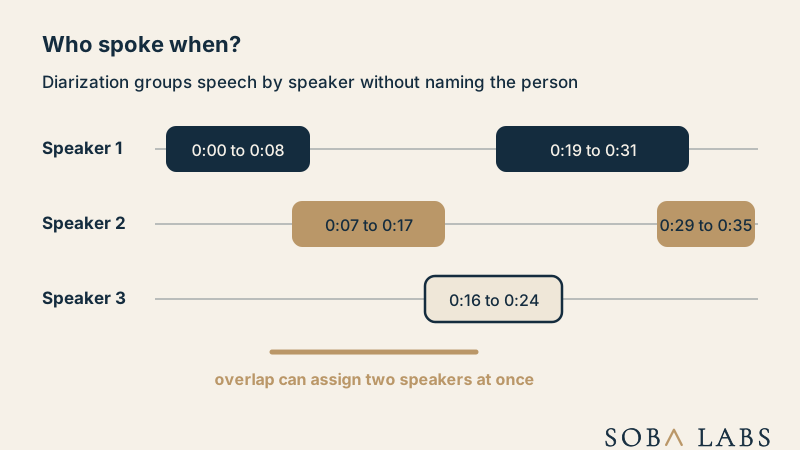
What does speaker diarization add to a transcript?
Automatic speech recognition produces words and timestamps. Diarization groups those time ranges by a consistent speaker label. The result answers who spoke when without claiming who each person is. A transcript can then show that Speaker 1 asked a question, Speaker 2 answered, and Speaker 3 interrupted, even if the system does not know their names.
That structure matters for meeting summaries, call review, and voice agent evaluation. The agent’s words must not be attributed to the caller. A decision made by one participant must not be assigned to another. Search and analytics also become more useful when a query can target customer speech rather than every word in the recording.
How does diarization work?
A diarization system detects speech, divides the recording into segments, represents the acoustic properties of each segment, and groups similar voices. Some systems perform these steps as one model. Others combine separate speech detection, embedding, clustering, and resegmentation components. The labels describe recurring voice patterns in this recording, not verified identities.
The number of speakers may be supplied in advance or estimated. A known two-person call is easier to constrain than an open meeting where people enter and leave. Long recordings provide more evidence for each voice, while short remarks and rapid exchanges provide less. Microphone position and room acoustics can make one person sound different across the same call.
What makes diarization fail?
Overlapping speech is the clearest problem because two people occupy the same time range. Short acknowledgements such as “yes” offer little acoustic evidence. Similar voices, crosstalk, compression, music, and moving microphones can split one person into several labels or merge different people under one label. A clean-looking transcript can still contain attribution errors that change its meaning.
Speaker identification is a separate task. It compares a voice with enrolled identities. Adding it creates consent, security, and false-match risks that ordinary diarization does not need.
How should diarization quality be checked?
Evaluate speaker confusion, missed speech, false speech, and overlap on recordings that match the intended microphones, channels, rooms, and languages. Review both aggregate error and consequential examples. The test must preserve the recording timeline so reviewers can trace every label back to the audio.
A readable sample is not enough when attribution affects a decision or record. Set a human review rule for sensitive minutes, regulated calls, or evidence. If naming a known person is necessary, add identification only with consent, narrow access, and a fallback when confidence is insufficient.