
If you are choosing a notetaker for your teams, the most useful public number is which ones other companies actually pay for, not which ones have the loudest launch. On Ramp’s spend data updated November 11, 2026, Granola is paid for by 68% of the businesses that buy an AI meeting notetaker, Fireflies by 40% and falling, and Fathom by 1%. Otter, one of the best known names in the category, does not appear in Ramp’s list at all. Below is the ranking, what the metric does and does not measure, what each vendor reports about its own reach, what the business tiers cost, and the privacy questions to settle before anyone presses record.
Granola leads Ramp’s notetaker category at 68%
The metric is Ramp’s adoption rate for its AI meeting notetakers category, from the category page linked above. Ramp defines it as “the share of businesses that purchased from a vendor, out of all businesses that made purchases in that software category over the past 12 months.” The data comes from corporate card and bill pay transactions across more than 85,000 American businesses on Ramp. A company can pay for two notetakers at once, so the shares add up to more than 100%.
| Rank | Vendor | Adoption | Year-over-year delta | Share of first-time adopters |
|---|---|---|---|---|
| 1 | Granola | 68% | 37%, up | 75% |
| 2 | Fireflies.ai | 40% | 34%, down | 25% |
| 3 | Fathom | 1% | under 1%, up | 1% |
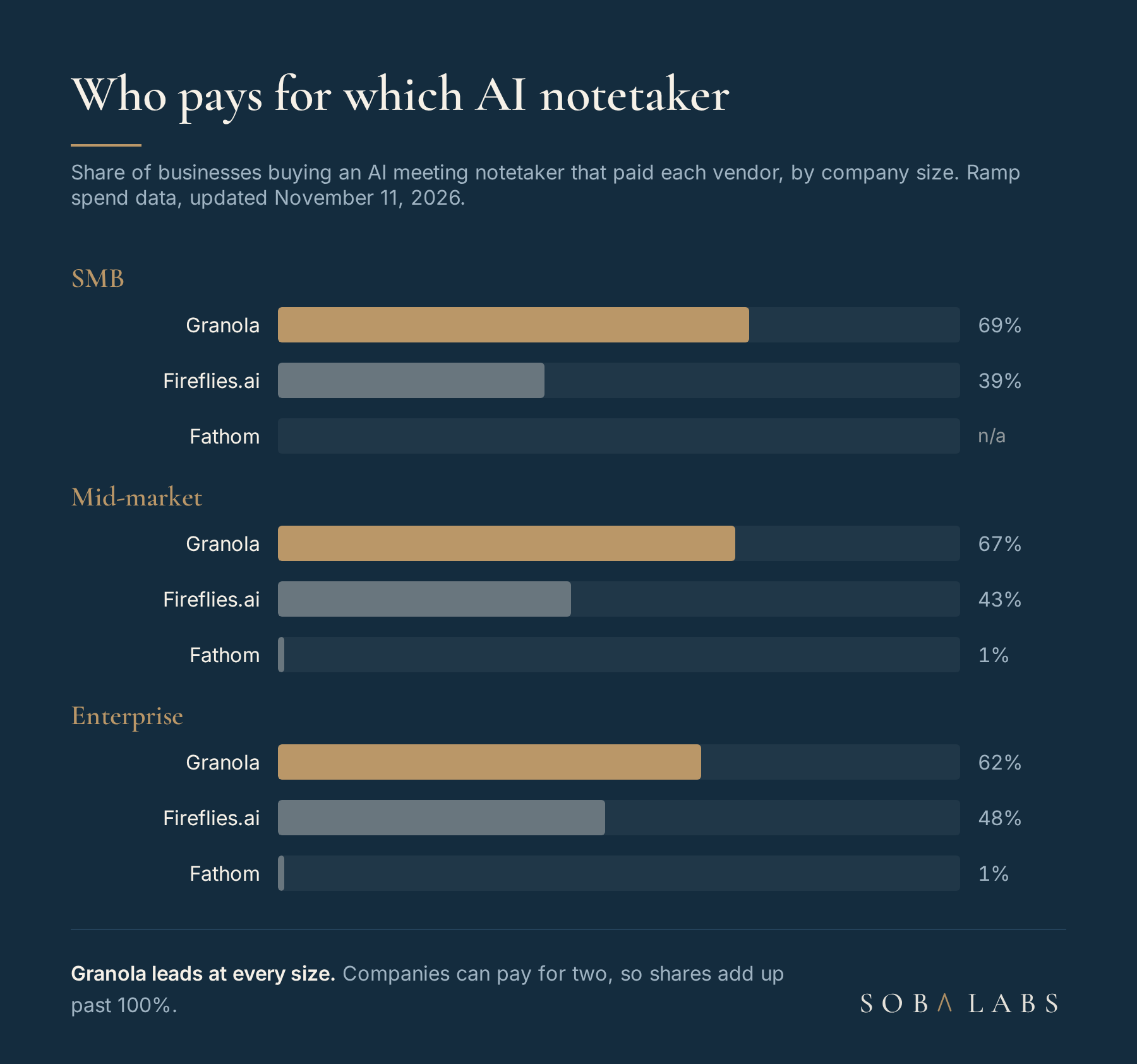
The category itself is still small. According to the same page, the share of businesses that rely on AI meeting notetaker tools “reached 10.4% in November 2026, up 0.3 percentage points from the previous month.” So roughly one company in ten on Ramp pays for a notetaker, and among those, two in three pay for Granola. By company size, Granola runs at 69% of small business buyers, 67% of mid-market and 62% of enterprise; Fireflies at 39%, 43% and 48%. Fathom shows 1% where Ramp gives a figure.
Granola is gaining about 2 points a month while Fireflies falls
The direction matters more than the level. Ramp reports that Granola is the fastest growing vendor in the category, “averaging +2.0 percentage points per month, and also attracted the most companies switching from alternatives.” Ramp lists Fireflies’ growth figure as 2.01% with a down arrow, without saying over what period. Year over year, Ramp’s delta reads 37% up for Granola and 34% down for Fireflies. Of the companies that switched notetakers within the category, 75% switched to Granola.
The growth shows up outside the category too. Ramp’s November list of top software vendors puts Granola sixth among the fastest growing vendors across all business software, three places above Wispr Flow, the dictation app that launched its own notetaker this summer. Granola answered with a dictation feature, so the two are now selling into each other’s category.
A second dataset agrees on direction but not on size. YipitData’s analysis, published April 30 and updated August 24, 2026, drawn from transactions at more than 900 mid-market companies with data running to February 2026, shows Granola posting 3x spend growth over six months, while spend on Otter plateaus and spend on Fathom and Fireflies declines. In the same panel, though, Fireflies still had about 40% more customers than Granola, and Otter and Fathom about 20% more. The same analysis records Granola’s $125M Series C in March 2026 at a $1.5 billion valuation.
What to notice: the two independent datasets agree on who is growing, and disagree on who is biggest, because they count different companies at different dates.
Otter, tl;dv and Read.ai are missing from the count
Ramp lists three vendors in the category. Otter, tl;dv and Read.ai do not appear, and Ramp does not say why. The likeliest explanation is that their paying customers buy individual plans on personal cards, which a corporate spend platform never sees, but that is our inference, not Ramp’s. What Ramp does measure is what companies buy through finance, which is the purchase a department head signs off on.
What the vendors report about themselves is a different kind of number:
| Vendor | Self-reported reach | Date |
|---|---|---|
| Otter | 40 million users to date | October 2026 |
| Otter | over $100 million ARR | 2025 |
| Fireflies.ai | 20 million people at more than 500,000 organizations | June 2025 |
| Zoom My Notes | 1.5 million monthly active users within four months | May 2026 |
Otter’s figures come from TechCrunch’s report on its $320 million raise from General Catalyst’s Customer Value Fund, which notes Otter gave no numbers on monthly active users or churn. Fireflies’ come from its own announcement of a valuation above $1 billion, where it also says it is profitable; its pricing page now says it is used across more than 1 million companies. Zoom’s notetaker number comes from UC Today’s write-up of Zoom’s fiscal first quarter of 2027.
None of these counts is comparable with another. “Users to date” counts everyone who ever signed in, and a free user counts the same as a paying team. That is why we rank on Ramp and print the rest beside it.
The video platform’s own notetaker is the quiet competitor
The quiet entry in that second table is Zoom. My Notes is Zoom’s own AI notetaker, sold inside the platform a company already pays for, and it reached 1.5 million monthly users without appearing in Ramp’s notetaker category at all. So Granola’s lead is a lead among standalone tools; it says nothing about how many teams simply use what their video platform offers.
For an AI vendor assessment, that changes the question. The comparison is rarely Granola against Fireflies. It is a standalone notetaker against whatever your video platform offers, on transcript quality, where the notes go afterward, and whether the tool works across Zoom, Teams and Meet when your clients use all three.
Under the surface they are similar machines. Each one runs automatic speech recognition over the call, uses speaker diarization to label who said what, and has a language model write the summary. Where they differ is how they capture the audio and what they cost, which the next table sets side by side.
What the business tiers cost per seat
List prices for the business tier, per user per month, read on November 13, 2026:
| Vendor | Business tier, monthly billing | Annual billing | Capture, per the same page | Compliance on the page |
|---|---|---|---|---|
| Granola | $14 (the only price listed) | not listed | Bot-free, device audio | SOC 2 Type II; HIPAA on Enterprise |
| Fireflies.ai | $29 | $19 | A bot that can autojoin calendar meetings, or a Chrome extension without it | HIPAA-ready on Enterprise with a BAA |
| Otter | $30 (shown at $24 for three months) | Not clear: the page’s $19.99 offer sits beside an India-only card note | Not stated | HIPAA as an Enterprise add-on |
| Fathom | $34 | $25 | A bot, or bot-free as a beta on Mac | HIPAA with a standard BAA from the Team tier |
The leader is also the cheapest. On our arithmetic, a 50-person team pays $8,400 a year on Granola’s Business tier against $11,400 on Fireflies billed annually, so price alone does not explain why Fireflies is losing share, but it does not hurt Granola either. Enterprise tiers run from $35 to $39 a seat where a price is listed. For most mid-sized companies the cost that matters is not the seat price, it is the AI vendor lock-in that builds up once two years of meeting history live in one vendor’s search.
What are examples of data privacy?
For a notetaker, the examples are concrete. Data privacy here means four questions you can put to any vendor: does every person on the call know they are being recorded, where are the notes stored, does the vendor train models on them, and when are they deleted.
Consent is where vendors have already been sued. A class action filed in August 2025, reported by NHPR, claims Otter’s notetaker joins meetings and records without asking every participant; the software will typically ask the host, “but it does not by default ask all the other participants.” The claims are allegations, not findings. In Europe, Luxembourg’s data protection authority CNPD writes in its guidance on recording meetings that consent is one of two possible legal bases and hard to collect validly in a meeting; where it is the basis, it has to be unambiguous and given by each person individually. The same guidance says a recording should be deleted once the minutes are drafted, signed and approved.
Training and storage are where the vendor pages differ. Fireflies states that it “does not use your meeting data to train AI models.” Granola says it trains on anonymized data, lets any user opt out, and turns training off by default on Enterprise. With a bot in the call, everyone at least sees that something is listening; with bot-free capture, telling people falls to whoever runs the meeting. Neither pricing page says where the notes are stored, so ask in writing; if your clients care about data residency, that answer decides the shortlist before features do.
Why a notetaker nobody approved is shadow AI
A notetaker is the easiest AI tool to adopt without asking anyone. One person connects a calendar, and from then on a bot or an app records every meeting that person joins, including meetings with clients who never agreed to it. That is shadow AI at its simplest, with company conversations flowing to a vendor nobody reviewed.
The fix is boring and it works. Pick one notetaker, put it on the company account, and write the rules into your AI usage policy: which meetings may be recorded, how participants are told, and how long notes are kept. We record our own client calls with Fathom, and our privacy policy names it as our meeting recording and notes provider, because a notetaker processes the personal data of everyone on the call on our behalf. Fathom is the vendor Ramp counts at 1%, which tells you how little a US spend panel says about any single buyer.
One more caution from our own work. A meeting summary is a lossy copy, and it tends to drop exactly the reversals and the “we decided not to” moments that matter later. We wrote about that failure in what AI summaries drop. Treat the transcript as the record and the summary as an index into it.
The takeaway
On the one metric no vendor controls, Granola is the most used AI meeting notetaker among companies paying through finance, at 68% of category buyers on Ramp, and it is gaining while Fireflies loses ground. Fathom barely registers and Otter is absent from the count, though Otter reports a large user base of its own. For a mid-sized company, the vendor choice matters less than getting people to use one approved notetaker instead of the unapproved ones already in your calls, which is an AI adoption problem more than a procurement one, and the questions on consent, storage and training decide which tool you approve. For the wider picture of which AI vendors companies pay for, see the AI vendors businesses actually pay for, and for letting employees adopt tools safely, should employees build their own AI agents.
Sources
- Ramp, AI meeting notetakers category (updated November 11, 2026)
- Ramp, top software vendors on Ramp, November 2026
- YipitData, Granola vs Fathom, Otter and Fireflies
- TechCrunch, Otter.ai raises $320 million from General Catalyst’s growth fund
- Fireflies.ai, Fireflies reaches a $1 billion valuation
- UC Today, Zoom reports $1.24bn Q1 revenue as AI Companion users surge
- Granola pricing
- Fireflies.ai pricing
- Otter pricing
- Fathom pricing
- NHPR, class action suit claims Otter.ai secretly records private work conversations
- CNPD Luxembourg, audio recording of meetings