How does speech-to-speech differ from a voice pipeline?
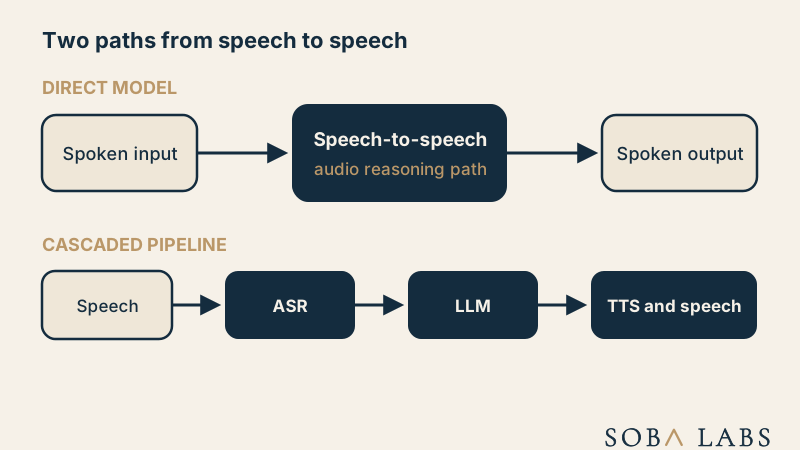
A cascaded pipeline runs automatic speech recognition, a language model, then text-to-speech. Each component receives a distinct representation and can be changed or tested on its own. A direct model learns the relationship between audio input and audio output as one main path. Fewer component boundaries can preserve rhythm, emotion, and pronunciation that a text transcript may flatten. They may also shorten the time before a response begins.
The direct path does not mean text disappears. A production system may still create a transcript for search, audit, safety checks, retrieval, or tool calls. The difference is that text is not the only representation carrying the conversation between separate speech components.
What does the direct path change?
A direct model can hear pace, emphasis, hesitation, and other acoustic cues that plain text does not fully capture. It can use those cues when producing the response. That can make a spoken exchange feel less mechanical, especially when timing and tone carry meaning. The same integration that preserves nuance also makes failures harder to isolate. A strange reply may come from hearing, reasoning, voice generation, or the interaction between them.
Cascaded systems expose clearer checkpoints. Teams can inspect the transcript, replace the language model, choose another voice, or apply deterministic text checks between stages. Direct systems need equivalent observability around audio events, tool actions, and outcomes. They also need a usable transcript when a person must review what happened.
When should a team use one?
Choose direct speech when natural timing, emotion, pronunciation, or interruption handling matters enough to justify deeper audio testing. Customer support, coaching, and live assistance may benefit when short acknowledgements and tone affect the next response. Choose a cascade when exact transcripts, replaceable components, or independent vendor control matter more. A structured intake flow may value predictable text and field validation above expressive speech.
This is an architecture choice, not a quality guarantee. Network delay, buffering, turn detection, and playback can make a direct model feel slow. A well-tuned cascade can outperform a poorly integrated direct system. Compare both designs on the same calls rather than comparing provider demos.
How should speech-to-speech models be evaluated?
Test the full spoken interaction with realistic microphones, accents, background noise, pauses, and overlapping speech. Measure task completion, interruption handling, latency, factual accuracy, tool results, and escalation. Audio quality cannot compensate for an incorrect business outcome. Preserve traces that show input audio, model events, tool calls, and the final action so failures can be investigated.
A production voice agent still needs permissions, barge-in, safety checks, and human handoff around the model. Direct audio changes the path through the system. It does not remove the controls the system owes its callers.