A plain AI agent plans one step, calls a tool, checks the result, and repeats, which works well for short jobs but tends to drift once a task runs for dozens of steps: the model loses track of what it already tried, or the growing conversation crowds out the instructions that mattered. Deep agents are the answer that shipped inside real production systems first, Claude Code, Deep Research, and similar long running coding and research tools all converged on the same four layers stacked on top of an ordinary harness.
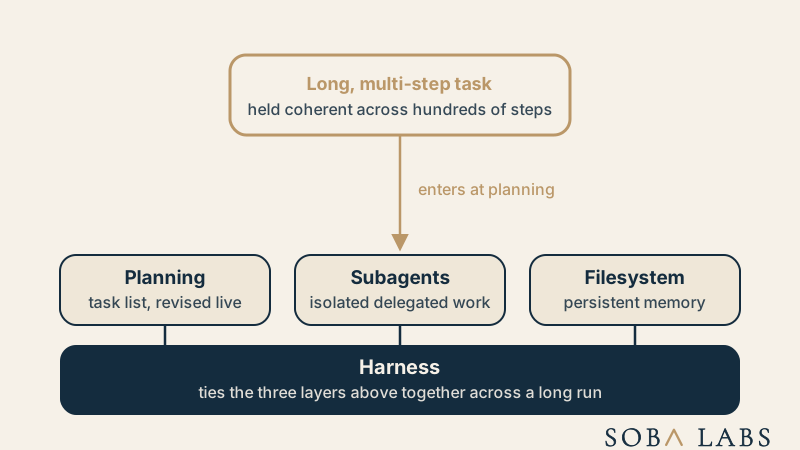
A deep agent is not a bigger model. It is four ordinary layers, planning, subagents, a filesystem, and a harness, stacked so a task can run for hundreds of steps without losing the thread.
What are the four layers of a deep agent?
Planning keeps an explicit task list the agent reviews and updates as work progresses, so a failed step changes the plan instead of getting silently retried forever. Subagents take a delegated piece of the plan into their own isolated context, do the work, and return only the finished result, which keeps the main run’s context from filling up with intermediate search results and file reads. A filesystem gives the agent a place to write findings and long documents rather than holding everything in the model’s context window, turning “remember everything” into “know where to look it up.” The agent harness underneath is what actually keeps the other three coordinated across a long run, and it is the layer most teams underestimate until a real task exposes it. LangChain’s deepagents is a common starting harness, with context compaction helping longer runs retain essential state when the active history grows.
Deep agents vs a plain AI agent: what actually changes?
The tool calling loop itself does not change. What changes is everything around it: a plain agent’s context is one growing conversation; a deep agent’s context is deliberately partitioned across the main thread, each subagent’s own thread, and the filesystem, so a long task does not run out of room. Our own breakdown of the four separate context levers a deep agent harness gives you is the detailed version of this tradeoff.
What does a deep agent still need from you in production?
The harness does not remove the responsibilities that come with any agentic AI system: a human approval gate on actions that touch money or production data, evals that catch regressions before a customer does, and a cost budget, since more subagent calls means more model calls billed per run. We cover exactly what a team still owns once the harness is doing the planning in deep agents in production. Coordinating multiple subagents at once is also where the orchestrator-worker pattern and deep agents overlap: a deep agent’s planner is effectively a lightweight orchestrator for its own subagents.